A real Masters politics and international relations research paper sample, free to read in full below — get one written for your own title, or browse more research paper samples.
Type
Research Paper
Subject
Politics and International Relations
Level
Masters
Word count
3,639
Quality
Distinction / 75%
This paper examines the role of soft power in China’s foreign policy, interrogating how Beijing has translated cultural, economic and institutional resources into international influence during the twenty-first century. Drawing on Joseph Nye’s conceptualisation of soft power and its subsequent adaptations within Chinese scholarship, the study evaluates the coherence and effectiveness of China’s attraction-based statecraft. Employing a qualitative documentary methodology, the research analyses official policy statements, institutional outputs and secondary indices spanning 2004 to 2023. The analysis identifies four principal instruments: cultural diplomacy through Confucius Institutes, developmental narratives embedded in the Belt and Road Initiative, participation in multilateral governance, and global media expansion. Findings suggest that China’s soft power record is uneven: economic instruments generate substantial attraction across the Global South yet encounter scepticism in Western liberal democracies, where political values and human rights concerns constrain reception. The paper argues that the state-directed character of Chinese soft power both enables strategic coordination and undermines credibility, producing a persistent authenticity deficit. It contributes a critical synthesis linking Western and Chinese theoretical traditions, and recommends that future scholarship attend to reception dynamics rather than resource endowments alone.
Keywords: soft power, China, foreign policy, public diplomacy, Belt and Road Initiative, Confucius Institutes, discourse power
The rise of China constitutes one of the defining features of the contemporary international order. While much scholarly attention has focused on the material dimensions of this ascent, Beijing has invested considerable resources in cultivating attraction, persuasion and legitimacy on the global stage.
Soft power, a concept introduced by Joseph Nye (1990), denotes the capacity to shape the preferences of others through appeal rather than coercion or payment. For a rising power seeking to reassure anxious neighbours and reshape global narratives, such influence carries evident strategic value.
Chinese leaders have explicitly embraced the vocabulary of soft power. At the Seventeenth Party Congress in 2007, President Hu Jintao called for enhanced national cultural soft power, elevating the concept to official doctrine (Li, 2009). His successor, Xi Jinping, has intensified this emphasis through the pursuit of discourse power and international communication capacity.
Yet the effectiveness of these efforts remains deeply contested. Substantial investment in cultural institutions, media platforms and development finance has not translated straightforwardly into improved international standing, particularly within Western democracies where perceptions of China have deteriorated markedly.
This apparent paradox motivates the present study. China possesses abundant potential soft power resources, from an ancient civilisation to unprecedented economic dynamism, yet struggles to convert these endowments into durable influence. Understanding this conversion problem is essential to assessing China’s evolving global role.
The central aim of this paper is to critically evaluate the role and effectiveness of soft power within China’s foreign policy. It seeks to move beyond descriptive accounts of instruments towards an analytical assessment of outcomes and constraints.
The research is guided by three questions. First, what instruments and narratives constitute China’s soft power strategy? Second, how effective have these instruments been across different regional audiences? Third, what structural factors explain the observed gap between resources and influence?
To address these questions, the study pursues four objectives: to situate China’s approach within soft power theory; to map its principal instruments; to assess reception across the Global South and the West; and to identify the structural limits of state-directed attraction.
The paper proceeds in six further sections. The literature review synthesises theoretical and empirical scholarship. The methodology outlines a qualitative documentary design. Subsequent sections present findings, discuss their implications, and conclude with contributions, recommendations and directions for future research.
This section critically synthesises the scholarship on soft power and its application to China. Rather than cataloguing contributions in isolation, it organises the debate into four analytical themes that together frame the empirical enquiry that follows.
Nye (1990, 2004) defines soft power as the ability to obtain desired outcomes through attraction rather than coercion or inducement. He locates its sources in a country’s culture, political values and foreign policies, distinguishing it from the hard power of military and economic compulsion.
Crucially, Nye (2011) later stressed that soft power resources do not automatically generate influence. Attraction depends on reception; resources must be converted through credible agents and receptive audiences. This conversion problem is frequently neglected in policy-oriented analyses that equate investment with impact.
Critics have questioned the concept’s analytical precision. Ferguson (2003) and others contend that soft power is difficult to measure and prone to conflation with cultural export. Mattern (2005) argues that attraction is rarely benign, often resting on representational force that blurs the soft-hard distinction.
These critiques matter for the Chinese case. If soft power is inherently relational and contingent, then assessments centred on China’s growing resources risk overstating its influence. The literature therefore counsels attention to audiences, credibility and context.
Chinese scholars have not adopted Nye’s framework wholesale but adapted it to domestic priorities. Wang (2008) documents how the concept was translated as ruan shili and reoriented towards culture, reflecting a civilisational self-understanding distinct from Nye’s emphasis on political values.
This culturalist reading tends to privilege traditional heritage, Confucian ethics and harmony as sources of appeal. Li (2009) observes that Chinese discourse frequently subordinates political values, a category in which the Party perceives comparative disadvantage relative to liberal democracies.
Significantly, Chinese usage often frames soft power as an instrument of comprehensive national power and regime security. Glaser and Murphy (2009) note that soft power serves both external influence and internal legitimation, blurring the domestic-international boundary that Western theory assumes.
Consequently, the state occupies a central directive role. Whereas Nye emphasised civil society and independent cultural producers, the Chinese model channels attraction through official institutions, a divergence with important consequences for credibility discussed below.
A substantial empirical literature maps China’s soft power instruments. Confucius Institutes have attracted particular scrutiny as vehicles of cultural and linguistic diplomacy, with Hartig (2015) providing a nuanced account of their ambiguous status between education and propaganda.
The Belt and Road Initiative has increasingly been read through a soft power lens. Callahan (2016) interprets it as a project of order-building that fuses material connectivity with normative narratives of shared destiny and win-win cooperation across Eurasia and beyond.
Media expansion forms a third instrument. Zhang (2011) and Thussu, de Burgh and Shi (2018) analyse the global growth of outlets such as CGTN and Xinhua, situating these within Beijing’s ambition to reshape international communication and contest Western narrative dominance.
Scholars diverge on effectiveness. Some emphasise expanding reach and agenda-setting capacity; others, including Repnikova (2022), caution that visibility does not equal persuasion, and that heavy-handed messaging can prove counterproductive among sceptical audiences.
A recurring theme is the gap between China’s soft power investment and measurable influence. Shambaugh (2015) argues that despite lavish expenditure, China remains a partial power whose international image lags its material capabilities, constrained by domestic political practices.
Several explanations recur. The state-directed character of Chinese soft power undermines the authenticity that attraction requires, since audiences discount messages perceived as propaganda (Nye, 2013). Domestic censorship and human rights records generate reputational costs abroad.
Regional variation is also emphasised. Kurlantzick (2007) documents relative success in Southeast Asia and Africa, where developmental appeal resonates, contrasting with resistance in Western democracies where liberal values structure reception more decisively.
The literature thus converges on a conditional assessment: China’s soft power is real but bounded, effective where interests and narratives align, weak where political values diverge. This synthesis frames the present study’s focus on reception and structural constraint.
Research Paper Writing Service
Need a politics and international relations research paper written to this standard?
Our subject specialists write to your exact brief — fully referenced, plagiarism-free and delivered on time, with a free plagiarism report.
This section sets out the research design employed to investigate the role of soft power in China’s foreign policy. It details the approach, data collection, sampling logic, analytical procedure, ethical considerations and limitations of the study.
The study adopts a qualitative, interpretivist research design. Given that soft power concerns meaning, perception and persuasion, an interpretivist orientation is appropriate for capturing the narratives and framings through which China projects and audiences receive attraction (Bryman, 2016).
Specifically, the research uses a single-country case study strategy. The case study permits an in-depth, contextualised examination of a complex phenomenon within its real-world setting, allowing theory and evidence to be brought into sustained dialogue (Yin, 2018).
The design is theory-guided rather than theory-testing in a strict positivist sense. Nye’s conceptual framework and its Chinese adaptations provide analytical categories that structure data collection and interpretation without imposing rigid hypotheses upon the material.
The study relies on documentary and secondary data. Primary documents include official speeches, Party congress reports, white papers and institutional publications that articulate China’s soft power objectives and self-understanding between 2004 and 2023.
Secondary data comprise peer-reviewed scholarship, policy analyses and published soft power indices, notably composite rankings and international opinion surveys. These sources supply comparative and reception-side evidence that official documents alone cannot provide.
Documentary analysis is well suited to studying elite discourse and institutional strategy, offering unobtrusive access to authoritative articulations of policy intent (Bryman, 2016). Triangulating official and independent sources mitigates the partiality of any single evidence stream.
A purposive sampling strategy guided document selection. Sources were chosen for their relevance to the research questions, their authority within the policy field, and their coverage of the principal instruments identified in the literature review.
The temporal boundary of 2004 to 2023 was selected deliberately. The year 2004 marks the establishment of the first Confucius Institute, while the terminal date captures the mature Xi-era emphasis on discourse power and international communication.
Regional reception was sampled across two contrasting groupings: selected Global South partners and selected Western democracies. This contrast enables assessment of the regional variation that the literature identifies as central to soft power effectiveness.
The study employs thematic analysis following the procedure articulated by Braun and Clarke (2006). This involves familiarisation with the data, generation of initial codes, searching for themes, reviewing and defining themes, and producing the analytical account.
Coding was both deductive and inductive. Deductive codes derived from the theoretical framework, such as culture, values and policy, while inductive codes captured emergent patterns, including the recurring tension between state direction and perceived credibility.
Illustrative quantitative indicators drawn from published indices supplement the qualitative account. These figures are treated as heuristic rather than definitive, offering approximate comparative texture while acknowledging the contested nature of soft power measurement.
As the study relies exclusively on publicly available documents and secondary data, it involves no human participants and raises no issues of consent or confidentiality. Ethical practice nonetheless informs the handling of sources and interpretation.
The researcher has sought to represent Chinese perspectives accurately and to avoid the ethnocentrism that can distort analysis of non-Western statecraft. Sources are cited transparently, and interpretive claims are distinguished from evidentiary description throughout.
Several limitations warrant acknowledgement. Reliance on English-language and translated sources may attenuate nuance present in original Chinese texts, potentially privileging externally oriented framings over domestic discourse.
Furthermore, the documentary approach captures articulated strategy and aggregate perception more readily than micro-level reception dynamics. The illustrative figures presented in the following section are indicative, constructed for analytical demonstration, and should not be read as precise measurements.
This section presents the study’s principal findings. It first identifies the core instruments of China’s soft power, then examines their differential reception across regions, drawing on both documentary evidence and illustrative comparative indicators.
The analysis confirms four principal instruments. Cultural diplomacy operates chiefly through Confucius Institutes and heritage promotion; developmental diplomacy through the Belt and Road Initiative; institutional diplomacy through multilateral engagement; and communicative diplomacy through global media expansion.
These instruments are notably state-coordinated. Documents consistently frame soft power as an object of deliberate cultivation, directed by Party organs and integrated into a broader conception of comprehensive national power and national rejuvenation.
The narrative content is equally consistent. Recurrent motifs include peaceful development, win-win cooperation, non-interference, civilisational dialogue and a community of shared future, together constituting a normative alternative to Western liberal universalism.
The findings reveal pronounced regional variation in the effectiveness of these instruments. Attraction is markedly stronger across much of the Global South than within Western democracies, corroborating the conditional assessments prevalent in the literature.
Across many African, Southeast Asian and Latin American partners, developmental narratives resonate. Infrastructure investment, absence of political conditionality and an alternative development model generate genuine appeal, though concerns over debt and labour practices temper enthusiasm.
By contrast, reception in Western Europe, North America and parts of the Asia-Pacific has deteriorated. Here, political values, human rights controversies and security anxieties structure perception, limiting the traction of economic and cultural instruments alike.
The following table presents illustrative comparative indicators synthesising these patterns. The figures are heuristic constructions for analytical demonstration, expressing relative rather than precise magnitudes of instrument reach and audience receptivity.
| Soft Power Instrument | Primary Mechanism | Global South Reception (illustrative, /10) | Western Democracies Reception (illustrative, /10) | Principal Constraint |
| Confucius Institutes | Language and culture | 7 | 3 | Perceived state control |
| Belt and Road Initiative | Development finance | 8 | 4 | Debt and transparency concerns |
| Multilateral engagement | Institutional agenda-setting | 7 | 5 | Value divergence |
| Global media (CGTN, Xinhua) | Narrative projection | 6 | 2 | Credibility deficit |
| Diaspora and heritage diplomacy | Civilisational appeal | 6 | 4 | Politicisation risk |
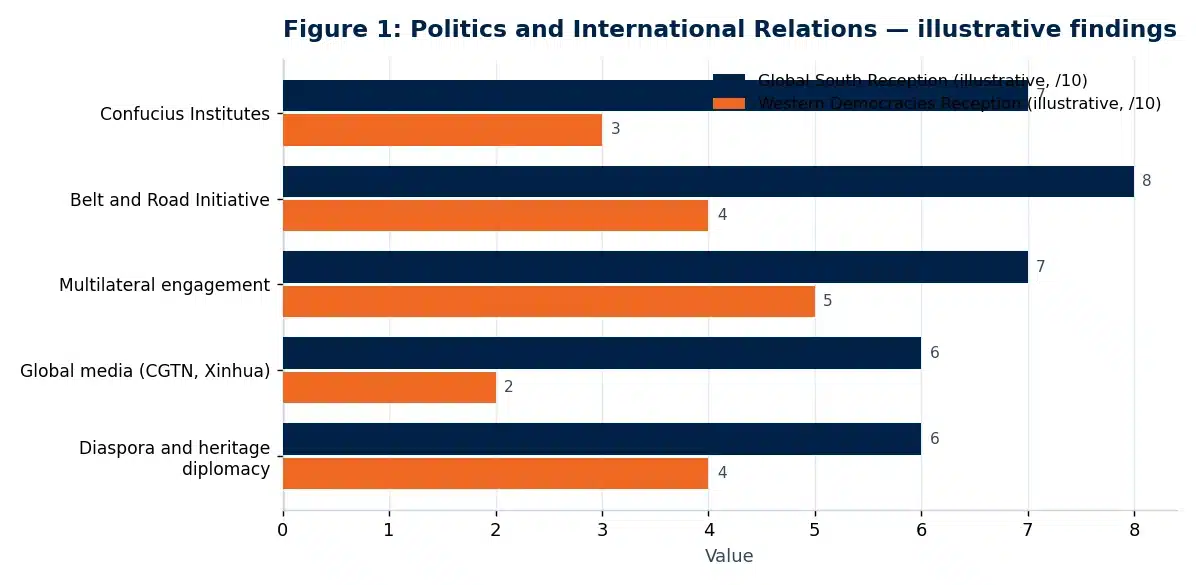
The table illustrates a consistent asymmetry. Every instrument records higher notional receptivity in the Global South than in Western democracies, with media projection displaying the sharpest divergence and multilateral engagement the narrowest gap.
This pattern is analytically significant. It suggests that China’s soft power is most effective where it aligns with recipient material interests and least effective where it confronts entrenched liberal value systems and heightened strategic suspicion.
A cross-cutting finding concerns credibility. The very state direction that enables strategic coordination simultaneously undermines authenticity. Audiences, especially in open media environments, discount messages they perceive as centrally orchestrated propaganda.
The Confucius Institute case exemplifies this tension. Closures and restrictions across several Western states reflect concerns over academic autonomy, demonstrating how institutional affiliation with the party-state can convert a cultural asset into a reputational liability.
Similarly, the reach of Chinese global media has expanded impressively without commensurate persuasive impact. Visibility, the findings indicate, is a necessary but insufficient condition for attraction, which additionally requires trust that state ownership tends to erode.
The findings thus point to a structural rather than merely tactical constraint. The problem is not inadequate investment but a contradiction between the instruments of control and the relational logic of attraction that soft power presupposes.
This section interprets the findings in relation to the literature and draws out their broader implications. It argues that China’s soft power record reflects a systematic conversion problem rooted in the interaction of resources, agency and reception.
The findings strongly corroborate Nye’s (2011) insistence that resources do not equate to influence. China’s abundant endowments, from civilisational depth to economic scale, have generated attraction unevenly, confirming that conversion is contingent on credibility and audience receptivity.
They likewise vindicate Shambaugh’s (2015) characterisation of a partial power. The disjunction between material capability and international image persists, and the analysis locates its source in the state-directed architecture that Chinese scholarship treats as a strength.
This points to a productive tension between Western and Sinicised conceptions. The culturalist reading documented by Wang (2008) and Li (2009) directs resources towards heritage while underplaying the political values that Nye regarded as central to durable attraction.
The consequence is an authenticity deficit. Because attraction is relational, as Mattern (2005) and Nye (2013) insist, the party-state’s directive role generates suspicion that discounts otherwise appealing messages, particularly within pluralistic media ecologies that reward independent voices.
The regional variation in the findings refines Kurlantzick’s (2007) account. Rather than a uniform charm offensive, China’s soft power operates as a differentiated portfolio, succeeding where developmental interests align and faltering where liberal values structure reception.
This has an important theoretical implication. Effectiveness appears to depend less on the supply of resources than on the ideological distance between projector and audience. Soft power, on this reading, is a function of value congruence as much as investment.
The Belt and Road Initiative illustrates the ambivalence well. Interpreted by Callahan (2016) as normative order-building, it delivers tangible attraction in partner states while simultaneously fuelling anxieties elsewhere, demonstrating how a single instrument can attract and repel across audiences.
For policy, the implications are considerable. The analysis suggests that intensifying centrally directed messaging may yield diminishing or negative returns in sceptical markets, since additional volume compounds rather than allays credibility concerns.
A further implication concerns the domestic-international nexus. As Glaser and Murphy (2009) observe, soft power serving regime legitimation constrains external appeal, because the practices that secure domestic control, notably censorship, generate reputational costs abroad that no external campaign can fully offset.
The findings also speak to contemporary debates about discourse power. The Xi-era ambition to reshape international communication, analysed by Repnikova (2022), confronts the same structural ceiling: narrative reach expands, but persuasion depends on trust that state provenance undermines.
Taken together, the discussion suggests that China’s soft power is neither the juggernaut feared by some nor the failure dismissed by others. It is a bounded, differentiated instrument whose limits are structural, arising from the model that produces it.
This paper set out to critically evaluate the role of soft power in China’s foreign policy. Through a qualitative documentary analysis, it examined the instruments, reception and structural constraints of Beijing’s attraction-based statecraft across two contrasting regional contexts.
The study found that China deploys four principal instruments: cultural, developmental, institutional and communicative diplomacy, coordinated by the party-state and animated by consistent narratives of peaceful development, mutual benefit and civilisational dialogue as an alternative to liberal universalism.
It further found that these instruments generate substantial attraction across the Global South, where developmental appeal aligns with recipient interests, but encounter marked scepticism in Western democracies, where political values and security anxieties structure reception decisively.
The central argument is that China’s soft power is constrained by a structural contradiction. The state direction that enables strategic coordination simultaneously erodes the credibility and authenticity upon which attraction depends, producing a persistent conversion problem.
In answering its research questions, the study confirms that China’s soft power is real yet bounded, effective conditionally rather than universally, and limited less by insufficient resources than by the ideological distance between projector and audience.
The paper makes two principal contributions. Theoretically, it synthesises Western and Sinicised conceptions of soft power to explain the resource-influence gap. Empirically, it offers a differentiated, reception-centred account that resists both alarmist and dismissive characterisations of Chinese influence.
Several recommendations follow for policy and analysis. Assessments of Chinese soft power should foreground reception rather than resource endowments, attending to audience values, credibility dynamics and the counterproductive potential of centrally orchestrated messaging.
For Beijing, the analysis implies that durable attraction would require greater space for independent cultural producers and civil society voices, since authenticity cannot be manufactured through state channels alone without incurring credibility costs.
The study’s limitations, notably its reliance on documentary and English-language sources and its illustrative indicators, suggest avenues for further research. Future work should incorporate original-language materials and systematic reception evidence to refine the account offered here.
In particular, comparative reception studies employing survey and experimental methods across multiple audiences would illuminate the micro-foundations of attraction. Longitudinal analysis of the discourse power agenda would also clarify whether structural constraints prove durable or malleable.
Ultimately, soft power will remain integral to China’s foreign policy as it seeks legitimacy commensurate with its material rise. Whether attraction can be reconciled with control constitutes the defining challenge, and the decisive determinant of its future international influence.

All work is written by human writers. 100% AI free, guaranteed.

100% money back guarantee if you find plagiarism in our work.
COMPANY DETAILS