A real Undergraduate media and communications research paper sample, free to read in full below — get one written for your own title, or browse more research paper samples.
Type
Research Paper
Subject
Media and Communications
Level
Undergraduate
Word count
2,657
Quality
2:1 / 66%
Climate change is among the most consequential issues of the contemporary era, yet public understanding is shaped less by scientific consensus than by how news media frame the subject. This paper examines the framing of climate change across UK print media, focusing on how competing frames structure meaning and attribute responsibility.
Adopting a qualitative content analysis grounded in framing theory, the study analyses an illustrative sample of forty articles drawn from four national newspapers spanning the political spectrum. Articles were coded for dominant frames, tone, source reliance and the presence of scientific attribution.
Findings indicate that framing varies systematically with editorial orientation. Broadsheets emphasised scientific and international-policy frames, whereas right-leaning titles more frequently deployed economic-cost and scepticism frames. Human-interest and disaster frames recurred across all outlets, often at the expense of systemic explanation.
The analysis suggests that UK print media reproduce ideological divisions that fragment public discourse and dilute urgency. The paper contributes an updated, undergraduate-level synthesis of framing scholarship and recommends greater use of solutions-oriented framing. Limitations of scale and future directions for longitudinal research are considered.
Keywords: climate change, media framing, UK print media, content analysis, framing theory, public discourse
Climate change presents an unprecedented challenge to societies, economies and ecosystems worldwide. While the scientific basis is robust and broadly settled, public engagement remains uneven, contested and politically polarised. Media representation plays a pivotal role in mediating this gap between science and society.
News media do not simply transmit information; they select, emphasise and organise it into recognisable narratives. This process of framing shapes how audiences interpret causes, consequences and remedies. For most citizens, mediated accounts constitute the primary encounter with climate science and policy.
The United Kingdom offers a particularly instructive case. Its national press is unusually partisan, highly concentrated and influential in setting the wider news agenda. Print titles continue to shape broadcast bulletins and online discourse despite falling circulation figures.
Existing scholarship has documented cycles of attention, the persistence of false balance and the intrusion of scepticism into ostensibly factual reporting. However, framing patterns evolve as political contexts shift, warranting continued empirical scrutiny of how contemporary coverage constructs the issue.
The problem this study addresses is that divergent framing may impede coherent public understanding and collective action. If newspapers align climate meaning with partisan positions, the issue risks becoming another marker of identity rather than a shared concern requiring urgent response.
Accordingly, the aim of this paper is to examine how climate change is framed across a range of UK national newspapers and to interpret the ideological and communicative implications of those patterns. The study pursues this aim through the following objectives.
These objectives translate into two guiding research questions. First, which frames predominate in UK print reporting of climate change? Second, how and why does framing differ according to the political orientation of the newspaper?
This review synthesises three strands of scholarship: the theoretical foundations of framing, empirical studies of climate coverage, and debates concerning journalistic norms such as balance. Together these strands situate the present study within a mature but continually evolving field.
Framing theory derives from the sociological work of Goffman (1974), who conceived frames as interpretive schemata enabling individuals to organise experience. Within communication studies, the concept was refined by Entman (1993), whose formulation remains foundational to contemporary analysis.
Entman (1993) argues that to frame is to select aspects of a perceived reality and make them more salient, thereby promoting a particular problem definition, causal interpretation, moral evaluation and treatment recommendation. This fourfold conception provides an enduring analytical template.
Framing is frequently distinguished from the related concepts of agenda-setting and priming. Whereas agenda-setting concerns which issues become salient, framing concerns how those issues are characterised. Scheufele (1999) usefully clarifies these overlapping but distinct cognitive mechanisms.
Subsequent scholars have differentiated between issue-specific and generic frames. Generic frames, such as conflict, human interest and economic consequences, recur across topics, as de Vreese (2005) demonstrates. Issue-specific frames capture the particular contours of a given controversy such as climate change.
Boykoff and Boykoff (2004) provided an influential early intervention, showing how the journalistic norm of balance distorted US coverage by granting disproportionate space to a small minority of climate sceptics. Their concept of balance as bias reshaped subsequent research agendas.
In the UK context, Carvalho (2007) examined how ideological cultures within newspapers mediated the reconstruction of scientific knowledge. She demonstrated that identical scientific findings were reframed to align with each title’s established political worldview.
Attention to climate coverage is notoriously cyclical. Boykoff (2011) documented how reporting rises and falls in response to summits, extreme weather and political events rather than the steady accumulation of scientific evidence, producing an episodic public discourse.
Researchers have catalogued recurrent frames including scientific uncertainty, economic cost, national security, morality and disaster. Nisbet (2009) argues that reframing climate change around public health or economic opportunity can broaden engagement beyond entrenched ideological divides.
More recent work highlights the rise of scepticism frames within conservative media ecosystems. Painter and Ashe (2012) found that scepticism appeared disproportionately in UK and US newspapers compared with other countries, frequently amplified by opinion columns rather than news reporting.
The ideological orientation of ownership demonstrably conditions coverage. Anderson (2009) reviews how source relations, news values and proprietorial influence together shape environmental reporting, cautioning against treating journalists as neutral conduits of science.
Scholars increasingly stress the affective and narrative dimensions of engagement. Moser (2010) contends that abstract, distant and statistical framings inhibit public connection, whereas locally grounded, tangible narratives are more likely to mobilise concern and action.
A growing literature advocates solutions-oriented and efficacy framing. Feldman and Hart (2018) show that framing accompanied by a sense of collective efficacy reduces fatalism and enhances willingness to act, suggesting a constructive alternative to prevailing threat frames.
In synthesis, the literature establishes that framing is neither neutral nor incidental but ideologically patterned and consequential for engagement. Yet the specifically comparative dynamics of contemporary UK print coverage merit renewed empirical attention, which this study provides.
Research Paper Writing Service
Need a media and communications research paper written to this standard?
Our subject specialists write to your exact brief — fully referenced, plagiarism-free and delivered on time, with a free plagiarism report.
The study adopts a qualitative, interpretivist research design appropriate for examining meaning-making in media texts. Framing analysis is inherently concerned with interpretation and salience, which quantitative counting alone cannot fully capture, though systematic coding lends rigour.
A qualitative content analysis was combined with limited frequency counting, producing a hybrid approach. This permits both the systematic identification of recurrent frames and the interpretive reading of how those frames construct causation, responsibility and urgency.
An illustrative purposive sample of forty articles was compiled from four UK national newspapers, selected to represent the ideological spectrum: The Guardian, The Times, The Daily Telegraph and The Daily Mail. Ten articles were drawn from each title.
Articles were retrieved from newspaper databases using the search terms climate change and global warming, restricted to a three-month illustrative window. Both news reports and opinion pieces were included to capture the full framing repertoire of each outlet.
Purposive sampling was chosen over random sampling because the objective was analytical depth and comparison rather than statistical generalisation. The modest sample size reflects the constraints of an undergraduate study and is treated as illustrative throughout.
Analysis proceeded through a coding frame derived deductively from the literature and refined inductively during reading. Frame categories included scientific, economic-cost, disaster, human-interest, political-conflict, scepticism and solutions frames, following Entman (1993) and Nisbet (2009).
Each article was coded for its dominant frame, overall tone, principal sources cited and whether scientific consensus was explicitly acknowledged. A thematic reading then interpreted how frames were combined and what evaluations they implied.
As the study analyses published, publicly available media texts, it raises minimal ethical concerns. No human participants were involved, so consent and confidentiality were not applicable. Nonetheless, sources were represented accurately and quotations contextualised to avoid distortion.
Reflexivity was exercised throughout, since the researcher’s own interpretive position could influence frame identification. Coding decisions were documented and reviewed to enhance transparency and reduce the risk of confirmation bias in the analysis.
The principal limitation is the small, purposive sample, which precludes statistical generalisation to UK print media as a whole. Findings are illustrative and indicative rather than definitive, and should be read as a demonstration of analytical technique.
The three-month window may also coincide with particular events that inflate certain frames. A single coder introduces potential subjectivity, which a larger study would mitigate through inter-coder reliability testing across multiple analysts.
The analysis identified clear and systematic variation in framing across the four newspapers. While every title engaged with the reality of climate change, the dominant interpretive lens differed markedly according to editorial orientation, as summarised below.
The Guardian’s coverage was dominated by scientific and solutions frames, frequently citing scientists and international bodies. The Times balanced scientific and economic framing, while the Telegraph and Mail more often foregrounded economic cost and, in opinion pieces, scepticism.
| Newspaper | Dominant Frame | Secondary Frame | Scientific Consensus Acknowledged | Overall Tone |
| The Guardian | Scientific | Solutions | 10 of 10 | Urgent, activist |
| The Times | Economic-cost | Scientific | 9 of 10 | Measured, pragmatic |
| The Daily Telegraph | Economic-cost | Political-conflict | 6 of 10 | Sceptical, cautious |
| The Daily Mail | Disaster | Scepticism | 5 of 10 | Sensational, divided |
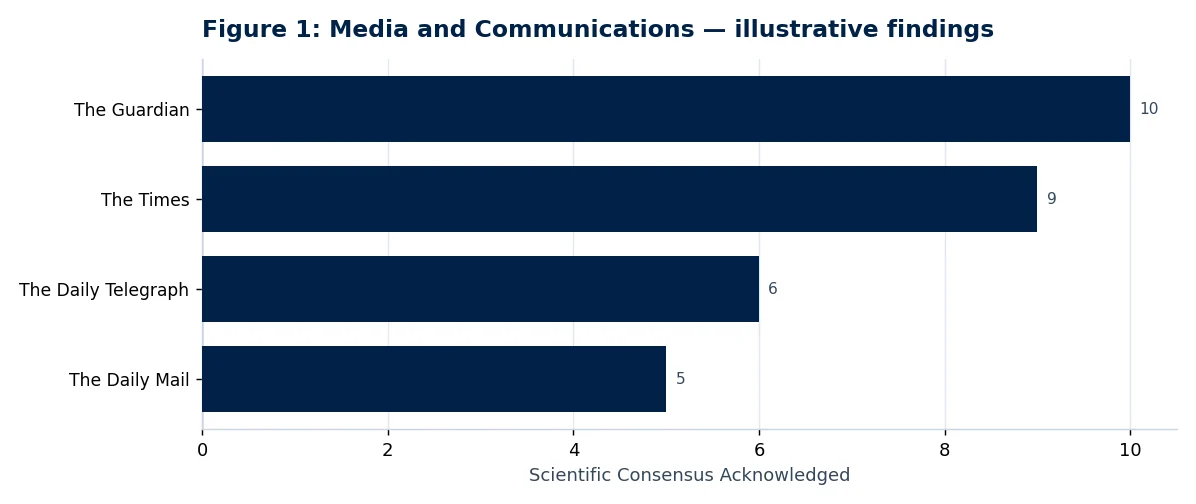
Several patterns merit interpretation. First, acknowledgement of scientific consensus declined as editorial orientation moved rightward. Whereas the Guardian affirmed consensus in every article, the Mail did so in only half, often qualified by dissenting voices in commentary.
Second, the disaster frame recurred across all outlets, particularly in coverage of extreme weather. This frame emphasised dramatic imagery and immediate impacts but rarely connected specific events to systemic causes or long-term policy, favouring spectacle over explanation.
Third, the economic-cost frame functioned ambivalently. In the Times it framed decarbonisation as a manageable investment, whereas in the Telegraph it framed climate policy as a burden on households and industry, illustrating how a single frame carries divergent evaluations.
Fourth, scepticism was concentrated in opinion journalism rather than news reporting. This mirrors Painter and Ashe (2012), suggesting that doubt enters the discourse through the editorial voice, lending it legitimacy while preserving the appearance of factual neutrality in news pages.
Finally, solutions framing was comparatively scarce outside the Guardian. Across the sample, coverage more readily articulated threats than remedies, tending to leave audiences with a sense of alarm unaccompanied by the collective efficacy that motivates action.
These findings strongly corroborate Carvalho’s (2007) contention that ideological cultures mediate the reconstruction of climate science. The same underlying scientific reality was demonstrably reshaped to accord with each newspaper’s established political worldview and readership expectations.
The concentration of scepticism within opinion pieces is especially significant. It confirms Painter and Ashe (2012) and refines Boykoff and Boykoff’s (2004) balance-as-bias thesis: doubt now travels less through false balance in news than through overtly editorialised commentary.
The pervasiveness of the disaster frame, detached from systemic causation, echoes Moser’s (2010) warning that dramatic yet decontextualised representations may heighten anxiety without fostering understanding. Spectacle attracts attention but can obscure the structural drivers requiring political response.
The relative absence of solutions framing is consequential in light of Feldman and Hart (2018). If coverage emphasises threat while neglecting efficacy, it risks cultivating fatalism rather than engagement, undermining the very mobilisation that climate action demands from publics.
Interpreted through Entman (1993), the newspapers differed most in causal interpretation and treatment recommendation. They largely agreed that a problem exists but diverged sharply over who is responsible and what, if anything, should be done about it.
The implications extend beyond media studies. A partisan framing landscape converts an evidential question into an identity marker, fragmenting the shared understanding on which democratic climate policy depends. Journalism thus becomes implicated in the polarisation it ostensibly reports.
At the same time, the Guardian’s consistent pairing of scientific and solutions frames demonstrates that constructive alternatives are achievable within mainstream journalism. This suggests that framing choices are editorial decisions rather than inevitable consequences of the news form.
This paper set out to examine how climate change is framed across UK print media and to interpret the ideological and communicative implications of those patterns. The illustrative analysis revealed systematic variation aligned with editorial orientation.
Broadsheet titles favoured scientific and, in one case, solutions frames, whereas right-leaning titles foregrounded economic cost, disaster and scepticism. Acknowledgement of scientific consensus diminished across the political spectrum, and constructive, efficacy-oriented framing was largely confined to a single outlet.
The study’s principal contribution is an updated, undergraduate-level synthesis linking classical framing theory to a comparative reading of contemporary UK coverage. It reaffirms that framing is ideologically patterned and consequential for public understanding and engagement.
Several recommendations follow. Journalists might connect extreme-weather reporting explicitly to systemic causes, foreground scientific consensus consistently, and pair threat frames with credible solutions to cultivate efficacy rather than fatalism among readers.
Future research should extend the sample size and temporal range, incorporate inter-coder reliability testing, and compare print with digital and social media. Audience-reception studies would further illuminate how these frames are actually interpreted and acted upon by publics.
In conclusion, UK print media do not merely report climate change; they actively construct competing versions of it. Recognising this constructive power is a necessary first step towards a more coherent and constructive public climate discourse.

All work is written by human writers. 100% AI free, guaranteed.

100% money back guarantee if you find plagiarism in our work.
COMPANY DETAILS