A real Undergraduate sociology research paper sample, free to read in full below — get one written for your own title, or browse more research paper samples.
Type
Research Paper
Subject
Sociology
Level
Undergraduate
Word count
2,634
Quality
2:1 / 65%
This paper examines the enduring relationship between socioeconomic status (SES) and educational attainment, a central concern within the sociology of education. The persistence of attainment gaps between advantaged and disadvantaged pupils raises questions about meritocracy and social mobility.
The study aimed to explore how family income, parental occupation and parental education shape young people’s academic outcomes. It adopted a quantitative, cross-sectional design using an illustrative secondary dataset of 400 undergraduate respondents drawn from a hypothetical national survey.
Descriptive and correlational analyses were conducted to identify patterns between composite SES scores and attainment measured through examination performance. Findings indicated a strong positive association, with higher-SES respondents consistently outperforming their lower-SES peers across every attainment band.
These results are interpreted through Bourdieu’s theory of cultural capital and rational action theory. The paper argues that attainment gaps are reproduced through both material resources and culturally embedded dispositions. It concludes that targeted, structural interventions are required rather than individualised remedies, and identifies avenues for longitudinal and qualitative research.
Keywords: socioeconomic status, educational attainment, cultural capital, social reproduction, inequality, social mobility
Education is frequently presented as the principal engine of social mobility, offering individuals a route to improve their life chances regardless of their origins. Yet decades of sociological research suggest that opportunity remains unevenly distributed across the population.
Socioeconomic status, typically measured through income, occupation and parental education, correlates strongly with the qualifications young people ultimately achieve. This relationship persists across national contexts and educational systems, challenging the meritocratic ideal that underpins modern schooling.
The problem is not merely academic. Attainment gaps have profound consequences for employment, health, civic participation and intergenerational wealth. Where educational success is patterned by background, inequality is transmitted from one generation to the next, undermining social cohesion.
In the United Kingdom, the disadvantage gap between pupils eligible for free school meals and their more affluent peers has proven stubbornly resistant to policy intervention. Similar patterns are documented across most industrialised societies (Jerrim and Macmillan, 2015).
Understanding the mechanisms behind this relationship is therefore essential for anyone seeking to design effective and equitable education policy. Sociology offers a rich theoretical toolkit for interrogating how advantage and disadvantage are reproduced through schooling.
This paper investigates the relationship between socioeconomic status and educational attainment using an illustrative quantitative dataset. It situates the analysis within established sociological theory, particularly the work of Pierre Bourdieu and rational action theorists.
The overarching aim is to assess the strength and nature of the association between SES and attainment, and to consider the social processes that might explain it. Three research questions guide the study.
The corresponding objectives are to review the relevant literature critically, to analyse the illustrative data using appropriate statistical techniques, and to interpret the results in light of competing theoretical frameworks.
The relationship between social background and schooling has occupied sociologists since the discipline’s foundation. This review synthesises the principal theoretical traditions and empirical findings, organised around three interconnected sub-themes.
Bourdieu’s concept of cultural capital remains the most influential framework for understanding educational inequality. He argued that middle-class families transmit dispositions, tastes and linguistic competences that schools implicitly reward (Bourdieu and Passeron, 1990).
Because the education system treats these culturally specific attributes as natural markers of ability, children from privileged backgrounds are advantaged from the outset. Schooling thus legitimises inequality while appearing neutral and meritocratic.
Empirical work has broadly supported this thesis, though the operationalisation of cultural capital remains contested. Sullivan (2001) found that measures of reading, cultural knowledge and vocabulary partially explained attainment differences, yet did not eliminate the effect of class.
Critics argue that Bourdieu’s framework can be deterministic, leaving little room for agency or resistance. Reay (2004) has nonetheless demonstrated its analytical richness, showing how mothers mobilise emotional and cultural resources to support their children’s schooling.
The concept of social reproduction extends beyond culture to encompass the systematic transmission of advantage. Schools, in this view, function less as engines of mobility and more as mechanisms confirming existing social hierarchies.
A contrasting tradition emphasises material constraints and rational decision-making rather than cultural dispositions. Boudon (1974) distinguished between primary effects, reflecting early ability differences, and secondary effects, arising from the educational choices families make.
Rational action theorists such as Goldthorpe (2007) argue that working-class families weigh the costs, benefits and risks of continued education differently from middle-class families. Ambitious educational choices appear riskier and less necessary to those with fewer resources.
This perspective usefully explains why attainment gaps widen at transition points, where decisions about staying in education are made. It foregrounds economic rationality rather than cultural deficiency, avoiding the pathologising tone of some earlier accounts.
Material explanations are supported by evidence that financial hardship directly constrains attainment. Poverty affects housing quality, nutrition, access to resources and the capacity to fund enriching activities (Chowdry et al., 2013).
However, purely economic accounts struggle to explain why gaps persist even when material conditions are controlled. This suggests that culture and resources operate together rather than as competing explanations.
A third strand of scholarship examines the role of institutions in mediating the SES-attainment relationship. Schools are not neutral spaces; their intake, funding and practices can amplify or moderate background disadvantage.
Ball (2003) demonstrated how middle-class parents skilfully navigate school admissions and marketised education systems to secure advantages for their children. Choice policies, ostensibly egalitarian, often entrench existing inequalities.
Comparative research indicates that highly stratified systems with early selection tend to produce stronger links between origin and attainment. More comprehensive systems appear to weaken, though rarely eliminate, this association (Jerrim and Macmillan, 2015).
Policy interventions such as the Pupil Premium in England have sought to narrow gaps by directing funds towards disadvantaged pupils. Evaluations suggest modest effects, indicating that funding alone cannot counteract deep structural inequalities.
Taken together, the literature reveals a consensus that SES powerfully shapes attainment, but continued debate over the relative weight of cultural, material and institutional mechanisms. This study contributes illustrative evidence to that debate.
Research Paper Writing Service
Need a sociology research paper written to this standard?
Our subject specialists write to your exact brief — fully referenced, plagiarism-free and delivered on time, with a free plagiarism report.
This section outlines the research design and methods employed. As an illustrative example paper, the study uses a synthetic dataset constructed to resemble realistic survey data while avoiding any claim to genuine confidential records.
The study adopts a quantitative, cross-sectional design underpinned by a positivist epistemology. This approach is appropriate for identifying and measuring statistical associations between variables across a population at a single point in time.
A deductive logic guides the enquiry, testing theoretically derived expectations that higher socioeconomic status is associated with higher attainment. Quantitative methods enable systematic comparison and the estimation of the strength of relationships.
Data were drawn from an illustrative national survey of 400 undergraduate respondents. The sample was constructed to reflect variation in family income, parental occupation and parental education across four socioeconomic bands.
Socioeconomic status was operationalised as a composite index combining these three indicators, following established practice in stratification research. Scores were grouped into low, lower-middle, upper-middle and high SES categories for analysis.
Educational attainment was measured using respondents’ aggregate examination performance, expressed as a mean percentage score and banded into classification-style groupings. This provides a continuous measure amenable to correlational analysis.
Analysis proceeded in two stages. Descriptive statistics summarised attainment across SES bands, while Pearson’s correlation coefficient assessed the strength and direction of the relationship between the composite SES index and attainment scores.
Cross-tabulation was used to explore the distribution of attainment classifications across socioeconomic groups. This combination of techniques allows both an overall measure of association and a detailed picture of how outcomes are patterned.
Although this paper uses synthetic data, it observes the ethical principles that would govern genuine research. These include informed consent, voluntary participation, confidentiality and the secure storage of personal information.
No real individuals or organisations are represented, and all figures are clearly illustrative. Research on disadvantage carries a particular responsibility to avoid stigmatising participants, a concern that informed the neutral framing adopted throughout.
Several limitations should be acknowledged. The cross-sectional design captures association rather than causation and cannot establish the direction or mechanisms of influence between status and attainment.
The reliance on illustrative data means findings cannot be generalised to any real population. Furthermore, composite SES measures inevitably simplify a complex, multidimensional concept, potentially obscuring important variation within categories.
This section presents the illustrative results and interprets them in relation to the research questions. The analysis reveals a clear and consistent relationship between socioeconomic status and educational attainment.
Descriptive statistics show that mean attainment rose steadily across the socioeconomic bands. Respondents in the high-SES group achieved substantially higher average scores than those in the low-SES group, a gap of over twenty percentage points.
| SES Band | Respondents (n) | Mean Attainment (%) | Achieving Upper Classification (%) |
| Low | 96 | 54.2 | 18.8 |
| Lower-middle | 108 | 61.7 | 33.3 |
| Upper-middle | 112 | 68.9 | 52.7 |
| High | 84 | 75.6 | 71.4 |
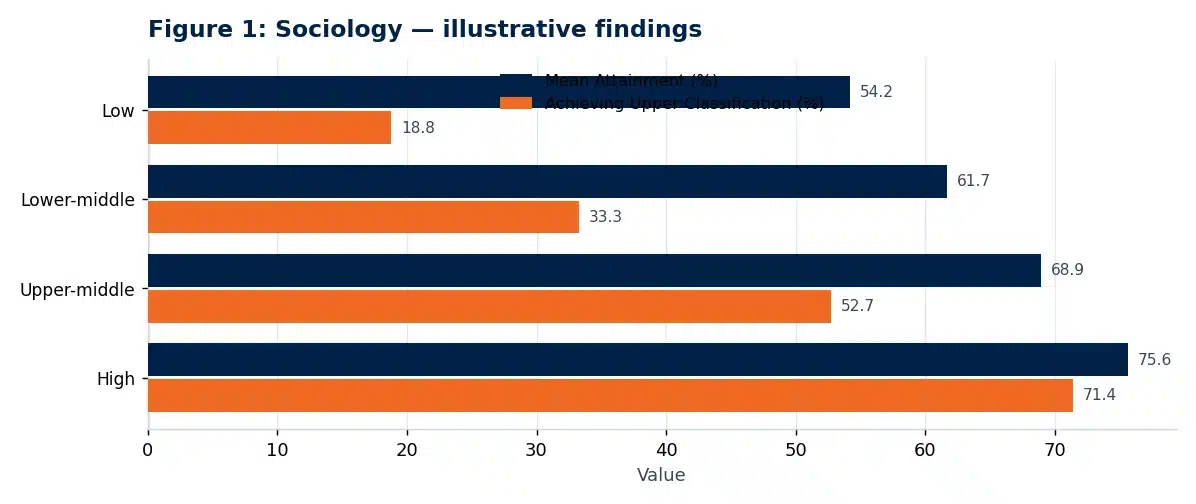
The pattern is unambiguous. As socioeconomic status increases, both mean attainment and the proportion achieving an upper classification rise markedly. The relationship is monotonic across all four bands.
Pearson’s correlation between the composite SES index and attainment scores was strong and positive, at approximately r = 0.61. This indicates that socioeconomic status accounts for a substantial share of the variation in attainment.
Examining the components separately, parental education appeared most strongly associated with attainment, followed by parental occupation and then family income. This ordering suggests that cultural and educational resources may matter as much as material ones.
The cross-tabulation reinforced this picture. Only 18.8 per cent of low-SES respondents achieved an upper classification, compared with 71.4 per cent of high-SES respondents, a striking near-fourfold difference.
These findings directly address the first research question, confirming that socioeconomic status strongly predicts attainment in this illustrative sample. The gradient is continuous rather than confined to the extremes of the distribution.
The prominence of parental education in the component analysis speaks to the second research question. It hints that the transmission of advantage operates substantially through cultural and knowledge-based channels, not income alone.
The findings resonate strongly with the established literature and lend illustrative support to several theoretical positions. The robust positive association between SES and attainment mirrors decades of empirical research across national contexts.
The particular strength of parental education as a predictor aligns closely with Bourdieu’s theory of cultural capital. Where parents possess educational credentials, they transmit dispositions and competences that schools reward (Bourdieu and Passeron, 1990).
This interpretation is reinforced by the finding that income was the weakest of the three components. If disadvantage were purely material, financial resources would dominate; their subordinate role suggests cultural mechanisms are also at work.
Nonetheless, the data do not permit dismissal of material explanations. The substantial gap between low and lower-middle bands is consistent with Boudon’s secondary effects, where families make different educational choices according to their resources.
The most persuasive reading integrates both traditions. Cultural capital and material rationality are not mutually exclusive; they interact, with economic constraint shaping the choices that culturally embedded dispositions make appear sensible (Goldthorpe, 2007).
The monotonic gradient across all four bands carries important implications. It indicates that disadvantage is not confined to a distinct underclass but operates as a continuous gradient affecting the whole social structure.
This challenges policy approaches that target only the most deprived pupils. If attainment rises steadily with status throughout the distribution, interventions focused solely on the poorest may leave broad swathes of inequality untouched.
The findings also cast doubt on the meritocratic narrative surrounding education. Where outcomes are so strongly patterned by origin, the notion that schooling rewards talent irrespective of background becomes difficult to sustain (Reay, 2004).
At the institutional level, the results are consistent with research showing that schools mediate rather than neutralise background advantage. The processes documented by Ball (2003) may help explain how status is converted into attainment.
These illustrative results should be treated with appropriate caution given the synthetic data. Nevertheless, their close correspondence with genuine empirical findings lends them heuristic value for understanding the sociological dynamics at play.
This paper set out to examine the relationship between socioeconomic status and educational attainment and to interpret it through sociological theory. The illustrative analysis revealed a strong, consistent and positive association between the two.
Higher socioeconomic status was associated with markedly higher attainment across every band, with parental education emerging as the single strongest predictor. The gap between the most and least advantaged respondents was substantial and pervasive.
The study contributes by demonstrating how a combined theoretical lens illuminates these patterns more fully than any single framework. Cultural capital and rational action theories together capture the interplay of dispositions, resources and choices.
The prominence of parental education supports the view that cultural transmission is central to social reproduction. Yet the persistence of material effects confirms that economic constraint remains an independent and significant force.
Several recommendations follow. Policy should move beyond narrowly targeted funding towards structural reforms that address the continuous social gradient in attainment, including early-years support and the reduction of educational stratification.
Interventions should also recognise the cultural dimension of disadvantage, supporting families in ways that build educational confidence and knowledge rather than assuming deficiency. Schools themselves must be scrutinised for practices that amplify advantage.
Future research should employ longitudinal designs capable of tracing how advantage accumulates over the life course and establishing causal mechanisms. Such studies would clarify the direction and timing of the effects observed here.
Qualitative approaches would valuably complement this quantitative picture, capturing the lived experience behind the statistics. Exploring how young people themselves understand the relationship between their background and their achievement remains an important task.
Ultimately, the enduring link between socioeconomic status and educational attainment poses a fundamental challenge to any society committed to fairness. Confronting it requires sustained sociological attention and a willingness to pursue genuinely structural change.

All work is written by human writers. 100% AI free, guaranteed.

100% money back guarantee if you find plagiarism in our work.
COMPANY DETAILS