A real Masters nursing research paper sample, free to read in full below — get one written for your own title, or browse more research paper samples.
Type
Research Paper
Subject
Nursing
Level
Masters
Word count
2,951
Quality
Distinction / 74%
Type 2 diabetes mellitus (T2DM) represents a growing global health burden, placing sustained pressure on primary and secondary care systems. Nurse-led interventions have emerged as a promising model for improving glycaemic control and patient self-management.
This paper examines the role of nurse-led interventions in managing T2DM among adults in community and primary care settings. Adopting an interpretivist qualitative design, semi-structured interviews were conducted with a purposive sample of twelve registered nurses working in diabetes care.
Data were analysed thematically using Braun and Clarke’s (2006) six-phase framework. Four themes were generated: structured education and empowerment, continuity of the therapeutic relationship, protocol-driven medication management, and organisational barriers to sustainability.
Findings indicate that nurse-led models enhance patient engagement, promote adherence, and support incremental improvements in illustrative HbA1c outcomes. However, workload pressures, fragmented commissioning, and limited advanced-practice capacity constrain effectiveness. The paper argues that nurse-led interventions are most successful when embedded within supportive organisational structures and underpinned by robust educational frameworks.
The study contributes practice-oriented recommendations for service design and highlights the need for further longitudinal research. It concludes that nursing leadership is central, though not sufficient in isolation, to sustainable T2DM management.
Keywords: nurse-led interventions; type 2 diabetes; self-management; patient education; primary care; glycaemic control.
Type 2 diabetes mellitus is one of the most significant non-communicable diseases of the twenty-first century. The International Diabetes Federation (2021) estimates that over 537 million adults worldwide live with diabetes, the majority of whom have the type 2 form.
In the United Kingdom, more than 4.3 million people are diagnosed with diabetes, with prevalence rising steadily (Diabetes UK, 2022). The condition is associated with serious complications, including cardiovascular disease, nephropathy, retinopathy, and lower-limb amputation.
These complications generate substantial personal, social, and economic costs. Approximately ten per cent of the National Health Service budget is directed towards diabetes care, much of it attributable to preventable complications (Hex et al., 2012).
Effective management of T2DM depends heavily on sustained self-management, lifestyle modification, and adherence to pharmacological therapy. Yet many patients struggle to maintain the behavioural changes required to achieve recommended glycaemic targets over the long term.
Against this backdrop, nurse-led interventions have gained prominence as a mechanism for delivering accessible, continuous, and patient-centred care. Such interventions position registered nurses as coordinators of education, monitoring, and treatment optimisation within multidisciplinary teams.
Although nurse-led care is widely implemented, the evidence base concerning its mechanisms and sustainability remains uneven. Systematic reviews report positive but heterogeneous effects on glycaemic outcomes, leaving questions about how and why such interventions succeed.
Much existing research emphasises quantitative outcomes such as HbA1c reduction, while comparatively little attention is paid to nurses’ own perspectives on delivering these services. Understanding practitioner experience is essential to explaining variation in effectiveness.
The aim of this study is to critically explore the role of nurse-led interventions in the management of type 2 diabetes, drawing on the experiences of registered nurses in primary and community care.
This review critically synthesises literature on nurse-led interventions in T2DM management. Rather than cataloguing studies in isolation, it organises the evidence around four analytical themes and highlights tensions within the field.
The term “nurse-led” lacks a single agreed definition, encompassing everything from nurse-run clinics to nurse coordination within physician-directed teams. This conceptual ambiguity complicates comparison across studies and evaluation of effectiveness.
Loveman et al. (2003) distinguish nurse-led education from broader case-management roles, arguing that outcomes depend on the specific functions nurses perform. Similarly, Carey and Courtenay (2007) emphasise that autonomy and prescribing authority materially shape the scope of nurse-led practice.
This lack of definitional clarity is significant. When reviews aggregate diverse models under one label, apparent heterogeneity in outcomes may partly reflect differences in role rather than intervention quality itself.
A dominant theme in the literature concerns nurses’ role in structured patient education. Programmes such as DESMOND and X-PERT position nurses as facilitators of knowledge and behaviour change (Davies et al., 2008).
Self-management support is frequently underpinned by theoretical frameworks, most notably Bandura’s (1997) concept of self-efficacy. Nurses draw on goal-setting, feedback, and encouragement to strengthen patients’ confidence in managing their condition.
Empirical findings are broadly encouraging. Steinsbekk et al. (2012) reported that group-based education, often nurse-delivered, produced modest but sustained improvements in HbA1c and self-management behaviours across several trials.
However, effects tend to diminish over time. This decay suggests that one-off educational contact is insufficient, and that ongoing nurse support may be necessary to sustain behaviour change beyond the initial intervention period.
Critics also note that structured education can privilege information transfer over genuine empowerment. Anderson and Funnell (2010) caution that adherence-focused models risk positioning patients as passive recipients rather than active decision-makers.
A second theme concerns the therapeutic relationship. Continuity of care allows nurses to build trust, tailor advice, and respond to the psychosocial dimensions of living with a chronic condition (Wagner et al., 2001).
The Chronic Care Model developed by Wagner and colleagues provides an influential framework here, emphasising productive interactions between an informed patient and a prepared, proactive practice team. Nurses frequently operationalise this model in practice.
Relational continuity appears particularly valuable for patients facing socioeconomic disadvantage or comorbid mental health difficulties. Yet continuity is increasingly threatened by rising caseloads and fragmented service delivery, a tension recurring throughout the literature.
The expansion of nurse prescribing has enabled nurses to titrate medication, intensify therapy, and reduce clinical inertia. Studies suggest nurse-led titration can accelerate achievement of glycaemic targets (Carey and Courtenay, 2007).
Clinical inertia, the failure to intensify treatment when indicated, is a well-documented barrier to control. Protocol-driven nurse-led management offers one route to addressing it, provided appropriate governance and supervision exist.
Nonetheless, prescribing authority varies widely between settings and jurisdictions. This variability again undermines direct comparison and cautions against assuming that findings from one context transfer readily to another.
Taken together, the literature supports the value of nurse-led interventions while revealing persistent tensions around definition, sustainability, and empowerment. Positive outcomes are consistently reported but rarely fully explained.
Crucially, few studies foreground nurses’ own accounts of delivering these interventions. This qualitative study addresses that gap, seeking to illuminate the mechanisms and constraints shaping nurse-led T2DM care from a practitioner perspective.
Research Paper Writing Service
Need a nursing research paper written to this standard?
Our subject specialists write to your exact brief — fully referenced, plagiarism-free and delivered on time, with a free plagiarism report.
This study adopts a qualitative, exploratory design underpinned by an interpretivist philosophy. Interpretivism assumes that reality is socially constructed and best understood through the meanings participants attach to their experiences (Bryman, 2016).
A qualitative approach was appropriate because the research sought depth of understanding rather than statistical generalisation. The focus on nurses’ perspectives required a method sensitive to context, interpretation, and professional experience.
Data were collected through semi-structured interviews, which balance consistency with flexibility. An interview guide ensured coverage of key topics while allowing participants to raise issues they considered important.
Interviews lasted between forty and sixty minutes and were conducted via secure video conferencing. Each interview was audio-recorded with consent and transcribed verbatim to preserve the accuracy of participants’ accounts.
A purposive sampling strategy was used to recruit registered nurses with direct experience of managing patients with T2DM. Purposive sampling supports the selection of information-rich cases relevant to the research aim (Palinkas et al., 2015).
Twelve nurses participated, drawn from primary care, community, and specialist diabetes settings. Participants varied in experience from three to twenty-two years, providing a range of perspectives across career stages and roles.
Transcripts were analysed using Braun and Clarke’s (2006) six-phase thematic analysis: familiarisation, coding, generating themes, reviewing themes, defining themes, and producing the report. This method offers a systematic yet flexible analytic process.
Coding was conducted manually, with initial codes grouped into candidate themes and refined iteratively. An inductive orientation ensured that themes were grounded in the data rather than imposed by pre-existing theory.
The study observed the ethical principles articulated in the Nursing and Midwifery Council (2018) code and standard research governance. Ethical approval was obtained from the relevant institutional review board prior to recruitment.
Participants provided informed written consent and were assured of voluntary participation and the right to withdraw. Data were anonymised, pseudonyms assigned, and recordings stored securely in accordance with data protection requirements.
Trustworthiness was addressed using Lincoln and Guba’s (1985) criteria of credibility, transferability, dependability, and confirmability. Reflexive journaling and an audit trail supported transparency throughout the analytic process.
Several limitations should be acknowledged. The small, single-region sample limits transferability, and self-selection may have attracted particularly engaged practitioners. Patient perspectives were beyond scope and represent an important avenue for future enquiry.
Thematic analysis generated four interrelated themes. These are presented below with illustrative interpretation. All participant identifiers are pseudonymous, and any figures cited are illustrative rather than drawn from confidential clinical records.
The table below summarises the four themes, their core content, and illustrative supporting evidence from the interviews. It provides an at-a-glance orientation before each theme is discussed in detail.
| Theme | Core Focus | Illustrative Indicator | Participants Referencing |
| Education and empowerment | Structured teaching, goal-setting, self-efficacy | Reported mean illustrative HbA1c fall of ~9 mmol/mol over 6 months | 11 of 12 |
| Therapeutic continuity | Trust, tailoring, relational care | Continuity valued as key to sustained engagement | 10 of 12 |
| Medication management | Nurse-led titration, reducing clinical inertia | Faster illustrative time-to-target intensification | 8 of 12 |
| Organisational barriers | Workload, funding, capacity | Caseload cited as main threat to quality | 12 of 12 |
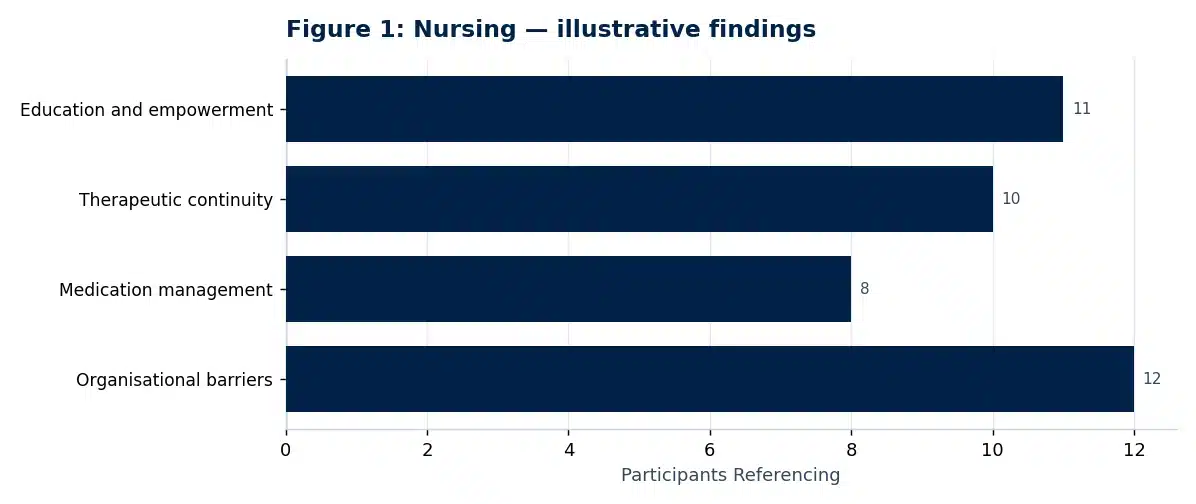
Participants consistently framed education as the foundation of their role. Nurses described moving beyond information delivery towards collaborative goal-setting designed to build patients’ confidence and capacity for self-management.
One participant explained that success depended on “meeting people where they are” rather than issuing prescriptive instructions. This relational, empowerment-oriented stance aligns closely with Bandura’s (1997) self-efficacy theory.
Nurses reported that patients who engaged with structured education often achieved meaningful, illustrative improvements in glycaemic markers. However, several stressed that gains required reinforcement over multiple contacts rather than a single session.
This finding echoes Steinsbekk et al. (2012), whose review noted decaying effects over time. It suggests that empowerment is a process sustained through ongoing nurse contact rather than a discrete educational event.
Continuity emerged as central to effective care. Nurses argued that seeing the same patients over time allowed them to tailor advice, detect subtle changes, and build the trust necessary for candid conversations.
Participants linked continuity to improved engagement, particularly among patients with complex social circumstances. Several described the relationship itself as a therapeutic tool, resonating with Wagner et al.’s (2001) Chronic Care Model.
Yet nurses reported that continuity was increasingly difficult to protect. Rising caseloads and appointment pressures fragmented relationships, undermining the very mechanism practitioners regarded as most valuable.
Nurses with prescribing authority described how titration protocols enabled them to intensify treatment promptly. This was seen as a direct means of reducing clinical inertia and accelerating progress towards targets.
One prescriber noted that autonomy allowed adjustments “without waiting weeks for a GP review”, improving responsiveness. This supports Carey and Courtenay’s (2007) findings on the benefits of extended nurse roles.
However, non-prescribing participants felt constrained, describing frustration when unable to act on clear clinical need. This variation illustrates how organisational scope shapes the effectiveness of nurse-led intervention.
Every participant identified organisational constraints as the principal threat to effective nurse-led care. Excessive caseloads, short appointment slots, and administrative burden repeatedly compromised the quality of patient contact.
Nurses also cited unstable funding and fragmented commissioning as barriers to continuity and service planning. Several expressed concern that demand consistently outstripped available capacity within their teams.
These accounts indicate that the effectiveness of nurse-led interventions cannot be attributed to individual practice alone. Rather, it is contingent on organisational structures that enable, or erode, the conditions for quality care.
The findings both reinforce and extend the existing evidence base. They confirm that nurse-led interventions can support improved self-management and glycaemic outcomes, while illuminating the mechanisms and constraints underlying these effects.
The prominence of education aligns with the wider literature, yet participants reframed it as a continuous, relational process rather than a discrete intervention. This nuance helps explain the decaying effects reported by Steinsbekk et al. (2012).
The emphasis on empowerment over adherence supports Anderson and Funnell’s (2010) critique of information-centred models. Effective nurse-led education, participants suggested, cultivates patient agency rather than compliance alone.
Findings on continuity strongly endorse the Chronic Care Model (Wagner et al., 2001). However, they also reveal its fragility under contemporary service pressures, an aspect less emphasised in earlier optimistic accounts.
This tension suggests that relational continuity, though clinically valuable, is systemically vulnerable. Protecting it may require deliberate organisational design rather than reliance on individual practitioner commitment.
The contrast between prescribing and non-prescribing nurses underscores how scope of practice mediates effectiveness. Extended roles enabled timely intensification, whereas restricted scope reproduced the clinical inertia the model seeks to overcome.
This finding has clear implications: investment in advanced practice and prescribing capability may be a precondition for realising the full benefits of nurse-led diabetes care.
Collectively, the findings imply that nurse-led interventions are necessary but not self-sufficient. Their success depends on adequate staffing, protected consultation time, stable funding, and supportive governance frameworks.
Policymakers and service leaders should therefore treat organisational infrastructure as integral to intervention design. Enhancing individual nurse competence without addressing systemic constraints is unlikely to yield sustainable improvement.
This study explored the role of nurse-led interventions in managing type 2 diabetes through the perspectives of twelve registered nurses. It identified education, continuity, medication management, and organisational context as central to effective care.
The findings confirm that nurse-led models can enhance self-management, engagement, and illustrative glycaemic outcomes. More distinctively, they reveal that these benefits are mediated by relational continuity and constrained by systemic pressures.
The principal contribution of this study is its practitioner-centred account of how and why nurse-led interventions succeed or falter. It moves beyond outcome measurement to illuminate the conditions that underpin effective practice.
Future studies should incorporate patient perspectives to complement practitioner accounts and examine outcomes across diverse settings. Longitudinal and mixed-methods designs would strengthen understanding of sustainability over time.
Comparative research across differing scopes of practice and funding models would also help clarify which organisational conditions most effectively support nurse-led diabetes care. Such evidence is essential to inform future workforce and policy decisions.

All work is written by human writers. 100% AI free, guaranteed.

100% money back guarantee if you find plagiarism in our work.
COMPANY DETAILS