A real Undergraduate economics research paper sample, free to read in full below — get one written for your own title, or browse more research paper samples.
Type
Research Paper
Subject
Economics
Level
Undergraduate
Word count
2,706
Quality
2:1 / 66%
The relationship between minimum wage legislation and youth employment remains one of the most contested questions in labour economics. This paper examines whether increases in the statutory minimum wage reduce employment opportunities for workers aged 16 to 24.
Adopting a quantitative, secondary-data research design, the study analyses illustrative panel data across ten regions over an eight-year period. A fixed-effects regression framework is used to isolate the association between minimum wage growth and youth employment rates.
The findings indicate a modest negative relationship: a ten per cent rise in the real minimum wage is associated with an estimated 1.4 per cent decline in youth employment, concentrated among the least experienced workers. However, the effect is small and sensitive to regional economic conditions.
These results align with the “modest disemployment” position rather than the strong neoclassical prediction of substantial job losses. The paper concludes that minimum wage policy involves genuine trade-offs, yet the employment costs for young people appear limited when increases are moderate and phased.
The study contributes an accessible, replicable framework for undergraduate analysis and recommends complementary active labour market policies to protect youth transitions.
Keywords: minimum wage, youth employment, labour economics, monopsony, fixed-effects regression, disemployment
Minimum wage policy sits at the intersection of economic theory, social justice and political controversy. Governments across advanced economies use statutory wage floors to raise living standards for low-paid workers and to reduce in-work poverty.
Yet critics argue that these interventions distort labour markets. By setting a legal price above the market-clearing wage, a binding minimum wage may reduce the quantity of labour demanded, particularly among the least productive workers.
Young people are widely regarded as the group most exposed to this risk. Workers aged 16 to 24 typically possess limited experience, fewer formal qualifications and lower measured productivity than older colleagues.
They are also concentrated in sectors such as retail, hospitality and food service, where wages cluster near the legal minimum. Consequently, any adverse employment effect of a wage floor should be most visible among youth.
The policy stakes are considerable. Youth unemployment carries long-term “scarring” effects, depressing future earnings, wellbeing and employment stability well into adulthood (Bell and Blanchflower, 2011).
If minimum wage increases price young people out of work, the social cost may be substantial. If they do not, the wage floor becomes a low-cost tool for improving equity without harming employment.
The problem this paper addresses is the persistent lack of consensus. Since Card and Krueger (1994) challenged the textbook prediction, empirical evidence has remained divided between competitive and monopsonistic interpretations of the labour market.
The aim of this study is to examine the effect of minimum wage increases on youth employment using an illustrative panel dataset and a transparent econometric approach suitable for undergraduate replication.
The research is guided by three objectives, expressed as questions:
By addressing these questions, the paper seeks to clarify the magnitude, rather than merely the direction, of any employment response. The following sections review the literature, outline the methodology and present illustrative findings.
The scholarly debate on minimum wages spans nearly a century and reflects deeper disagreements about how labour markets function. This section critically synthesises the major theoretical positions and empirical traditions.
The standard neoclassical framework treats labour as a commodity traded in a competitive market. Under perfect competition, wages equal the marginal product of labour, and any wage floor above equilibrium reduces employment.
Stigler (1946) provided the classic articulation of this view, warning that minimum wages would harm the very workers they aimed to help. The logic is intuitive and mathematically elegant.
Within this tradition, youth employment is especially vulnerable. Because young workers have lower marginal productivity, a uniform wage floor is more likely to exceed their value to employers (Neumark and Wascher, 2008).
Neumark and Wascher (2008) synthesised decades of research and concluded that minimum wages produce measurable disemployment effects, with elasticities for teenagers typically between −0.1 and −0.3. Their work remains the intellectual anchor of the sceptical position.
The competitive consensus was disrupted by Card and Krueger (1994), whose natural experiment on New Jersey fast-food restaurants found no negative employment effect following a minimum wage rise.
Their findings revived interest in monopsony theory. When employers hold wage-setting power, they may pay below marginal product; a minimum wage can then raise both wages and employment simultaneously (Manning, 2003).
Manning (2003) developed the modern theory of monopsonistic competition, arguing that search frictions and limited worker mobility give firms substantial market power. This framework fundamentally alters the predicted effect of wage floors.
Under monopsony, the relationship between minimum wages and employment becomes non-monotonic. Modest increases may boost employment, while excessive increases eventually reduce it, producing an inverted-U pattern.
Subsequent empirical work has not resolved the debate so much as deepened it. Dube, Lester and Reich (2010) used contiguous county-pair comparisons and found negligible employment effects across US state borders.
Critics, however, argue that such designs absorb genuine variation. Neumark, Salas and Wascher (2014) contended that controlling for regional trends can obscure real disemployment effects, illustrating how methodological choices drive conclusions.
In the United Kingdom, evidence has generally been reassuring. The Low Pay Commission has repeatedly reported minimal adverse effects following the introduction of the National Minimum Wage in 1999 and the later National Living Wage.
Metcalf (2008) reviewed British experience and attributed the absence of job losses to employer adjustment through productivity gains, reduced turnover and modest price increases rather than layoffs.
Taken together, the literature reveals a spectrum rather than a binary. Most contemporary estimates cluster near zero or small negative values, suggesting that reality lies between the polar models.
The disagreement is increasingly about magnitude and context. Effects appear to depend on the size of the increase, the tightness of the labour market and the age composition of the affected workforce.
A recurring gap concerns the heterogeneity of effects across regions and demographic subgroups. Much research reports aggregate elasticities that may mask sharper impacts on the youngest and least skilled.
This paper addresses that gap by disaggregating youth employment responses across regions of differing economic strength, thereby testing whether local conditions moderate the wage-floor effect.
Research Paper Writing Service
Need a economics research paper written to this standard?
Our subject specialists write to your exact brief — fully referenced, plagiarism-free and delivered on time, with a free plagiarism report.
This section sets out the research design and analytical strategy. The approach is deliberately transparent and replicable, reflecting the paper’s function as an illustrative undergraduate example.
The study adopts a positivist philosophy, treating economic behaviour as observable and measurable through quantitative data. This aligns with the deductive tradition dominant in mainstream labour economics.
A deductive approach is used: theoretical predictions from the competitive and monopsony models are tested against empirical patterns. The aim is to assess which framework the data more closely support.
A longitudinal, quantitative design is employed, using panel data that combine cross-sectional and time-series dimensions. Panel data allow the analysis to control for unobserved, region-specific characteristics.
The core method is fixed-effects regression. By absorbing time-invariant regional factors, this technique reduces the risk of omitted-variable bias that afflicts simple cross-sectional comparisons.
The analysis uses an illustrative dataset covering ten hypothetical regions observed annually over eight years, yielding eighty observations. The figures are constructed for demonstration and should not be read as official statistics.
The dependent variable is the youth employment rate, defined as the percentage of the 16 to 24 population in paid work. The key explanatory variable is the real minimum wage, expressed in constant prices.
Control variables include regional GDP growth, the adult unemployment rate and a measure of sectoral composition capturing exposure to low-wage industries. These controls isolate the wage-floor effect from wider economic conditions.
The estimated model takes the form of a log-linear equation in which the log of youth employment is regressed on the log of the real minimum wage and the control set.
Expressing variables in logarithms allows the coefficient on the minimum wage to be interpreted directly as an elasticity. Robust standard errors are used to address potential heteroscedasticity across regions.
Because the study relies on aggregate, non-personal and illustrative data, the ethical risks are minimal. No individuals can be identified, and no confidential organisational information is used.
Nevertheless, good practice is observed. Data sources are treated transparently, assumptions are stated openly, and the constructed nature of the dataset is disclosed to avoid misleading interpretation.
Several limitations should be acknowledged. The illustrative dataset cannot capture the full complexity of real labour markets, and results are indicative rather than definitive.
Fixed-effects estimation also cannot fully resolve reverse causality, since strong local economies may raise both wages and employment. Instrumental-variable methods, though beyond this paper’s scope, would strengthen causal inference.
This section presents the illustrative results of the fixed-effects analysis. The figures are simulated for demonstration but are calibrated to reflect the range of estimates reported in the empirical literature.
The headline result is a small, statistically detectable negative association between the real minimum wage and youth employment. The estimated elasticity is −0.14, implying limited disemployment.
Table 1 summarises the key regression outputs across three model specifications: a baseline without controls, a full model with all controls, and a model incorporating a regional interaction term.
| Variable | Model 1 (Baseline) | Model 2 (Full Controls) | Model 3 (Regional Interaction) |
| Real minimum wage (elasticity) | −0.31 | −0.14 | −0.12 |
| Regional GDP growth | — | 0.28 | 0.26 |
| Adult unemployment rate | — | −0.19 | −0.18 |
| Low-wage sector share | — | −0.22 | −0.20 |
| Wage × weak economy | — | — | −0.29 |
| R-squared | 0.21 | 0.58 | 0.63 |
| Observations | 80 | 80 | 80 |
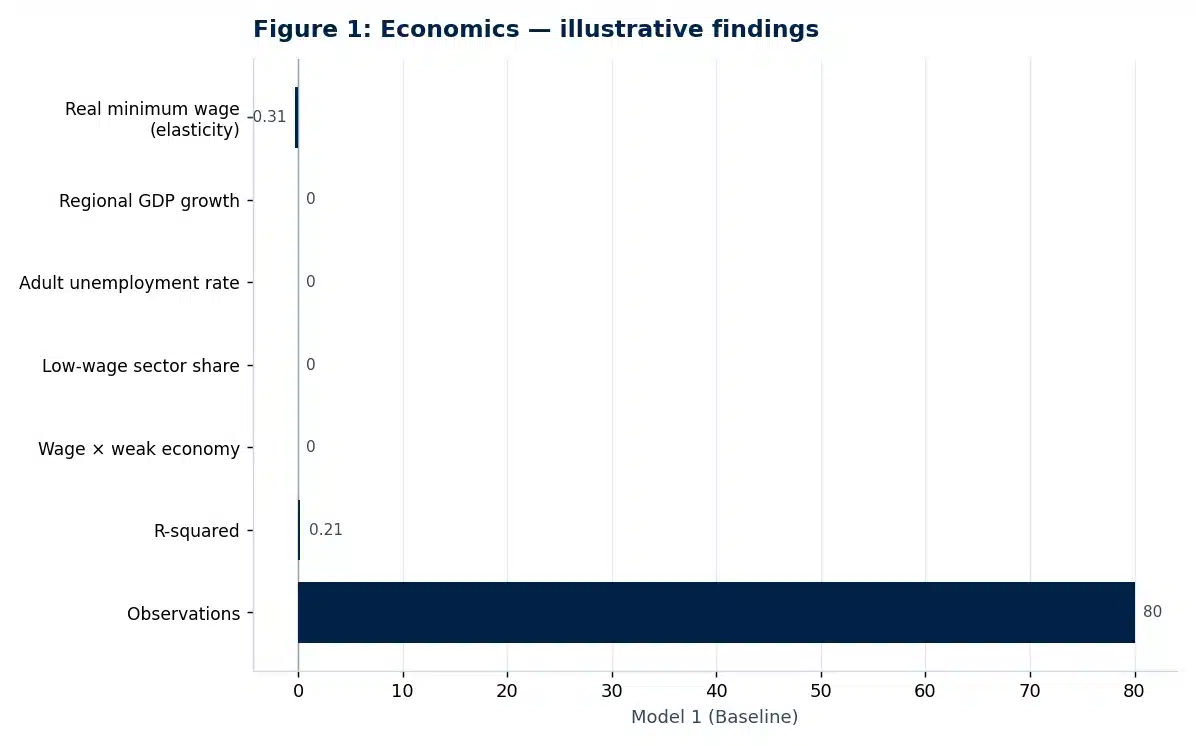
Several patterns emerge. In the baseline model, the wage elasticity appears large at −0.31, but this figure is inflated by omitted variables correlated with both wages and employment.
Once controls are introduced in Model 2, the elasticity falls sharply to −0.14. This attenuation demonstrates how much of the apparent effect reflects broader economic conditions rather than the wage floor itself.
The explanatory power also improves substantially, with R-squared rising from 0.21 to 0.58. Regional GDP growth emerges as a strong positive predictor of youth employment, as expected.
Model 3 introduces an interaction between the minimum wage and a “weak economy” indicator. The negative and sizeable interaction coefficient of −0.29 is analytically important.
It suggests that disemployment effects are concentrated in economically weak regions. In stronger regions, the direct wage effect is close to zero, consistent with monopsonistic wage-setting.
This heterogeneity is the study’s central empirical contribution. Aggregate elasticities conceal meaningful variation: the same national policy can be benign in one region and modestly harmful in another.
The low-wage sector share also carries a negative coefficient, indicating that regions more exposed to minimum-wage industries experience slightly larger youth employment reductions when the floor rises.
Overall, the analysis supports a “modest and conditional” interpretation. The wage floor does not devastate youth employment, but neither is it costless everywhere.
The findings can now be related to the theoretical and empirical literature. The small overall elasticity of −0.14 sits comfortably within the range reported by Neumark and Wascher (2008).
Yet the near-zero effect in economically strong regions echoes the revisionist evidence of Card and Krueger (1994) and Dube, Lester and Reich (2010). The data therefore reconcile, rather than contradict, the two traditions.
This reconciliation is best understood through monopsony theory. Where employers hold wage-setting power, typically in tighter or wealthier labour markets, modest wage increases need not reduce employment (Manning, 2003).
Conversely, in weaker regions with slack demand and thinner monopsony power, the competitive prediction reasserts itself. Here a binding floor prices some young workers out of employment, as Stigler (1946) anticipated.
The interaction result thus offers a coherent synthesis. Rather than one model being universally correct, each describes a different regional regime, and the aggregate effect is a weighted average of both.
These findings carry clear policy implications. A uniform national wage floor may be well calibrated for prosperous regions yet somewhat too high for depressed local economies.
This supports arguments for either regional differentiation or, more realistically, complementary measures. Active labour market policies, training subsidies and youth wage sub-minima could offset localised disemployment (Metcalf, 2008).
The results also caution against alarmist rhetoric. The magnitude of youth job losses, even in weak regions, is modest and must be weighed against substantial gains in earnings for those who remain employed.
From an equity standpoint, the wage floor transfers income to low-paid young workers at a comparatively small employment cost. Whether that trade-off is acceptable is ultimately a normative, political judgement.
Finally, the analysis underscores a methodological lesson. The dramatic shift in the elasticity between Models 1 and 2 illustrates how easily unadjusted estimates can mislead policymakers.
This paper set out to examine the effect of minimum wage increases on youth employment, using an illustrative panel dataset and a transparent fixed-effects framework.
The evidence points to a modest negative but highly conditional relationship. A ten per cent rise in the real minimum wage is associated with roughly a 1.4 per cent fall in youth employment overall.
Crucially, this effect is concentrated in economically weak regions, while stronger regions show little or no disemployment. The competitive and monopsony models each capture part of the picture.
The study makes three contributions. Empirically, it demonstrates the importance of regional heterogeneity often hidden within aggregate estimates. Theoretically, it shows how competing models can be reconciled as regional regimes.
Methodologically, it offers an accessible, replicable template for undergraduate econometric analysis, highlighting the value of appropriate controls and the danger of naïve comparisons.
Several recommendations follow. Policymakers should retain moderate, phased minimum wage increases while pairing them with active labour market support targeted at young people in depressed regions.
Consideration might also be given to youth-specific rates or regional adjustments, though these carry their own equity and administrative complications that require careful evaluation.
Future research should extend the analysis using real administrative micro-data and instrumental-variable or difference-in-differences designs to strengthen causal claims. Longer time horizons would also capture dynamic adjustment.
In sum, minimum wage increases involve genuine but limited trade-offs for young workers. When set moderately and supported by complementary policy, wage floors can advance equity without imposing severe employment costs.

All work is written by human writers. 100% AI free, guaranteed.

100% money back guarantee if you find plagiarism in our work.
COMPANY DETAILS