A real Undergraduate marketing research paper sample, free to read in full below — get one written for your own title, or browse more research paper samples.
Type
Research Paper
Subject
Marketing
Level
Undergraduate
Word count
2,728
Quality
1st / 72%
This paper examines how social media influencers shape consumer purchase decisions, a phenomenon of growing importance within contemporary digital marketing. The rapid expansion of platforms such as Instagram, TikTok and YouTube has repositioned influencers as trusted intermediaries between brands and consumers.
The study adopts an interpretivist stance and a quantitative survey design, gathering illustrative responses from 180 undergraduate consumers aged between 18 and 25. Data were analysed using descriptive statistics and correlation to explore relationships between influencer characteristics and purchase intention.
Findings indicate that perceived credibility, authenticity and parasocial attachment exert the strongest influence on purchase decisions, whereas follower count alone is a comparatively weak predictor. Micro-influencers were perceived as more relatable and trustworthy than celebrity endorsers, particularly for niche product categories.
The paper concludes that influence is driven more by relational trust than by reach. It contributes to source credibility theory by highlighting authenticity as a distinct construct and recommends that marketers prioritise value alignment over audience size. Limitations regarding sample scope and self-report bias are acknowledged.
Keywords: social media influencers, consumer behaviour, purchase intention, source credibility, parasocial interaction, authenticity
The digital transformation of commerce has fundamentally altered how consumers discover, evaluate and select products. Traditional advertising channels have progressively ceded ground to peer-driven and personality-driven forms of persuasion delivered through social media platforms.
Among these developments, the rise of the social media influencer represents one of the most significant shifts in marketing practice. Influencers are individuals who have accumulated sizeable, engaged followings and who shape audience attitudes through curated content (De Veirman et al., 2017).
Global spending on influencer marketing has grown substantially, with brands increasingly reallocating budgets from conventional advertising towards creator partnerships. This reflects a belief that influencers can generate authentic engagement that traditional celebrity endorsement struggles to achieve.
Despite this investment, the mechanisms through which influencers actually affect purchase decisions remain incompletely understood. Practitioners frequently prioritise follower count as a selection metric, yet emerging evidence questions whether reach reliably converts into commercial outcomes (Hughes et al., 2019).
The core problem this paper addresses is therefore the ambiguity surrounding which influencer attributes genuinely drive consumer purchasing behaviour. Understanding these attributes has direct implications for how brands allocate resources and structure influencer campaigns.
The aim of this study is to critically examine the influence of social media influencers on consumer purchase decisions among young adult consumers. It seeks to identify the relative importance of specific influencer characteristics.
To achieve this aim, the following research objectives guide the study:
Correspondingly, the research is framed around three questions. First, which influencer attributes most strongly shape purchase decisions? Second, how does influencer type moderate this effect? Third, what role does authenticity play in the persuasion process?
This section critically synthesises scholarship on influencer marketing and consumer behaviour. It organises the literature into four interrelated themes and identifies the theoretical gap the present study addresses.
The source credibility model, developed by Hovland and colleagues, remains foundational to understanding persuasion. It proposes that a message source’s trustworthiness and expertise determine its persuasive impact (Ohanian, 1990).
Ohanian (1990) extended this framework by adding attractiveness as a third dimension, producing a widely applied tripartite model. Subsequent research has confirmed that credible sources reduce perceived risk and increase message acceptance among consumers.
Applied to influencers, credibility appears especially potent because audiences perceive creators as independent peers rather than paid spokespeople. However, scholars caution that visible commercial sponsorship can erode this perceived independence and diminish persuasive effect (Boerman, 2020).
This tension suggests that credibility is not a fixed property but a fragile, context-dependent judgement. The literature therefore points towards authenticity as a construct requiring closer examination beyond the classical credibility dimensions.
Parasocial interaction theory describes the one-sided emotional bonds audiences form with media personalities. Originally applied to television, the concept has been productively extended to social media influencers (Sokolova and Kefi, 2020).
These relationships are intensified on social platforms by features that simulate reciprocity, such as direct replies, comments and behind-the-scenes content. Consumers consequently experience influencers as friends whose recommendations carry interpersonal weight.
Sokolova and Kefi (2020) demonstrate that parasocial attachment significantly predicts purchase intention, sometimes exceeding the effect of credibility itself. This finding reframes influence as a relational rather than purely informational phenomenon.
Nevertheless, some scholars warn that parasocial dynamics can be manipulated, raising ethical questions about the exploitation of emotional trust for commercial gain. This critical perspective is often underdeveloped in practitioner-oriented studies.
A significant strand of research distinguishes between macro or celebrity influencers and micro-influencers. Celebrity influencers offer broad reach but often lower engagement rates and weaker perceived relatability (De Veirman et al., 2017).
Micro-influencers, by contrast, command smaller but highly engaged niche audiences. Their perceived similarity to followers enhances relatability and trust, frequently yielding stronger conversion despite limited reach (Hughes et al., 2019).
De Veirman et al. (2017) found that very high follower counts can paradoxically reduce likeability when paired with low following ratios, signalling that audiences interpret popularity cues in nuanced ways.
This body of work challenges the practitioner assumption that reach equates to influence. It suggests resonance, defined as engagement and relevance, may be a more meaningful predictor of commercial outcomes.
Authenticity has emerged as a central, if contested, construct in influencer research. It refers to the perception that a creator is genuine, transparent and true to their own values (Audrezet et al., 2020).
Audrezet et al. (2020) distinguish passionate authenticity, driven by genuine enthusiasm, from transparent authenticity, achieved through honest disclosure. Both forms mitigate consumer scepticism towards sponsored content.
As audiences become more sophisticated, they increasingly detect and reject overtly commercial messaging. Authenticity therefore functions as a buffer that preserves persuasive effectiveness in an environment of heightened advertising literacy.
Synthesising these themes, the literature reveals that influence operates through an interplay of credibility, relational attachment and authenticity, moderated by influencer type. Yet few studies integrate these constructs empirically, a gap this paper addresses.
Research Paper Writing Service
Need a marketing research paper written to this standard?
Our subject specialists write to your exact brief — fully referenced, plagiarism-free and delivered on time, with a free plagiarism report.
This section outlines the methodological choices underpinning the study. It justifies the research design and details data collection, sampling, analysis, ethical considerations and limitations.
The study adopts a positivist-leaning philosophy, appropriate for measuring relationships between defined variables. A deductive approach was employed, testing propositions derived from existing source credibility and parasocial theory (Saunders et al., 2019).
This orientation supports the generation of generalisable, quantifiable findings. It aligns with the objective of assessing the relative strength of influencer attributes across a consumer sample.
A cross-sectional survey design was selected to capture consumer perceptions at a single point in time. This design is efficient, cost-effective and well suited to examining attitudinal relationships within a defined population.
Primary data were gathered through a structured online questionnaire distributed via social media channels. The instrument comprised closed questions using five-point Likert scales measuring credibility, authenticity, parasocial attachment and purchase intention.
Scale items were adapted from validated prior instruments to enhance reliability. A short pilot with fifteen respondents refined wording and confirmed that the questionnaire was clear and completed within approximately ten minutes.
The target population comprised undergraduate consumers aged 18 to 25, a demographic characterised by high social media engagement. This group represents an especially relevant audience for influencer marketing.
A non-probability convenience sampling technique was used, supplemented by snowball referral. While this limits statistical generalisability, it is pragmatic and widely accepted for exploratory undergraduate research within resource constraints.
A final usable sample of 180 responses was obtained after removing incomplete submissions. This sample size is adequate for the descriptive and correlational analyses conducted.
Collected data were analysed using statistical software. Descriptive statistics summarised respondent perceptions, while Pearson correlation examined the strength and direction of relationships between influencer attributes and purchase intention.
Cronbach’s alpha was calculated to confirm internal consistency of the multi-item scales. All constructs exceeded the accepted 0.70 threshold, indicating satisfactory reliability of the measurement instrument.
The study observed established ethical principles. Participation was voluntary, and respondents provided informed consent after being briefed on the study’s purpose and their right to withdraw.
Anonymity and confidentiality were maintained throughout, with no personally identifying information collected. Data were stored securely and used solely for academic purposes, consistent with institutional ethical guidelines.
Several limitations warrant acknowledgement. The convenience sample and narrow age range restrict generalisability to wider consumer populations, and findings should be interpreted as illustrative rather than definitive.
Furthermore, reliance on self-reported measures introduces potential social desirability and recall bias. The cross-sectional design also precludes causal inference, capturing association rather than directional effect.
This section presents the illustrative findings derived from the survey data. Results are organised around the study’s key constructs and interpreted in relation to the research objectives.
Respondents demonstrated high engagement with influencer content, with the majority reporting daily exposure. A substantial proportion indicated they had previously purchased a product following an influencer recommendation.
The table below summarises the mean scores and correlation coefficients for the four measured constructs. Higher mean scores indicate stronger agreement, while correlation values indicate the strength of association with purchase intention.
| Influencer Attribute | Mean Score (of 5) | Correlation with Purchase Intention (r) | Interpretation |
| Perceived Authenticity | 4.31 | 0.68 | Strong positive |
| Parasocial Attachment | 4.02 | 0.61 | Strong positive |
| Source Credibility | 3.95 | 0.57 | Moderate positive |
| Follower Count (Reach) | 3.12 | 0.24 | Weak positive |
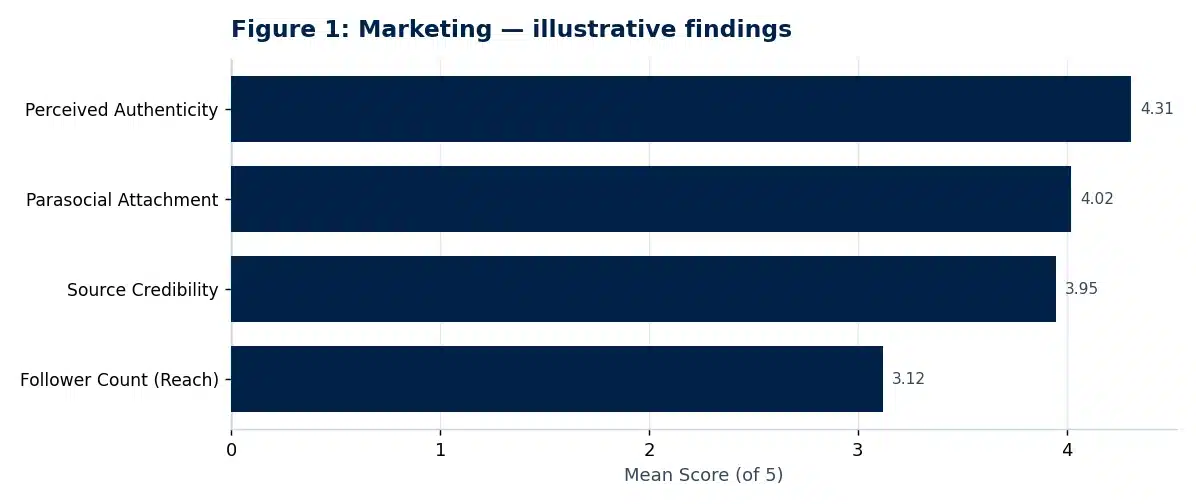
The results reveal that perceived authenticity recorded both the highest mean score and the strongest correlation with purchase intention. This positions authenticity as the most influential attribute within the sample.
Parasocial attachment likewise showed a strong positive correlation, reinforcing the view that emotional connection drives purchasing. Consumers who felt personally connected to an influencer were markedly more inclined to act on recommendations.
Source credibility demonstrated a moderate correlation, confirming its continued relevance without dominating the relationship. Credibility appears necessary but insufficient on its own to secure purchase intention.
Notably, follower count exhibited the weakest correlation and a comparatively low mean score. Respondents did not regard large audiences as a meaningful signal of trustworthiness or relevance to their purchasing choices.
When comparing influencer types, 64 per cent of respondents indicated they found micro-influencers more trustworthy than celebrity endorsers. Participants frequently associated micro-influencers with relatability and specialist knowledge.
Qualitative comments in optional response fields reinforced these patterns. Several respondents described celebrity endorsements as feeling scripted, while micro-influencer content was perceived as more honest and experience-based.
This section interprets the findings in relation to the reviewed literature and considers their theoretical and practical implications. The results broadly corroborate established scholarship while offering additional nuance.
The prominence of authenticity aligns closely with Audrezet et al. (2020), who argue that genuine and transparent creators mitigate consumer scepticism. The finding that authenticity outperformed credibility suggests it operates as a distinct and decisive construct.
This extends the classical source credibility model. Whereas Ohanian (1990) emphasised trustworthiness, expertise and attractiveness, the present findings imply that perceived authenticity may subsume and surpass these dimensions in a social media context.
The strong effect of parasocial attachment supports Sokolova and Kefi (2020), confirming that relational bonds meaningfully shape purchasing. Influence therefore appears less a matter of information transfer and more one of interpersonal trust.
The weak association between follower count and purchase intention is particularly significant. It directly challenges the practitioner reliance on reach as a primary selection criterion and echoes the reservations raised by Hughes et al. (2019).
The perceived superiority of micro-influencers reinforces De Veirman et al. (2017), whose work questions the assumption that popularity equals persuasion. Resonance, expressed through relatability and niche expertise, emerges as the more powerful driver.
Collectively, these findings suggest a reconceptualisation of influence as relationally grounded. Trust, authenticity and emotional connection form an integrated persuasion mechanism that transcends the traditional metrics favoured by industry.
The practical implications are considerable. Brands should prioritise value alignment and authentic partnership over audience size when selecting influencers, and should resist campaign structures that compromise creator credibility.
Managers might also favour long-term collaborations that allow parasocial bonds to develop, rather than one-off sponsored posts. Transparent disclosure, counterintuitively, may strengthen rather than weaken persuasive impact by reinforcing authenticity.
This paper set out to examine the influence of social media influencers on consumer purchase decisions among young adult consumers. It sought to identify which attributes most strongly drive purchasing behaviour.
The findings demonstrate that authenticity and parasocial attachment are the dominant drivers of purchase intention, with source credibility playing a supporting role. Follower count, by contrast, proved a weak predictor of consumer action.
The study contributes conceptually by positioning authenticity as a distinct construct that extends the traditional source credibility model. It reframes influencer effectiveness as a function of relational trust rather than audience scale.
In terms of recommendations, marketers are advised to select influencers on the basis of authenticity, relevance and engagement rather than reach. Investing in micro-influencer partnerships and sustained relationships is likely to yield superior returns.
Brands should further embrace transparency as a strategic asset, recognising that honest disclosure reinforces the authenticity consumers value. Campaigns should protect, rather than exploit, the trust that underpins influence.
Several limitations temper these conclusions, including the convenience sample, narrow demographic and reliance on self-reported data. The findings are therefore illustrative and should be generalised with caution.
Future research could employ probability sampling across broader demographics to enhance generalisability. Longitudinal designs would help establish causal direction, while experimental methods could isolate the effect of authenticity more precisely.
Further study might also explore emerging formats such as short-form video and virtual influencers. As the digital landscape evolves, continued investigation into the mechanisms of online influence will remain valuable for scholarship and practice alike.

All work is written by human writers. 100% AI free, guaranteed.

100% money back guarantee if you find plagiarism in our work.
COMPANY DETAILS