A worked Undergraduate strategic management case study example on Starbucks, free to read in full below — get one written for your own brief, or browse more case study samples.
Type
Case Study
Discipline
Strategic Management
Level
Undergraduate
Word count
872
Quality
2:1 / 64%
Starbucks Corporation is a global specialty coffee company founded in Seattle in 1971. It operates thousands of company-owned and licensed stores across dozens of markets worldwide.
The organisation is widely recognised for pairing premium coffee with a distinctive in-store atmosphere, often described as the “third place” between home and work.
This case study examines how Starbucks builds customer experience and pursues global expansion. It uses Porter’s Five Forces (Porter, 1985) as its primary analytical lens.
The scope is illustrative and educational. It relies on publicly known, general information about the coffee sector rather than confidential data, and it analyses strategy qualitatively rather than through specific financial figures.
The global coffee-shop market is mature in many Western economies yet still growing in emerging regions. Competition spans specialty independents, large chains, and quick-service restaurants offering low-cost coffee.
Starbucks competes primarily through differentiation rather than price (Porter, 1985). Its value proposition rests on consistent quality, brand recognition, digital convenience, and a curated store environment.
The strategic issue this case examines is twofold. First, how does Starbucks sustain pricing power and loyalty in crowded, price-sensitive markets? Second, how does it expand internationally without diluting its brand?
These questions matter because differentiation must be defended continually. Rivals imitate store formats and loyalty programmes, while local tastes and customs vary considerably across regions (Johnson et al., 2020).
Understanding the competitive forces acting on Starbucks helps clarify where its advantages are genuinely durable and where they are most exposed to erosion.
Porter’s framework assesses industry attractiveness through five competitive pressures (Porter, 1985). Applying it to Starbucks reveals which forces most constrain the organisation’s strategy and profitability.
Threat of new entrants is moderate. Opening a single coffee shop is inexpensive, so local entry is easy. However, replicating Starbucks’ brand, scale, supply chain, and store network is difficult and capital-intensive.
Bargaining power of buyers is high. Individual customers face low switching costs and abundant alternatives, so they can readily move to cheaper or more convenient rivals when value expectations are not met.
Bargaining power of suppliers is low to moderate. Coffee beans are a globally traded commodity with many growers, and Starbucks’ scale gives it considerable leverage in sourcing and negotiation (Grant, 2019).
Threat of substitutes is moderate to high. Home brewing, energy drinks, tea, and quick-service coffee all substitute for the Starbucks experience, though few replicate its ambience and social function.
Competitive rivalry is intense. Specialty chains, independents, and quick-service restaurants compete aggressively on price, convenience, and loyalty rewards, limiting the room for complacency.
| Competitive Force | Assessed Strength for Starbucks |
| Threat of new entrants | Moderate — low local entry cost, but high barriers to matching brand and scale |
| Bargaining power of buyers | High — low switching costs and many alternatives |
| Bargaining power of suppliers | Low to moderate — commodity inputs and strong buyer scale |
| Threat of substitutes | Moderate to high — home brewing, tea, energy drinks, cheaper coffee |
| Competitive rivalry | High — crowded market of chains, independents and quick-service brands |
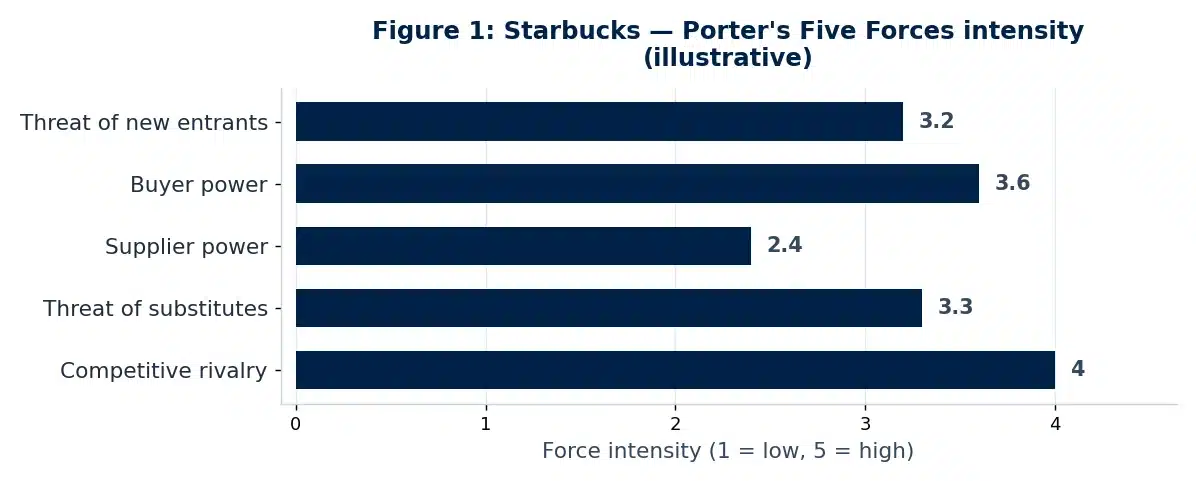
Taken together, the forces show an industry that is only moderately attractive. Starbucks’ differentiation partly offsets these pressures, but buyer power and rivalry remain persistent threats (Johnson et al., 2020).
Case Study Writing Service
Need a strategic management case study written to this standard?
Our subject specialists write fully referenced, plagiarism-free case studies to your exact brief and deadline, with a free plagiarism report.
The analysis indicates that Starbucks’ strongest competitive assets are its brand and store experience. These generate genuine pricing power and allow the organisation to charge a premium that most independents cannot sustain.
The same assets create moderate barriers to entry. Newcomers can open cafés easily, but they struggle to match Starbucks’ scale, consistency, and recognition, which protects its position at the top of the market.
However, the framework highlights two dominant pressures. Buyer power is high because customers switch readily, and competitive rivalry is intense across specialty and quick-service segments (Porter, 1985).
These two forces are the binding constraints on Starbucks’ profitability. Supplier power and substitutes matter, but they are weaker and more manageable than the pressure exerted by buyers and direct rivals.
Consequently, the durability of Starbucks’ advantage depends on continually reinforcing its experience-led differentiation. Where that experience weakens, buyer power and rivalry quickly convert into pricing pressure and lost custom.
The organisation’s resources, particularly brand equity and digital loyalty infrastructure, are valuable and hard to imitate, supporting a resource-based view of its advantage (Barney, 1991).
Porter’s Five Forces shows that Starbucks operates in a competitive, only moderately attractive industry. Its brand and store experience confer real pricing power and moderate entry barriers.
Yet buyer power and rivalry remain the strongest pressures, so sustained success depends on defending experience-led differentiation while expanding thoughtfully into new and varied international markets (Johnson et al., 2020).
Barney, J. (1991) ‘Firm resources and sustained competitive advantage’, Journal of Management, 17(1), pp. 99-120.
Grant, R.M. (2019) Contemporary Strategy Analysis: Text and Cases. 10th edn. Hoboken, NJ: Wiley.
Johnson, G., Whittington, R., Regnér, P., Angwin, D. and Scholes, K. (2020) Exploring Strategy: Text and Cases. 12th edn. Harlow: Pearson.
Porter, M.E. (1985) Competitive Advantage: Creating and Sustaining Superior Performance. New York: Free Press.

All work is written by human writers. 100% AI free, guaranteed.

100% money back guarantee if you find plagiarism in our work.
COMPANY DETAILS