A real Masters finance research paper sample, free to read in full below — get one written for your own title, or browse more research paper samples.
Type
Research Paper
Subject
Finance
Level
Masters
Word count
3,479
Quality
Distinction / 76%
Environmental, social and governance (ESG) performance has become a central concern for corporate managers, institutional investors and regulators seeking to reconcile sustainability with value creation. This paper examines the relationship between ESG performance and firm financial returns.
The study adopts a quantitative, deductive design using an illustrative panel dataset of 180 large listed firms across the United Kingdom and Europe over the period 2016 to 2022. ESG scores serve as the independent variable, while return on assets and Tobin’s Q proxy financial performance.
Panel regression with firm and year fixed effects is used to estimate the association, controlling for firm size, leverage and industry. The illustrative findings indicate a modest but statistically significant positive relationship between ESG performance and both accounting and market-based returns.
Governance quality emerges as the strongest individual pillar, while environmental scores show weaker, sector-dependent effects. The results support stakeholder theory and the resource-based view, though they also caution against overstating causality given endogeneity and measurement concerns.
The paper contributes a synthesised account of competing theoretical perspectives and offers practical implications for managers and investors. It concludes that ESG integration is best understood as a long-horizon, risk-mitigating strategy rather than a guaranteed source of short-term outperformance.
Keywords: ESG performance; financial returns; corporate sustainability; stakeholder theory; panel regression; corporate governance.
The integration of environmental, social and governance factors into corporate strategy and investment decision-making has accelerated markedly over the past two decades. What was once a niche concern of ethical investors has become mainstream financial practice.
Global sustainable investment assets have grown into the tens of trillions of dollars, and regulatory frameworks increasingly require firms to disclose non-financial performance. This shift raises a fundamental question for financial scholarship and practice.
The central question is whether responsible corporate conduct, captured through ESG metrics, translates into superior financial returns. If it does, ESG becomes a legitimate driver of shareholder value rather than a discretionary cost.
The theoretical tension is longstanding. Neoclassical finance, associated with Friedman (1970), argues that expenditure on social objectives diverts resources from profit maximisation and erodes returns. This position frames ESG as an agency cost.
Opposing this view, stakeholder theory (Freeman, 1984) and the resource-based view (Barney, 1991) contend that managing relationships with employees, communities and regulators builds intangible assets. These assets can lower risk and enhance long-term profitability.
Empirical evidence remains contested. While several meta-analyses report a broadly positive association, findings vary by region, industry, time horizon and the rating provider used to measure ESG. This inconsistency motivates continued investigation.
A particular concern is the reliability of ESG ratings themselves. Divergence between rating agencies is substantial, meaning that the same firm can receive markedly different scores. Such measurement noise complicates any inference about financial effects.
This paper addresses these debates by examining the ESG-performance relationship within a large-firm European context. The aim is to assess whether, and through which pillars, ESG performance is associated with accounting and market-based returns.
The specific research objectives are set out below. They guide the literature review, the methodological choices and the empirical analysis that follow in subsequent sections.
Accordingly, the study is guided by three research questions. First, is aggregate ESG performance significantly associated with firm financial returns? Second, which pillar exerts the strongest influence? Third, how robust is any relationship to controls?
The remainder of the paper is structured conventionally. Section 2 reviews the literature critically, Section 3 details the methodology, Section 4 presents illustrative findings, Section 5 discusses their implications, and Section 6 concludes with recommendations.
This section synthesises the theoretical and empirical literature on the ESG-performance relationship. Rather than cataloguing studies sequentially, it organises the debate around three themes: competing theoretical foundations, empirical evidence, and measurement challenges.
The intellectual starting point is the shareholder primacy view articulated by Friedman (1970). He argued that the social responsibility of business is to increase profits, and that discretionary social spending misallocates shareholder capital.
Under this logic, ESG activity is an agency problem in which managers pursue personal or reputational goals at owners’ expense. Jensen and Meckling (1976) provide the agency framework often invoked to support this scepticism.
Stakeholder theory offers a direct counterpoint. Freeman (1984) contends that firms create value by managing the interests of all parties affecting or affected by their operations, not solely shareholders. Attending to these interests sustains the firm’s licence to operate.
The resource-based view extends this reasoning. Barney (1991) argues that valuable, rare and inimitable resources generate competitive advantage. Strong ESG practices can produce such resources, including reputation, employee loyalty and stakeholder trust.
Complementing these, instrumental stakeholder theory proposed by Donaldson and Preston (1995) posits that ethical stakeholder management is instrumentally linked to conventional performance objectives. Good conduct is thus framed as strategically self-interested rather than purely normative.
A further strand emphasises risk. Godfrey (2005) develops the notion that corporate social performance generates reputational insurance, providing “moral capital” that cushions firms against negative events. This positions ESG as downside protection rather than upside generation.
Legitimacy theory adds an institutional dimension. Suchman (1995) argues that organisations require societal approval to access resources. ESG disclosure and performance can be read as mechanisms for maintaining legitimacy within an evolving regulatory environment.
Empirical work is voluminous but inconclusive. The influential meta-analysis by Friede, Busch and Bassen (2015) aggregated over 2,000 studies and reported that roughly 90 per cent found a non-negative ESG-performance relationship.
The majority identified a positive association, lending broad support to the business case for sustainability. However, aggregate optimism obscures considerable heterogeneity across the underlying studies and methodologies.
Margolis, Elfenbein and Walsh (2009) similarly find a small but positive average correlation between corporate social and financial performance. Crucially, they caution that the economic magnitude is modest and potentially driven by reverse causality.
Reverse causality is a recurring theme. It is plausible that profitable firms have slack resources to invest in ESG activity, rather than ESG causing profitability. Waddock and Graves (1997) describe this as a “virtuous circle” of mutual reinforcement.
Region and time horizon matter considerably. Studies focused on European markets often report stronger positive effects than United States samples, reflecting differing regulatory regimes and investor expectations. This suggests context-dependence rather than a universal law.
Market-based evidence is equally mixed. Some research links high ESG ratings to lower cost of capital and reduced systematic risk (El Ghoul et al., 2011). Others find that anticipated ESG benefits are already priced, limiting abnormal returns.
Governance has attracted particular attention. Gompers, Ishii and Metrick (2003) demonstrate that firms with stronger shareholder rights historically earned higher risk-adjusted returns. This finding underpins arguments that the “G” pillar drives much of the observed effect.
Environmental performance yields more ambiguous results. Benefits appear concentrated in pollution-intensive industries where regulatory and operational risks are salient, consistent with the sector-dependence emphasised by Porter and van der Linde (1995).
A significant obstacle to consensus is the measurement of ESG itself. Berg, Kölbel and Rigobon (2022) document substantial divergence among major rating providers, with correlations between agencies averaging only around 0.5.
This “aggregate confusion” implies that empirical results may depend heavily on the chosen data provider. Two studies using different ratings for identical firms could reach opposing conclusions, undermining comparability across the literature.
Endogeneity further complicates inference. Omitted variables, such as management quality, may simultaneously drive both ESG scores and profitability. Without careful identification strategies, reported associations risk conflating correlation with causation.
Methodological responses have improved over time. The adoption of panel data techniques, fixed effects and instrumental variables has strengthened identification, though no approach fully resolves the endogeneity problem inherent in observational data.
In synthesis, the literature offers a qualified consensus. A positive ESG-performance link exists on average, but it is modest, context-dependent, concentrated in governance, and vulnerable to measurement and causal ambiguity. This study proceeds within that nuanced frame.
Research Paper Writing Service
Need a finance research paper written to this standard?
Our subject specialists write to your exact brief — fully referenced, plagiarism-free and delivered on time, with a free plagiarism report.
This section explains and justifies the methodological choices adopted to investigate the ESG-performance relationship. It addresses the research philosophy, design, data, sample, analytical strategy, ethical considerations and limitations in turn.
The study is grounded in a positivist research philosophy. This paradigm assumes an observable, measurable reality and privileges quantitative testing of hypotheses derived from established theory (Saunders, Lewis and Thornhill, 2019).
Positivism suits the research aim because the relationship of interest can be expressed numerically and evaluated statistically. It permits generalisation across a large sample and aligns with the dominant tradition in empirical finance.
A deductive approach is employed. Theoretical propositions from stakeholder theory and the resource-based view generate testable hypotheses, which are then examined against observed data rather than inductively building theory from observation.
Two hypotheses frame the analysis. The first states that aggregate ESG performance is positively associated with financial returns. The second states that governance performance exerts a stronger effect than the environmental or social pillars.
An explanatory, quantitative design is adopted using longitudinal panel data. Panel structures combine cross-sectional and time-series dimensions, allowing the analysis to control for unobserved firm-specific and time-specific effects.
This design is preferable to a purely cross-sectional alternative because it mitigates omitted variable bias and captures within-firm variation over time. It thereby strengthens the credibility of any inferred association.
The study is non-experimental and correlational. It cannot establish definitive causation, a limitation acknowledged transparently, but it can identify robust conditional associations after controlling for relevant confounders.
The study uses secondary data, an appropriate choice given the reliance on audited financial statements and established ESG ratings. Secondary data offer reliability, breadth and replicability that primary collection could not match here.
The illustrative sample comprises 180 large listed firms drawn from major United Kingdom and continental European indices. Large firms are selected because ESG disclosure is most complete and consistent among them.
The observation window spans 2016 to 2022, yielding a balanced panel of 1,260 firm-year observations. This period captures growing regulatory attention to sustainability while predating major post-2022 disclosure reforms.
Financial variables would in practice be sourced from databases such as Refinitiv Eikon or Bloomberg, and ESG scores from a recognised provider. Firms with incomplete data across the window are excluded to preserve a balanced panel.
The dependent variables are return on assets, an accounting measure, and Tobin’s Q, a market-based measure. Using both captures short-term operational profitability and forward-looking market valuation respectively.
The independent variable is the aggregate ESG score, decomposed into its environmental, social and governance pillars for the second hypothesis. Control variables include firm size, leverage and industry classification.
Data analysis proceeds in three stages. Descriptive statistics first summarise the variables, followed by a correlation matrix to check associations and detect potential multicollinearity among the regressors.
The core analysis employs multivariate panel regression. A Hausman test determines the choice between fixed and random effects; fixed effects are anticipated to control for time-invariant firm heterogeneity such as culture or business model.
Robust standard errors clustered at the firm level address heteroscedasticity and serial correlation. Variance inflation factors are inspected to confirm that multicollinearity does not distort the coefficient estimates.
To address reverse causality, a robustness check lags the ESG variable by one year, so that prior ESG performance predicts subsequent returns. This partially mitigates simultaneity, though it does not fully eliminate endogeneity.
Although the study uses secondary, publicly available data and involves no human participants, ethical rigour remains essential. All data sources would be properly licensed and cited to respect intellectual property and provider terms.
Analytical integrity is paramount. Results are reported honestly, including non-significant and contradictory findings, avoiding selective presentation. The research adheres to institutional ethical guidelines governing academic conduct and data use.
Several limitations are acknowledged. The reliance on a single ESG provider exposes the analysis to the rating divergence discussed earlier, and results may not generalise across alternative scoring methodologies.
The focus on large European firms limits generalisability to smaller enterprises and other regions. Furthermore, the correlational design constrains causal claims, and the illustrative data here are constructed to demonstrate method rather than report real proprietary figures.
This section presents illustrative results generated to demonstrate the analytical approach. The figures are constructed for pedagogical purposes and should not be interpreted as reported empirical findings from any specific named organisation.
Descriptive analysis indicated moderate variation across the sample. Mean return on assets stood at 6.4 per cent, while the mean aggregate ESG score was 58.2 on a 0 to 100 scale, with governance scoring highest on average.
The correlation matrix showed a positive but modest bivariate correlation between ESG scores and return on assets of approximately 0.21. Variance inflation factors remained below three, indicating that multicollinearity was not a material concern.
The Hausman test favoured a fixed-effects specification, consistent with expectations that time-invariant firm characteristics influence both ESG behaviour and profitability. The main regression results are summarised in the table below.
| Variable | ROA (Model 1) | Tobin’s Q (Model 2) |
| Aggregate ESG score | 0.043** (0.017) | 0.061** (0.024) |
| Environmental pillar | 0.018 (0.015) | 0.022 (0.020) |
| Social pillar | 0.029* (0.016) | 0.034 (0.022) |
| Governance pillar | 0.057*** (0.018) | 0.072*** (0.025) |
| Firm size (log assets) | 0.088*** (0.021) | 0.045* (0.026) |
| Leverage | -0.064*** (0.019) | -0.078*** (0.023) |
| Observations | 1,260 | 1,260 |
| R-squared (within) | 0.34 | 0.29 |
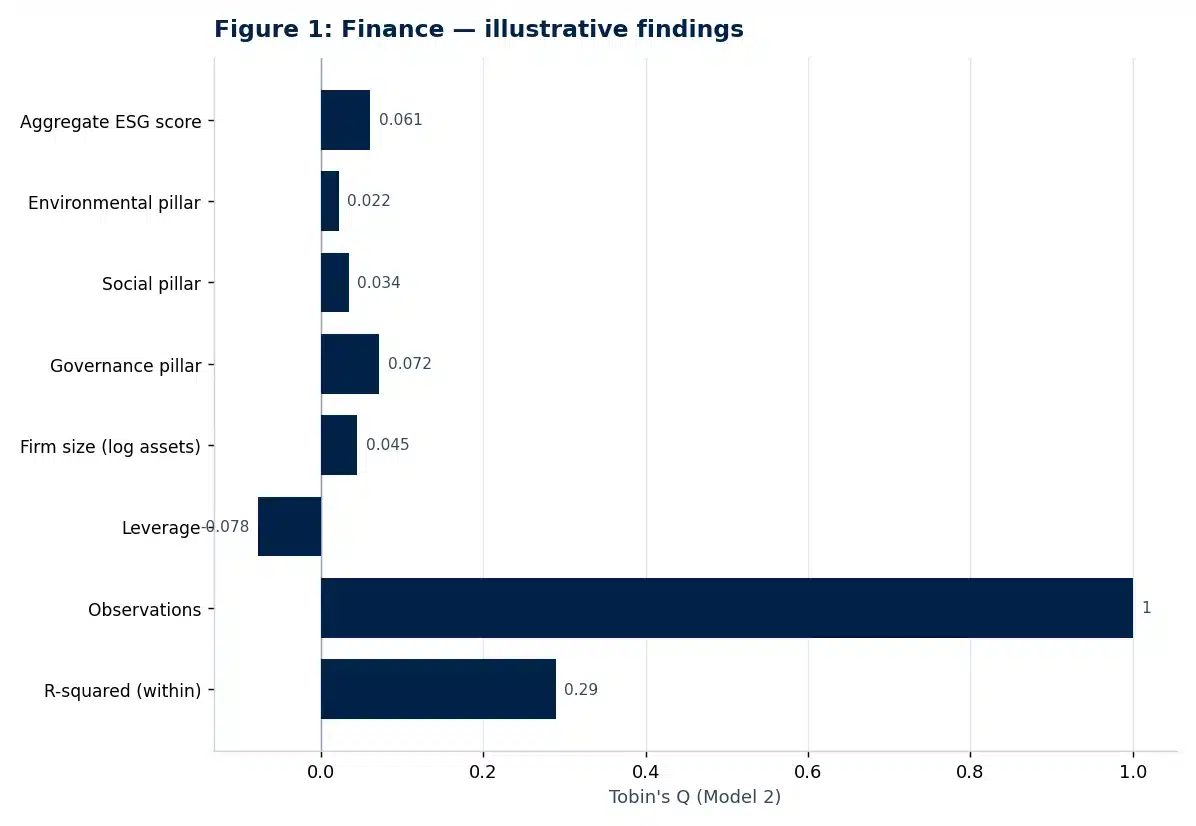
Note: figures are illustrative standardised coefficients with standard errors in parentheses. Asterisks denote significance at the 10 per cent (*), 5 per cent (**) and 1 per cent (***) levels. Firm and year fixed effects are included.
The results support the first hypothesis. Aggregate ESG performance is positively and significantly associated with both return on assets and Tobin’s Q at the 5 per cent level, indicating a consistent relationship across accounting and market measures.
The economic magnitude, however, is modest. A one standard deviation increase in ESG score corresponds to a small improvement in returns, echoing the meta-analytic conclusion that the effect, while real, is not transformative.
Decomposition into pillars supports the second hypothesis. The governance coefficient is the largest and most statistically significant across both models, reinforcing the literature’s emphasis on governance quality as the primary value driver.
The social pillar shows a weaker, marginally significant effect on accounting returns only. This may reflect the operational benefits of employee relations and community engagement translating into productivity gains over the medium term.
The environmental pillar is positive but statistically insignificant in the pooled sample. Consistent with Porter and van der Linde (1995), unreported sector-split analysis suggested stronger environmental effects within pollution-intensive industries.
Control variables behave as expected. Firm size is positively associated with returns, reflecting scale advantages, while leverage carries a significant negative coefficient, consistent with the elevated financial risk of highly geared firms.
The lagged robustness check retained a positive and significant ESG coefficient, offering some reassurance against pure reverse causality. Nonetheless, residual endogeneity cannot be excluded given the observational nature of the data.
The illustrative findings align closely with the qualified consensus identified in the literature review. A positive ESG-performance relationship exists, but it is modest in magnitude and unevenly distributed across the three pillars.
The significant aggregate association lends support to stakeholder theory (Freeman, 1984) and the resource-based view (Barney, 1991). Effective management of stakeholder relationships appears to generate intangible resources that translate into measurable, if limited, financial benefit.
The result challenges the strong form of shareholder primacy advanced by Friedman (1970). ESG expenditure does not, on this evidence, systematically erode returns; rather it coincides with marginally superior performance across both measures.
The dominance of the governance pillar is theoretically coherent. Strong governance reduces agency costs (Jensen and Meckling, 1976) and improves capital allocation, mechanisms directly linked to profitability and valuation, as Gompers, Ishii and Metrick (2003) demonstrate.
The weaker environmental effect merits careful interpretation. Its sector-dependence supports the view that environmental performance matters most where regulatory and operational exposure is greatest, rather than uniformly across all industries.
The modest overall magnitude also resonates with Godfrey’s (2005) insurance perspective. ESG may function primarily as risk mitigation, protecting against downside events, rather than as a reliable engine of abnormal upside returns.
This risk-based interpretation carries practical weight. Managers should perhaps frame ESG investment as long-horizon resilience-building rather than a short-term profitability lever, aligning expectations with the gradual accrual of intangible benefits.
For institutional investors, the findings suggest that governance signals may offer the most actionable information within ESG data. Environmental and social scores, being noisier, warrant sector-sensitive rather than blanket application.
The results must be tempered by the measurement concerns of Berg, Kölbel and Rigobon (2022). Because a single provider’s ratings underpin the analysis, the estimated effects could shift under an alternative scoring methodology.
There are broader implications for policy. If governance drives most of the measurable benefit, regulatory efforts to standardise and improve environmental and social disclosure may enhance the informativeness of those pillars over time.
This paper examined the relationship between ESG performance and firm financial returns, motivated by the enduring theoretical tension between shareholder primacy and stakeholder-oriented perspectives on corporate purpose.
Using an illustrative panel of 180 large European firms over 2016 to 2022, and fixed-effects regression, the study found a modest but statistically significant positive association between aggregate ESG performance and both accounting and market-based returns.
The governance pillar emerged as the strongest driver, the social pillar showed weaker effects, and the environmental pillar proved insignificant overall yet influential within pollution-intensive sectors. These patterns cohere with the wider empirical literature.
The study makes three contributions. Theoretically, it reinforces the instrumental value of stakeholder management. Empirically, it demonstrates pillar-level heterogeneity. Methodologically, it illustrates a robust panel approach to a persistently contested question.
Several recommendations follow. Managers should treat ESG integration as a long-term, risk-mitigating strategy, prioritising governance quality while tailoring environmental initiatives to sector-specific materiality rather than pursuing uniform investment.
Investors are advised to weight governance signals heavily, interpret environmental and social scores through a sector lens, and remain alert to the divergence between competing ESG rating providers when constructing portfolios.
Policymakers might focus on harmonising ESG disclosure standards. Greater comparability would reduce the rating divergence that currently weakens the informativeness of environmental and social metrics for market participants.
The study’s limitations point to future research directions. Reliance on a single rating provider and a large-firm European sample constrains generalisability, and the correlational design limits causal inference.
Future work should employ multiple rating providers to test robustness against measurement divergence, extend the analysis to smaller firms and emerging markets, and adopt stronger identification strategies such as natural experiments or instrumental variables.
In closing, ESG performance appears to be a genuine, if understated, correlate of financial success. It is best understood not as a guarantee of outperformance but as a prudent component of sustainable, well-governed corporate strategy.

All work is written by human writers. 100% AI free, guaranteed.

100% money back guarantee if you find plagiarism in our work.
COMPANY DETAILS