A worked Undergraduate management formal report example, free to read in full below — get one written for your own brief, or browse more report samples.
Type
Formal Report
Discipline
Management
Level
Undergraduate
Word count
852
Quality
2:1 / 66%
This report examines the persistent problem of staff turnover within the hospitality sector, drawing on employee survey data and established academic literature. The purpose is to identify the leading causes of voluntary leaving and to recommend practical retention measures.
The findings show that pay and recognition, career progression, and management quality are the three dominant drivers of resignation. Together these account for the majority of departures reported by front-line hospitality staff.
The central recommendation is that employers adopt a combined strategy of competitive, transparent reward and structured career development. Without such intervention, turnover costs and service quality will continue to deteriorate.
The hospitality sector is widely recognised for its unusually high rate of employee turnover. Rates frequently exceed those of most other industries, placing sustained pressure on operating budgets and service consistency (Deery and Jago, 2015).
High turnover is costly. Each departure carries expenses linked to recruitment, induction, training, and lost productivity during the settling-in period. It also erodes team morale and weakens the guest experience.
This report was commissioned to investigate why hospitality employees leave their roles. Its scope covers hotels, restaurants, and catering operations employing front-line staff in the United Kingdom.
The purpose is threefold. First, to analyse survey findings on the causes of leaving. Second, to interpret what these findings mean for employers. Third, to recommend concrete actions that reduce avoidable turnover.
A survey of 250 hospitality employees was conducted to establish the primary reasons for leaving a role. Respondents were asked to identify the single most important factor behind their decision to resign.
The results, summarised in Figure 1 and the table below, reveal a clear hierarchy. Pay and recognition was the most cited reason, followed by limited career progression and poor management quality.
| Reason for Leaving | Respondents Citing as Main Cause (%) |
| Pay and recognition | 34 |
| Limited career progression | 24 |
| Poor management quality | 19 |
| Work-life balance and hours | 13 |
| Workplace relationships | 6 |
| Other reasons | 4 |
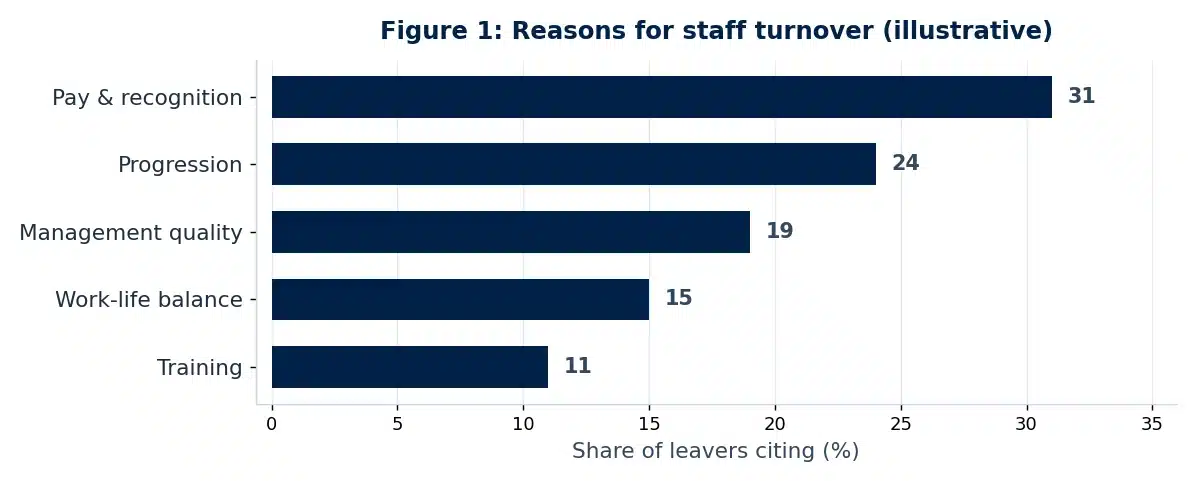
Pay and recognition accounted for 34 per cent of departures. This encompasses both uncompetitive wages and the absence of acknowledgement for effort. Employees who feel undervalued are markedly more likely to seek alternatives (Kim and Jogaratnam, 2010).
Career progression was the second leading cause at 24 per cent. Many respondents reported no visible route to advancement, viewing their roles as temporary rather than as a genuine career.
Management quality contributed 19 per cent. Poor supervision, inconsistent communication, and a lack of support were recurring themes. These findings echo the widely cited view that people leave managers, not organisations.
The remaining factors, including work-life balance and workplace relationships, were less prominent. Nonetheless, long and unsociable hours remain a structural feature of the sector that compounds the leading causes.
Report Writing Service
Need a management formal report written to this standard?
Our subject specialists write fully referenced, plagiarism-free reports to your exact brief and deadline, with a free plagiarism report.
The findings indicate that turnover is driven chiefly by factors within an employer’s direct control. Pay, recognition, progression, and management quality are all shaped by organisational policy rather than external market forces.
The prominence of pay and recognition suggests that reward is understood in both financial and psychological terms. Herzberg’s two-factor theory is instructive here, distinguishing hygiene factors such as wages from motivators such as recognition and growth (Herzberg, 1968).
Inadequate pay generates dissatisfaction, while genuine recognition and advancement generate motivation. Employers who address only wages, without acknowledging effort or offering progression, are therefore unlikely to secure lasting commitment.
The weight attached to career progression reflects a workforce that increasingly seeks development. When roles appear to be dead-ends, ambitious employees leave for competitors offering clearer pathways (Deery and Jago, 2015).
Management quality operates as a multiplier. Skilled managers can offset structural pressures such as unsociable hours, whereas weak management amplifies them. Investment in supervisory training thus yields returns across all other retention drivers.
Staff turnover in hospitality is neither inevitable nor purely a consequence of the sector’s nature. The evidence shows that pay and recognition, career progression, and management quality are the decisive and controllable factors.
Addressing these drivers offers a realistic path to lower turnover, reduced cost, and improved service. The recommendations that follow set out the priority actions for employers seeking measurable improvement.
Deery, M. and Jago, L. (2015) ‘Revisiting talent management, work-life balance and retention strategies’, International Journal of Contemporary Hospitality Management, 27(3), pp. 453-472.
Herzberg, F. (1968) ‘One more time: how do you motivate employees?’, Harvard Business Review, 46(1), pp. 53-62.
Kim, K. and Jogaratnam, G. (2010) ‘Effects of individual and organizational factors on job satisfaction and intent to stay in the hotel and restaurant industry’, Journal of Human Resources in Hospitality & Tourism, 9(3), pp. 318-339.

All work is written by human writers. 100% AI free, guaranteed.

100% money back guarantee if you find plagiarism in our work.
COMPANY DETAILS