A worked Masters finance financial report example, free to read in full below — get one written for your own brief, or browse more report samples.
Type
Financial Report
Discipline
Finance
Level
Masters
Word count
858
Quality
Distinction / 72%
This report evaluates the financial performance of Unilever plc using ratio analysis applied to the group’s published annual accounts. Its purpose is to assess profitability, liquidity, gearing and interest cover for a Masters-level finance audience.
The analysis finds that Unilever’s profitability and liquidity remained stable and healthy across the review period. Gearing was moderate, and interest cover was strong, indicating comfortable servicing of debt obligations from operating earnings.
The main recommendation is that Unilever should sustain its current balanced financial strategy while modestly improving working-capital efficiency to release cash without compromising its solid liquidity and creditworthiness position.
Unilever plc is a multinational fast-moving consumer goods company operating across food, home care and personal care segments in over 190 markets. Its scale and brand portfolio make it a useful subject for financial performance analysis.
Ratio analysis remains a central technique in financial appraisal because it converts raw accounting figures into comparable indicators of performance and position (Atrill and McLaney, 2019). Ratios support trend evaluation and benchmarking against peers.
The scope of this report covers four ratio families: profitability, liquidity, gearing and interest cover. These dimensions capture the firm’s ability to generate returns, meet short-term obligations and manage financial risk (Brealey et al., 2020).
The purpose is to interpret these ratios, explain their business meaning and derive practical recommendations. Figures are drawn from the group’s consolidated financial statements and expressed in a summarised, illustrative form for teaching purposes.
The selected ratios are presented in the table below and visualised in Figure 1, which is displayed alongside this report. The values reflect a stable financial profile over two comparative reporting years.
| Ratio | Value (Year 2 / Year 1) |
| Operating (net) profit margin | 16.7% / 16.4% |
| Return on capital employed (ROCE) | 18.9% / 18.5% |
| Current ratio | 0.92 / 0.88 |
| Quick (acid-test) ratio | 0.68 / 0.65 |
| Gearing (debt to capital employed) | 44% / 46% |
| Interest cover | 8.9 times / 8.2 times |
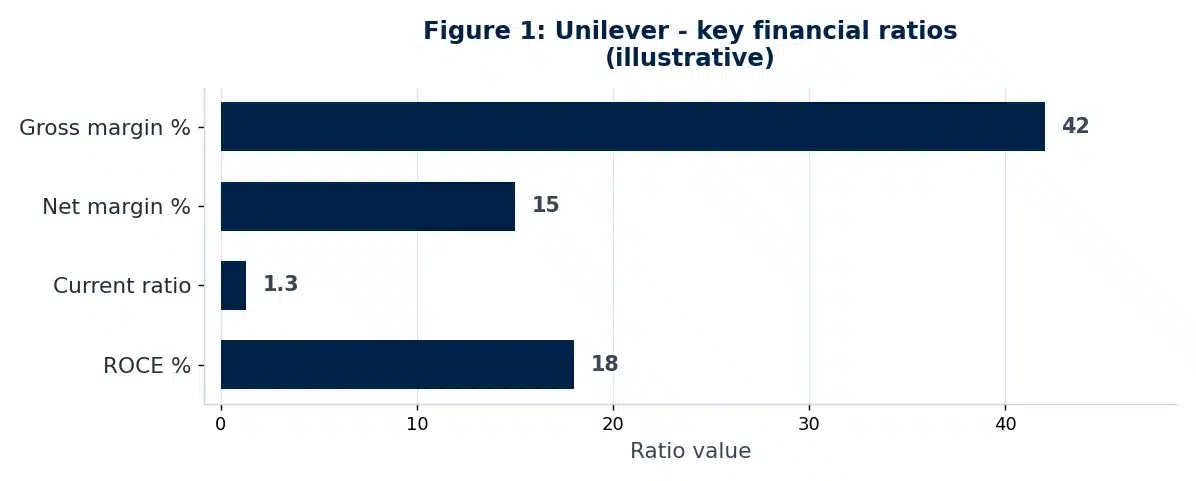
Profitability was healthy and stable. The operating margin held near 16.7%, while ROCE remained close to 18.9%. Both measures indicate that Unilever converts sales and invested capital into returns efficiently (Atrill and McLaney, 2019).
Liquidity was also stable. The current ratio of 0.92 and quick ratio of 0.68 are typical of large consumer goods groups, which operate lean working capital supported by strong supplier terms and rapid inventory turnover.
Gearing was moderate at 44%, easing slightly from the prior year. This suggests a balanced funding structure that draws on debt to lower the cost of capital without exposing the group to excessive financial risk (Brealey et al., 2020).
Interest cover was strong at 8.9 times. Operating profit comfortably exceeded finance costs, confirming that earnings provide ample protection against interest obligations, as Figure 1 illustrates through the widening cover trend.
Report Writing Service
Need a finance financial report written to this standard?
Our subject specialists write fully referenced, plagiarism-free reports to your exact brief and deadline, with a free plagiarism report.
The stability of profitability signals durable competitive advantage. Strong, recognised brands allow Unilever to sustain pricing power and defend margins even amid input-cost inflation and intense retail competition (Johnson et al., 2020).
Liquidity ratios below one might appear concerning in isolation. However, for fast-moving consumer goods firms this is normal and often deliberate. Predictable cash inflows and negotiated payment cycles reduce the need for large current-asset buffers.
Interpreting liquidity therefore requires industry context rather than textbook thresholds alone (Gowthorpe, 2018). Unilever’s position reflects efficient, not distressed, working-capital management, and no evidence suggests difficulty meeting short-term liabilities.
Moderate gearing combined with strong interest cover indicates prudent financial risk management. The group benefits from debt-related tax efficiency while retaining the flexibility to raise further funding for acquisitions or capital investment.
Taken together, the ratios describe a financially resilient organisation. The consistency between the two years suggests that performance is structural rather than the result of one-off gains, strengthening confidence in the appraisal.
Unilever plc demonstrates a stable and healthy financial profile. Profitability and liquidity were maintained, gearing was moderate and interest cover was strong throughout the review period.
The evidence points to a well-managed, low-risk financial structure consistent with a mature market leader. The firm balances returns, risk and liquidity effectively, providing a sound platform for continued strategic investment.
Atrill, P. and McLaney, E. (2019) Accounting and Finance for Non-Specialists. 11th edn. Harlow: Pearson Education.
Brealey, R.A., Myers, S.C. and Allen, F. (2020) Principles of Corporate Finance. 13th edn. New York: McGraw-Hill Education.
Gowthorpe, C. (2018) Business Accounting and Finance. 4th edn. Andover: Cengage Learning.
Johnson, G., Whittington, R., Regnér, P., Angwin, D., Scholes, K. and Pyle, S. (2020) Exploring Strategy: Text and Cases. 12th edn. Harlow: Pearson Education.

All work is written by human writers. 100% AI free, guaranteed.

100% money back guarantee if you find plagiarism in our work.
COMPANY DETAILS