A worked Masters operations management case study example on Zara, free to read in full below — get one written for your own brief, or browse more case study samples.
Type
Case Study
Discipline
Operations Management
Level
Masters
Word count
968
Quality
Distinction / 73%
Zara, the flagship retail brand of the Spanish group Inditex, is one of the most studied organisations in operations management. This case study examines the operational logic behind its distinctive fast-fashion model.
Founded in La Coruña in 1975, Zara grew into a global apparel retailer with a presence across the Americas, Europe, Asia and the Middle East. Its reputation rests on speed rather than scale alone.
The purpose of this case study is to analyse how Zara configures its operations to convert emerging fashion trends into store-ready garments within remarkably short timeframes. The scope is deliberately strategic and qualitative.
Rather than presenting confidential figures, this illustrative sample draws on publicly known characteristics of Zara’s strategy. It uses the value chain as its principal analytical lens to explain where operational advantage is created (Porter, 1985).
The global apparel market is characterised by volatile demand, short product life cycles and intense price competition. Traditional retailers historically relied on long, forecast-driven supply chains sourced from low-cost Asian manufacturing centres.
This conventional model committed retailers to seasonal ranges many months in advance. When forecasts proved wrong, the result was heavy markdowns on unsold stock or lost sales from stock-outs of popular lines.
Zara pioneered an alternative approach often described as fast fashion. Instead of forecasting far ahead, it responds to demand as it materialises, producing smaller batches and replenishing successful designs rapidly (Christopher, 2016).
The strategic issue this case examines is how Zara sustains competitive advantage through operations. Its rivals compete largely on cost and marketing, whereas Zara competes primarily on responsiveness and freshness of assortment.
This positioning raises an important management question. How does the organisation design and coordinate its activities so that agility becomes a durable, hard-to-imitate capability rather than a temporary advantage (Barney, 1991)?
Porter’s (1985) value chain framework distinguishes primary activities, which create and deliver the product, from support activities that enable them. Applying it to Zara reveals how each activity is tuned for speed and responsiveness.
In inbound logistics and operations, Zara retains substantial vertical integration. A significant share of production, particularly trend-sensitive and higher-fashion items, occurs in proximity manufacturing near its Spanish headquarters rather than in distant low-cost regions.
This geographic proximity shortens replenishment cycles dramatically. Basic, price-stable garments are still outsourced globally, but fashionable lines are made close to home, allowing rapid adjustment to observed demand.
Outbound logistics is centralised through highly automated distribution centres in Spain. Garments are shipped to stores worldwide on a frequent, twice-weekly schedule, keeping assortments fresh and inventory lean (Slack et al., 2019).
Marketing and sales are distinctive because Zara spends comparatively little on advertising. Prime store locations and frequently changing window displays act as the primary promotional mechanism, drawing customers back repeatedly.
The service activity closes a vital feedback loop. Store managers and staff continually gather qualitative customer reactions and hard sales data, transmitting them to design and production teams almost in real time.
Among support activities, technology and information systems are central, linking stores, designers and factories. Procurement and human resource management reinforce the culture of speed, empowering local staff to influence assortment decisions.
| Value Chain Activity | How Zara Configures It for Advantage |
| Inbound logistics and operations | Proximity manufacturing in Spain and nearby regions for trend items; global sourcing reserved for basics. |
| Outbound logistics | Centralised, automated distribution with frequent twice-weekly shipments to keep stores fresh and stock lean. |
| Marketing and sales | Minimal advertising; prime locations and rotating window displays drive footfall and perceived scarcity. |
| Service and feedback | Store-level customer insight and sales data fed rapidly back to design and production teams. |
| Technology and procurement | Integrated information systems connecting stores, designers and factories to enable responsive, small-batch production. |
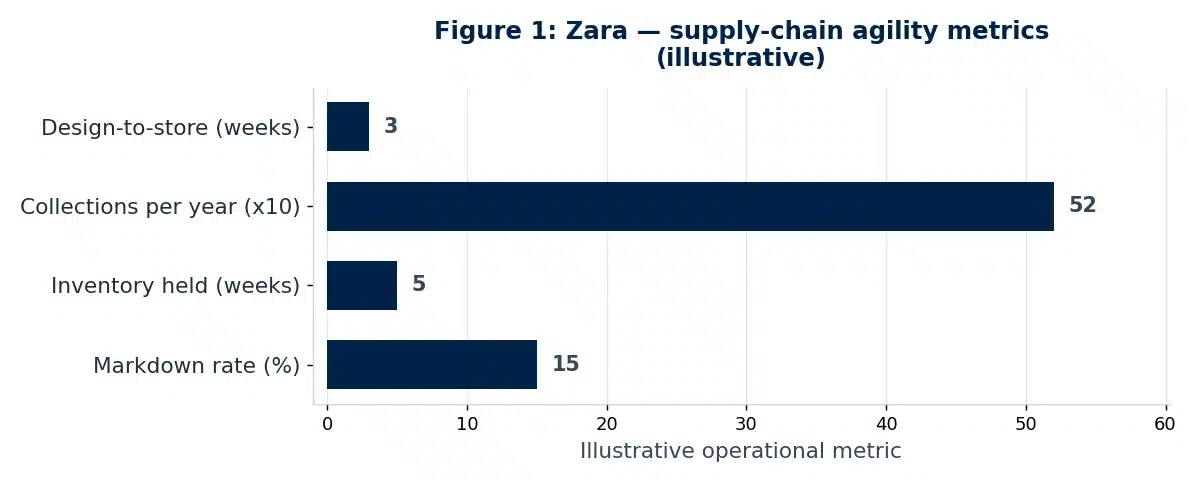
Taken together, these linkages are what generate advantage. It is not any single activity but the tight coordination between them that competitors find difficult to replicate (Johnson et al., 2020).
Case Study Writing Service
Need a operations management case study written to this standard?
Our subject specialists write fully referenced, plagiarism-free case studies to your exact brief and deadline, with a free plagiarism report.
The analysis shows that Zara’s vertically integrated and responsive supply chain is its defining operational strength. Proximity manufacturing enables very short design-to-store lead times, often measured in weeks rather than months.
Because production is triggered by observed demand rather than distant forecasts, inventory risk is markedly reduced. Small initial batches limit exposure to unsold stock, while rapid replenishment captures sales of proven designs.
Agility therefore emerges as the core competitive advantage. The organisation trades some unit-cost efficiency for the ability to react quickly, and this trade-off consistently favours responsiveness in a volatile market.
The store feedback loop is equally critical. Continuous flows of customer information allow designers to amend, drop or extend lines quickly, aligning supply with real-time preferences (Christopher, 2016).
Crucially, these findings confirm that advantage is systemic. Speed, low inventory risk and demand sensing are mutually reinforcing outcomes of an integrated value chain rather than isolated operational tactics.
This case study demonstrates that Zara’s success is rooted in operations rather than marketing or price alone. Its value chain is deliberately configured to prioritise speed, responsiveness and low inventory risk.
By integrating manufacturing, distribution and store feedback into a single responsive system, Zara has built an agile capability that rivals struggle to imitate. The model offers enduring lessons for operations strategy in volatile markets.
Barney, J. (1991) ‘Firm resources and sustained competitive advantage’, Journal of Management, 17(1), pp. 99-120.
Christopher, M. (2016) Logistics and Supply Chain Management. 5th edn. Harlow: Pearson.
Johnson, G., Whittington, R., Scholes, K., Angwin, D. and Regnér, P. (2020) Exploring Strategy: Text and Cases. 12th edn. Harlow: Pearson.
Porter, M.E. (1985) Competitive Advantage: Creating and Sustaining Superior Performance. New York: Free Press.
Slack, N., Brandon-Jones, A. and Johnston, R. (2019) Operations Management. 9th edn. Harlow: Pearson.

All work is written by human writers. 100% AI free, guaranteed.

100% money back guarantee if you find plagiarism in our work.
COMPANY DETAILS