
A worked Undergraduate marketing case study example on Nike, free to read in full below — get one written for your own brief, or browse more case study samples.
Type
Case Study
Discipline
Marketing
Level
Undergraduate
Word count
954
Quality
1st / 71%
Nike, Inc. is one of the world’s most recognisable sportswear organisations, competing globally in footwear, apparel and equipment. Founded in 1964 as Blue Ribbon Sports, it has grown into a leading athletic brand.
This case study examines Nike’s marketing strategy and brand positioning from an undergraduate marketing perspective. It uses publicly available, general knowledge of the organisation as an illustrative teaching example rather than confidential data.
The scope centres on how Nike coordinates its marketing activities to sustain a premium, aspirational identity. The extended marketing mix, or 7Ps (Booms and Bitner, 1981), provides the primary analytical lens throughout the discussion.
The global sportswear market is intensely competitive, with rivals such as Adidas, Puma and newer entrants like On and Lululemon challenging established players. Consumer demand blends athletic performance with lifestyle and fashion considerations.
Nike operates in a mature yet growing category where differentiation is difficult to sustain through product features alone. Competitors can quickly imitate technical innovations, eroding any temporary advantage gained from a single product launch.
This creates the central strategic issue the case examines. Nike must continually justify premium pricing and maintain emotional relevance while facing imitation, shifting consumer values, and the rising importance of direct-to-consumer digital channels.
Resource-based theory suggests that sustainable advantage comes from valuable, rare and hard-to-imitate assets (Barney, 1991). For Nike, the brand itself, rather than any individual product, represents this durable strategic resource.
The case therefore explores how Nike’s marketing mix reinforces brand equity. It considers which elements generate genuine differentiation and which are comparatively vulnerable to competitive parity within the wider industry structure (Porter, 1985).
The 7Ps framework extends the traditional four-element mix to include people, process and physical evidence, reflecting the service and experiential dimensions of modern brands (Booms and Bitner, 1981).
Product: Nike offers a broad portfolio spanning performance footwear, apparel and equipment. Continuous innovation, iconic silhouettes and design collaborations keep the range aspirational and technically credible across multiple sporting categories.
Price: Nike adopts a premium pricing approach, using perceived value and brand prestige to justify higher price points. Selective discounting protects the aspirational image while tiered ranges widen accessibility for different segments.
Place: Distribution combines wholesale partners, branded flagship stores and a growing direct-to-consumer digital ecosystem. This channel mix improves reach, yet much of it can be replicated by well-resourced competitors.
Promotion: Promotion is Nike’s signature strength. Emotive storytelling, the enduring “Just Do It” campaign and high-profile athlete endorsements build powerful associations between the brand and human achievement.
People: Sponsored athletes, designers and retail staff embody the brand’s values. Endorsements by elite performers lend authenticity and aspiration, transferring credibility from sporting excellence to the everyday consumer.
Process: Membership programmes, apps and streamlined online journeys personalise the customer experience. These processes gather data, encourage repeat engagement and deepen the relationship beyond a single transaction.
Physical evidence: Store design, packaging, the swoosh logo and app interfaces provide tangible cues. While polished, these elements are broadly comparable to those offered by other premium sportswear organisations.
| Marketing mix element | Nike’s application and differentiation |
| Product | Innovative, iconic and continually refreshed portfolio; a strong but imitable source of advantage. |
| Price | Premium positioning justified by brand prestige and perceived value; selective discounting. |
| Place | Multi-channel wholesale, retail and direct-to-consumer digital; comparatively easy to replicate. |
| Promotion | Emotive storytelling and athlete endorsement; the strongest and most distinctive lever. |
| People | Elite athletes and staff who embody and authenticate the brand’s aspirational values. |
| Process | Personalised apps, membership and data-driven journeys that build loyalty and engagement. |
| Physical evidence | Logo, stores, packaging and interfaces; polished yet broadly comparable to rivals. |
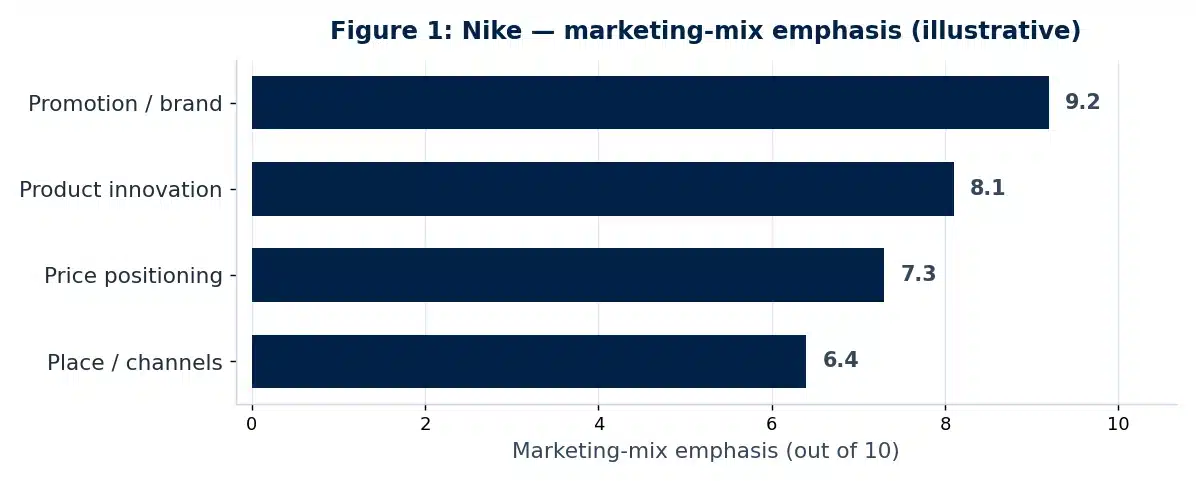
Analysed together, the seven elements are not equally differentiating. Promotion and product carry the heaviest strategic weight, while place and physical evidence largely establish competitive parity rather than genuine advantage (Johnson et al., 2020).
Case Study Writing Service
Need a marketing case study written to this standard?
Our subject specialists write fully referenced, plagiarism-free case studies to your exact brief and deadline, with a free plagiarism report.
The analysis indicates that promotion and brand storytelling are Nike’s strongest strategic levers. Emotional narratives and athlete endorsement create meaning that transcends product specification, forging loyalty that competitors struggle to replicate quickly.
Product innovation and premium positioning reinforce this strength. Credible technical design and consistent pricing discipline support the aspirational identity, allowing the brand to command value and sustain healthy perceived quality.
People and process add meaningful, though secondary, support. Sponsored athletes authenticate brand values, while membership programmes and digital journeys deepen engagement and encourage the repeat behaviour that underpins long-term customer relationships.
By contrast, place and physical evidence are comparatively less differentiated. Distribution channels, store aesthetics and packaging are competent and professional, yet well-resourced rivals can match them, offering limited durable competitive distinction.
Overall, Nike’s advantage rests on intangible brand equity rather than any single tangible element. This aligns with the resource-based view that hard-to-imitate assets drive sustainable performance (Barney, 1991).
This case study demonstrates that Nike’s competitive strength lies principally in promotion and brand storytelling, supported by product innovation and premium positioning. Place and physical evidence, by comparison, deliver parity rather than distinction.
Applying the 7Ps framework highlights that durable advantage stems from intangible brand equity rather than easily imitated tangible elements. Sustaining this position requires ongoing investment in storytelling, personalisation and experiential differentiation across the wider marketing mix.
Barney, J. (1991) ‘Firm resources and sustained competitive advantage’, Journal of Management, 17(1), pp. 99-120.
Booms, B.H. and Bitner, M.J. (1981) ‘Marketing strategies and organization structures for service firms’, in Donnelly, J.H. and George, W.R. (eds.) Marketing of Services. Chicago: American Marketing Association, pp. 47-51.
Johnson, G., Whittington, R., Scholes, K., Angwin, D. and Regnér, P. (2020) Exploring Strategy: Text and Cases. 12th edn. Harlow: Pearson.
Porter, M.E. (1985) Competitive Advantage: Creating and Sustaining Superior Performance. New York: Free Press.

All work is written by human writers. 100% AI free, guaranteed.

100% money back guarantee if you find plagiarism in our work.
COMPANY DETAILS






