A worked Masters business case study example on Amazon, free to read in full below — get one written for your own brief, or browse more case study samples.
Type
Case Study
Discipline
Business
Level
Masters
Word count
824
Quality
Distinction / 74%
Amazon.com, Inc. is a multinational technology and retail organisation founded in 1994, originally as an online bookseller. It has since grown into one of the world’s largest e-commerce and cloud-computing enterprises.
This case study examines how Amazon’s customer-centric philosophy and operational excellence underpin its competitive position. The analysis draws on publicly available, general knowledge of the organisation’s strategy rather than proprietary data.
The purpose is illustrative and educational. Its scope covers Amazon’s core retail and logistics operations, using Porter’s Five Forces (Porter, 1985) as the primary analytical lens to assess industry attractiveness and strategic resilience.
Amazon operates across online retail, marketplace services, cloud computing, digital media and consumer devices. Its stated mission centres on being “Earth’s most customer-centric company”, a principle that shapes investment, pricing and service decisions.
The organisation competes in a fast-moving, technology-intensive market characterised by thin margins, rapid innovation and demanding consumers. Global e-commerce continues to expand, attracting both established retailers and agile digital entrants.
Strategically, Amazon has pursued scale, vertical integration and relentless reinvestment in infrastructure. Its fulfilment network, Prime membership programme and recommendation systems create tightly interlinked sources of advantage (Johnson et al., 2020).
The strategic issue this case examines is how a customer-obsessed operating model translates into durable competitive advantage. It considers whether Amazon’s position is genuinely defensible against shifting industry forces and evolving consumer behaviour.
Porter’s framework assesses five competitive forces that collectively determine industry profitability and the balance of power within a market (Porter, 1985). Applying it to Amazon reveals where the organisation’s advantages are concentrated.
Threat of new entrants: this is low. Amazon’s vast fulfilment network, data assets, brand recognition and economies of scale impose formidable capital and capability barriers on any prospective entrant.
Bargaining power of buyers: individually low but collectively significant. Low switching costs and price transparency empower consumers, yet Amazon manages this through convenience, Prime lock-in and a superior customer experience.
Bargaining power of suppliers: moderate. Amazon’s scale grants leverage over many suppliers, though branded manufacturers and specialised technology providers retain some negotiating strength within the relationship.
Threat of substitutes: this is the strongest pressure. Physical retail, other digital platforms, direct-to-consumer brands and alternative fulfilment models all offer consumers credible substitutes for Amazon’s services.
Competitive rivalry: moderate but intensifying. Amazon faces large, well-resourced rivals across retail and cloud computing, competing on price, delivery speed, selection and technological innovation.
| Competitive Force | Assessment for Amazon |
| Threat of new entrants | Low — scale, logistics and data create high barriers to entry |
| Bargaining power of buyers | Managed — low switching costs offset by Prime lock-in and convenience |
| Bargaining power of suppliers | Moderate — scale gives leverage, but branded suppliers retain influence |
| Threat of substitutes | High — physical retail and rival platforms offer credible alternatives |
| Competitive rivalry | Moderate — strong rivals compete on price, speed and innovation |
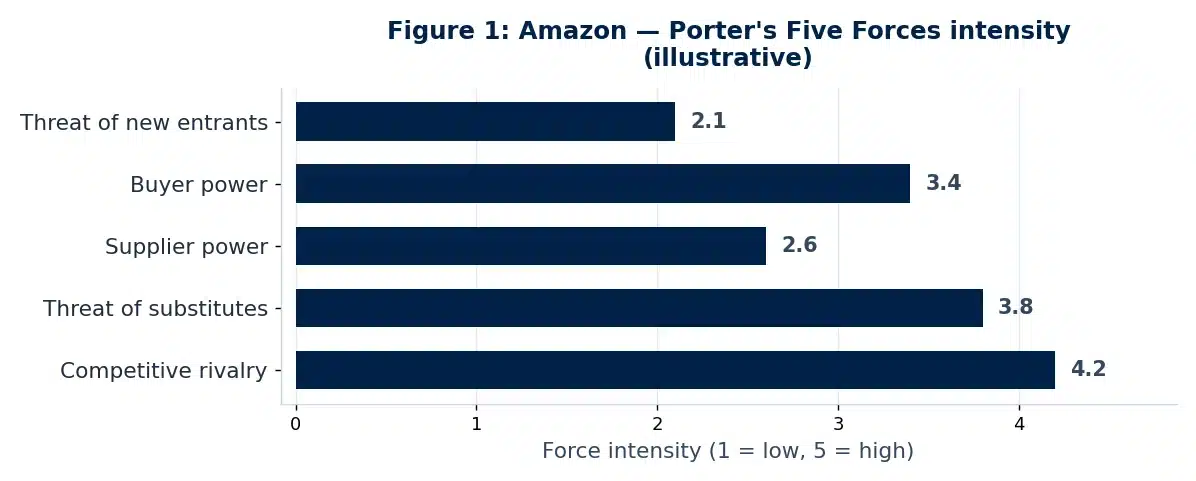
Overall, the framework suggests a favourable industry position. Amazon’s greatest exposure lies in substitution, while its scale and customer focus neutralise the forces most retailers find threatening (Grant, 2019).
Case Study Writing Service
Need a business case study written to this standard?
Our subject specialists write fully referenced, plagiarism-free case studies to your exact brief and deadline, with a free plagiarism report.
The analysis indicates that Amazon’s scale, logistics network and customer obsession function as mutually reinforcing capabilities. Together they create genuine strategic depth rather than a single point of advantage (Barney, 1991).
These capabilities allow Amazon to manage buyer power effectively. Although consumers face low switching costs, the convenience, reliability and value delivered through Prime keep them engaged and loyal.
The same capabilities raise barriers to entry to a formidable level. Replicating a global fulfilment network, data infrastructure and brand trust demands capital and time that few organisations can realistically commit.
Competitive rivalry and supplier power emerge as moderate forces. Amazon competes vigorously but from a position of strength, while its scale tempers the influence of most suppliers within negotiations.
The threat of substitutes stands out as the principal pressure. Evolving consumer preferences, physical retail experiences and alternative digital platforms all challenge Amazon’s continued dominance and warrant sustained attention.
Amazon’s customer-centric strategy and operational excellence combine to produce a resilient competitive position. The Five Forces analysis confirms that scale and customer obsession neutralise most industry pressures effectively.
The principal vulnerability lies in substitution, driven by changing consumer behaviour and an evolving retail landscape. Continued reinvestment and adaptability will therefore remain essential to sustaining Amazon’s long-term advantage (Johnson et al., 2020).
Barney, J. (1991) ‘Firm resources and sustained competitive advantage’, Journal of Management, 17(1), pp. 99-120.
Grant, R.M. (2019) Contemporary Strategy Analysis. 10th edn. Chichester: John Wiley & Sons.
Johnson, G., Whittington, R., Regnér, P., Angwin, D. and Scholes, K. (2020) Exploring Strategy: Text and Cases. 12th edn. Harlow: Pearson.
Porter, M.E. (1985) Competitive Advantage: Creating and Sustaining Superior Performance. New York: Free Press.

All work is written by human writers. 100% AI free, guaranteed.

100% money back guarantee if you find plagiarism in our work.
COMPANY DETAILS