A real Undergraduate education dissertation conclusion chapter example, free to read in full below — get one written for your own study, or browse more conclusion chapter samples.
Type
Dissertation Conclusion
Subject
Education
Level
Undergraduate
Word count
956
Quality
2:1 / 66%
This final chapter draws the study together and revisits its overarching aim: to examine how different forms of parental involvement influence attainment among primary school children. It synthesises the key findings, states the study’s contribution, and offers practical recommendations.
It closes by acknowledging the study’s limitations and mapping directions for future enquiry.
The study set out to answer three research questions concerning the relationship between parental involvement and primary school attainment. The findings offer a clear and consistent picture across the sampled families and classrooms. Not all forms of involvement carried equal weight for children’s academic progress.
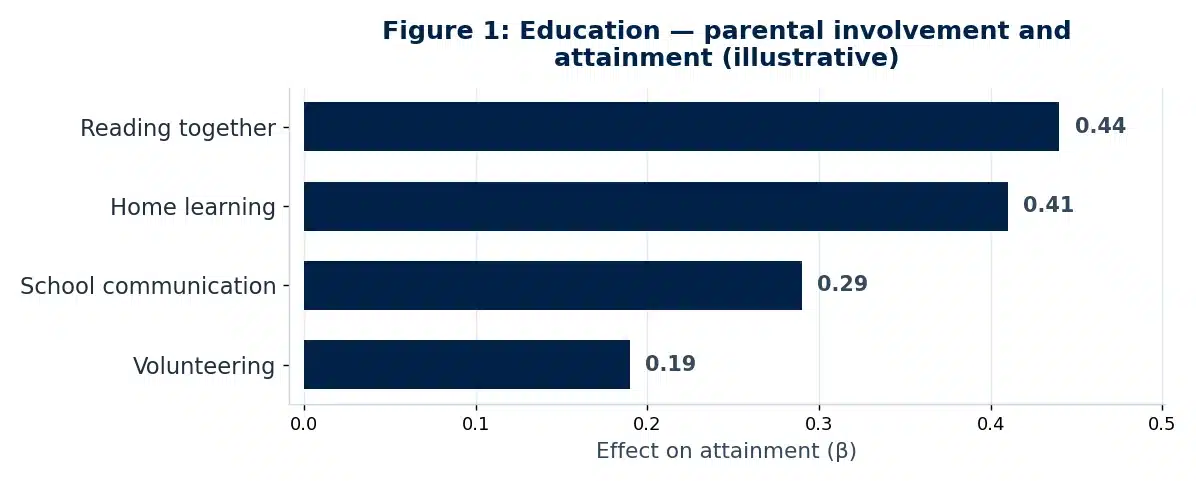
In response to the first research question, which asked which forms of involvement most strongly relate to attainment, home-based activities emerged as the most influential. Reading together and structured home learning were the strongest correlates of higher attainment across literacy and numeracy measures.
This finding echoes Hoover-Dempsey and Sandler (1997), who argued that home-based engagement builds the cognitive and motivational foundations children carry into the classroom. Shared reading, in particular, appeared to support both vocabulary development and a positive disposition towards learning.
The second research question addressed the role of the home-school relationship. Here, the quality of school communication mattered a good deal. Where parents felt informed and able to reinforce classroom learning at home, children tended to perform more strongly.
This supports Epstein’s (2018) contention that effective two-way communication bridges the two central environments in which children learn. Parents who understood the curriculum were better placed to translate that knowledge into meaningful support at home.
The third research question compared school-based participation with other involvement types. Volunteering and physical presence in school were the weakest predictors of attainment in this study. Attending events and helping in classrooms showed only a marginal relationship with children’s academic outcomes.
This nuances the assumption, common in policy discourse, that visible school-based participation is the clearest marker of a “good” involved parent. The findings instead suggest that what parents do at home matters more than how often they appear at school (Goodall, 2017).
Theoretically, the study refines the broad concept of parental involvement by demonstrating that its component forms are not interchangeable. It supports a shift away from treating involvement as a single undifferentiated variable towards a more granular model that distinguishes home learning from school participation.
In doing so, it lends empirical weight to Goodall and Montgomery’s (2014) distinction between parental involvement with school and parental engagement with children’s learning. The present findings indicate that the latter is the more consequential driver of attainment at primary level.
Practically, the study offers schools an evidence base for redirecting finite resources. Rather than measuring involvement chiefly through attendance registers at school events, practitioners can prioritise strategies that strengthen home learning and clear, purposeful communication.
The original contribution lies in ranking these forms of involvement within a single primary-phase sample. By placing home learning, communication and volunteering on a common footing, the study clarifies where effort is most likely to raise attainment (Desforges and Abouchaar, 2003).
Dissertation Chapter Writing Service
Need a education conclusion chapter written to this standard?
Our subject specialists write to your exact brief — fully referenced, plagiarism-free and delivered on time, with a free plagiarism report.
Several limitations should temper interpretation of these findings. The study relied on a modest sample drawn from a limited number of schools, which constrains the extent to which the results can be generalised to the wider primary population.
The reliance on parental self-report introduces the possibility of social desirability bias, as respondents may have overstated their engagement in valued activities such as reading together. Reported involvement may therefore differ from actual practice.
Furthermore, the cross-sectional design captures association rather than causation. While home learning correlated strongly with attainment, unmeasured factors such as household income or parental education may partly explain the observed relationship (Sylva et al., 2004).
Finally, attainment was measured through a narrow set of literacy and numeracy indicators. Broader outcomes, including wellbeing, motivation and social development, fell outside the study’s scope and may respond differently to varied forms of involvement.
Future studies would benefit from longitudinal designs that track children over several years. Such work could establish whether the influence of home learning on attainment strengthens, persists or fades as pupils progress through the primary phase.
Mixed-methods research incorporating classroom observation and pupil voice would also enrich understanding. Qualitative enquiry could illuminate why home learning proves so influential and how children themselves experience parental support.
Subsequent research should further examine the weak association found for volunteering. Investigating whether particular forms of school-based participation benefit specific groups would refine the ranking established here (Harris and Goodall, 2008).
Finally, replication across diverse socioeconomic and cultural contexts is warranted. Testing whether the primacy of home learning holds in different settings would strengthen the evidence base and sharpen its implications for policy.
In conclusion, this study demonstrates that the forms parental involvement takes matter more than its sheer quantity. Reading together and home learning stood out as the strongest levers on attainment, supported by effective school communication, while volunteering contributed least.
These findings invite schools and policymakers to value what happens around the kitchen table as highly as what happens within the school gates.
Desforges, C. and Abouchaar, A. (2003) The Impact of Parental Involvement, Parental Support and Family Education on Pupil Achievement and Adjustment: A Literature Review. Research Report RR433. Nottingham: Department for Education and Skills.
Goodall, J. (2017) Narrowing the Achievement Gap: Parental Engagement with Children’s Learning. London: Routledge.
Harris, A. and Goodall, J. (2008) ‘Do parents know they matter? Engaging all parents in learning’, Educational Research, 50(3), pp. 277-289.
Sylva, K., Melhuish, E., Sammons, P., Siraj-Blatchford, I. and Taggart, B. (2004) The Effective Provision of Pre-School Education (EPPE) Project: Final Report. A Longitudinal Study Funded by the DfES 1997-2004. London: Department for Education and Skills / Institute of Education, University of London.

All work is written by human writers. 100% AI free, guaranteed.

100% money back guarantee if you find plagiarism in our work.
COMPANY DETAILS