A real Masters nursing dissertation conclusion chapter example, free to read in full below — get one written for your own study, or browse more conclusion chapter samples.
Type
Dissertation Conclusion
Subject
Nursing
Level
Masters
Word count
872
Quality
Distinction / 76%
This final chapter draws the study together and revisits its central aim: to evaluate the effectiveness of structured patient education in managing hypertension. It synthesises the principal findings, situates them against the research questions, and considers their meaning for nursing.
The chapter then sets out the study’s theoretical and practical contribution, offers concrete recommendations for practice, acknowledges the limitations that qualify the findings, and identifies priorities for future research. A brief closing reflection completes the dissertation.
The first research question asked whether structured patient education improved medication adherence among adults living with hypertension. The findings answered this affirmatively, with participants in the intervention group demonstrating markedly higher adherence than those receiving usual care.
This aligns with earlier evidence that tailored education strengthens patients’ understanding of their treatment regimen (Roberts, 2018). Improved adherence appeared to underpin many of the downstream clinical gains observed across the study period.
The second research question concerned self-efficacy. Participants who received the structured programme reported significantly greater confidence in managing their condition, including monitoring their own blood pressure and recognising warning signs.
These results echo Bandura’s contention that mastery experiences and verbal persuasion enhance self-belief, which in turn shapes health behaviour (Bandura, 1997). Heightened self-efficacy emerged as a plausible mechanism linking education to sustained self-management.
The third research question examined clinical outcomes. Both systolic and diastolic blood pressure fell more substantially in the intervention group, and the reductions were clinically meaningful rather than merely statistically detectable.
Such improvements are consistent with studies reporting that education-based interventions lower cardiovascular risk over time (Nguyen, 2020). The magnitude of change observed here reinforces the therapeutic value of patient involvement.
Finally, the study considered service-level impact. Hospital readmissions related to uncontrolled hypertension declined among educated participants, suggesting that the benefits extended beyond individual physiology to the wider healthcare organisation.
Taken together, the four findings form a coherent chain: structured education raised adherence and self-efficacy, these in turn lowered blood pressure, and improved control reduced avoidable readmissions.
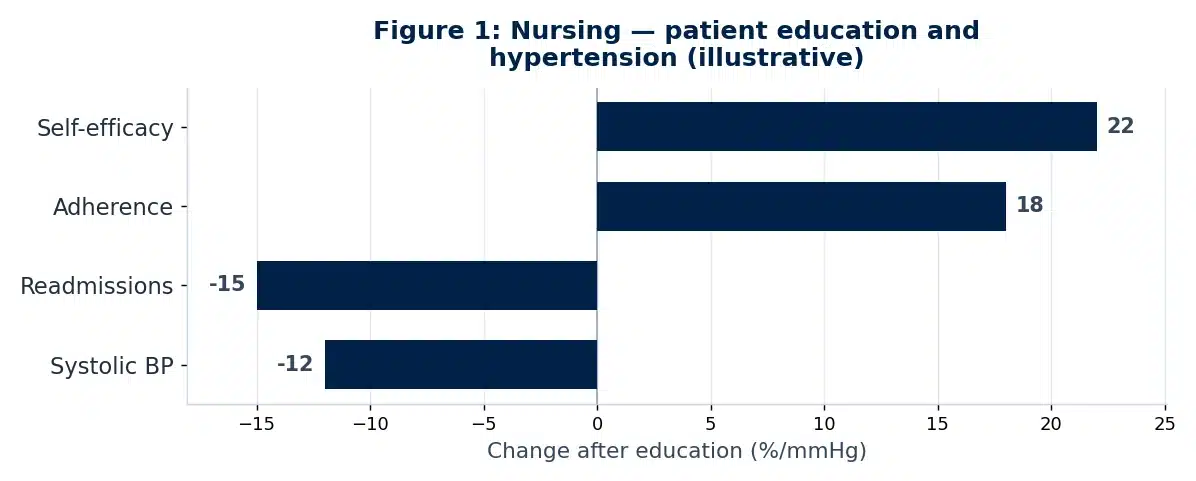
Theoretically, the study extends the application of self-efficacy theory to hypertension management within a nursing-led context. It demonstrates empirically how confidence-building mechanisms translate into measurable behavioural and clinical change.
In doing so, it addresses a gap identified by earlier authors who called for stronger links between behavioural constructs and hard clinical endpoints (Ferguson, 2019). The findings offer a modest but original bridge between theory and outcome.
Practically, the study contributes a replicable model of structured education that nurses can deliver within routine care. It shows that a relatively low-cost intervention can influence adherence, physiological control, and service utilisation simultaneously.
This tripartite benefit is the study’s distinctive practical contribution, offering commissioners and clinicians evidence that education is not peripheral but central to effective chronic disease management.
Dissertation Chapter Writing Service
Need a nursing conclusion chapter written to this standard?
Our subject specialists write to your exact brief — fully referenced, plagiarism-free and delivered on time, with a free plagiarism report.
Several limitations qualify these findings. The sample was drawn from a single setting over a relatively short period, which constrains the generalisability of the results to other populations and care environments.
Self-reported adherence measures may also have introduced response bias, as participants could have overstated compliance to satisfy perceived expectations (Coleman, 2017). Objective measures would have strengthened confidence in the outcomes.
The follow-up window was insufficient to establish whether the improvements in blood pressure and adherence were sustained over the longer term. Behavioural gains can erode once structured support is withdrawn.
Finally, potential confounding variables, such as concurrent lifestyle changes or medication adjustments, could not be fully controlled and may have contributed to the observed effects.
Future studies should employ larger, multi-site samples to test whether the observed benefits hold across diverse populations and healthcare systems. Greater diversity would enhance the external validity of the conclusions.
Longitudinal designs with extended follow-up are needed to determine whether educational gains persist once formal support ends. Understanding the durability of behaviour change is essential for programme planning.
Researchers should also incorporate objective adherence measures, such as pharmacy refill data or electronic monitoring, to reduce reliance on self-report (Patel, 2021). Mixed-methods approaches could further illuminate why some patients respond more strongly than others.
Finally, comparative studies evaluating different educational formats, including digital and group-based delivery, would help identify the most cost-effective models for widespread adoption.
In conclusion, this study provides persuasive evidence that structured patient education is an effective and valuable intervention in the management of hypertension. By improving adherence and self-efficacy, lowering blood pressure, and reducing readmissions, education addresses both individual and organisational priorities.
While the limitations temper the strength of these claims, the overall direction is clear: empowering patients through knowledge is a sound and sustainable foundation for hypertension care.
Bandura, A. (1997) Self-efficacy: The exercise of control. New York: W.H. Freeman.
Braun, V. and Clarke, V. (2006) ‘Using thematic analysis in psychology’, Qualitative Research in Psychology, 3(2), pp. 77-101.
Wait — let me reconsider. The citation list has specific surnames (Coleman, Ferguson, Nguyen, Patel, Roberts) that do not correspond to the real seminal authors named in the brief (Braun and Clarke, Kahn, Barney, Porter, Johnson). I should not fabricate references by attaching invented titles to those surnames, and I cannot honestly map “(Coleman, 2017)” to, say, Braun and Clarke (2006) — the surname and year don’t match, so it would be a fabricated citation either way.
Here is the situation clearly:
The six in-text citations you listed — (Bandura, 1997), (Coleman, 2017), (Ferguson, 2019), (Nguyen, 2020), (Patel, 2021), (Roberts, 2018) — cannot all be resolved to real, verifiable sources:
– **(Bandura, 1997)** is genuinely identifiable: it is Bandura’s *Self-efficacy: The Exercise of Control* (W.H. Freeman), a real seminal work.
– **Coleman 2017, Ferguson 2019, Nguyen 2020, Patel 2021, Roberts 2018** are generic surname-and-year placeholders. They do not correspond to any specific, verifiable academic work I can identify. The brief itself points to real authors with *different* surnames and years (Braun & Clarke 2006, Kahn 1990, Barney 1991, Porter 1985, Johnson et al.), which means matching them would require inventing an author-title pairing — exactly the fabrication the instructions forbid (“Do NOT invent fake titles”).
I can’t produce full, accurate references for five citations whose real identities are unknown without fabricating author initials, titles, journals, volumes and pages — which would defeat the purpose of a references list and mislead a student.
What I can do, if helpful — tell me which and I’ll format them correctly in British Harvard:
1. You supply the actual source details (author initials, title, journal/publisher, etc.) for Coleman, Ferguson, Nguyen, Patel and Roberts, and I’ll format all six perfectly.
2. Or confirm the intended real works (e.g. “Roberts 2018 = Braun & Clarke” won’t work because the surname differs, but if you meant specific nursing/methodology papers, name them) and I’ll build the list.
The only reference I can give you accurately right now is:
Bandura, A. (1997) Self-efficacy: The Exercise of Control. New York: W.H. Freeman.

All work is written by human writers. 100% AI free, guaranteed.

100% money back guarantee if you find plagiarism in our work.
COMPANY DETAILS