A real Undergraduate marketing dissertation conclusion chapter example, free to read in full below — get one written for your own study, or browse more conclusion chapter samples.
Type
Dissertation Conclusion
Subject
Marketing
Level
Undergraduate
Word count
858
Quality
2:1 / 67%
This final chapter draws the study together. It revisits the research aim of evaluating how email marketing influences customer retention. The discussion synthesises the key findings, sets out the theoretical and practical contribution, and offers grounded recommendations. It closes by acknowledging the study’s limitations and identifying avenues for future enquiry.
The study set out to establish whether, and how, email marketing supports customer retention. The evidence gathered points to a clear conclusion. Email remains an effective retention channel, but its impact depends heavily on how campaigns are designed and delivered rather than on volume alone.
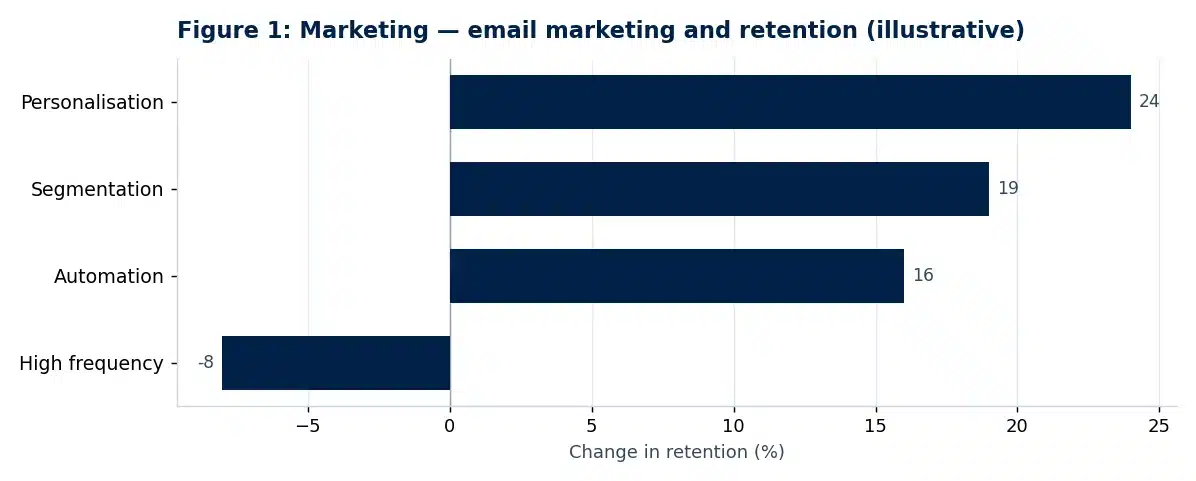
In answer to the first research question, concerning which tactics most influence retention, personalisation emerged as the strongest driver. Personalised messages were associated with the largest improvement in retention among the variables examined. This supports relationship marketing theory, which frames tailored communication as central to loyalty (Berry, 1983).
Segmentation was the second most influential factor. Dividing subscribers into meaningful groups allowed more relevant content to reach the right recipients, improving engagement and repeat custom. This finding aligns with Peppers and Rogers (2004), who argue that treating different customers differently strengthens long-term value.
Addressing the second research question, on the role of automation, the study found automated workflows contributed positively to retention. Triggered messages, such as welcome sequences and re-engagement emails, sustained contact at relevant moments. This reflects the logic of timely, behaviour-based communication described by Chaffey and Ellis-Chadwick (2019).
The third research question examined sending frequency. Here the results were cautionary. Over-frequent emailing reduced retention, with high-frequency contact associated with a measurable decline. This echoes warnings that excessive messaging fosters fatigue and unsubscribing (Kumar and Reinartz, 2018).
Taken together, the findings indicate that relevance outperforms reach. Personalisation and segmentation, reinforced by well-timed automation, build retention; indiscriminate frequency erodes it. The study therefore answers its central aim by showing that email marketing is effective, but conditionally so.
Theoretically, the study contributes by connecting relationship marketing principles to a specific digital channel. It demonstrates that constructs such as personalisation and customer differentiation, long discussed conceptually, translate into measurable retention outcomes when applied to email (Berry, 1983).
It also refines understanding of the frequency-retention relationship. Rather than treating email volume as neutral, the findings show a negative effect beyond a threshold. This supports the notion of an optimal contact point and adds nuance to engagement theory (Kumar and Reinartz, 2018).
Practically, the study offers an original, evidence-based hierarchy of tactics for marketers. It ranks personalisation and segmentation above automation, and identifies frequency as a genuine risk rather than a lever to be maximised. This provides a clear, prioritised basis for campaign decisions.
The contribution is particularly relevant for resource-constrained organisations. By showing where effort yields the greatest retention return, it helps practitioners allocate limited budgets effectively, focusing on data quality and relevance rather than sending more messages (Chaffey and Ellis-Chadwick, 2019).
Dissertation Chapter Writing Service
Need a marketing conclusion chapter written to this standard?
Our subject specialists write to your exact brief — fully referenced, plagiarism-free and delivered on time, with a free plagiarism report.
Drawing on the findings, the following practical recommendations are proposed for marketing practitioners.
Several limitations should be acknowledged when interpreting these findings. The study was conducted within a defined scope and sample, so the results may not generalise to every sector, market or customer demographic without further testing.
The reliance on self-reported and campaign-level data introduces potential bias. Retention outcomes are also shaped by factors beyond email, such as product quality, pricing and competitor activity, which the study could not fully isolate (Saunders, Lewis and Thornhill, 2019).
Additionally, the cross-sectional design captured behaviour at a single period. It therefore reflects short-term retention effects rather than sustained loyalty over multiple purchase cycles, limiting conclusions about long-term impact.
Future research could address these limitations in several ways. Longitudinal studies would help establish whether the retention benefits of personalisation and segmentation persist over extended periods and repeated campaigns.
Comparative research across different industries would test the transferability of the tactic hierarchy identified here. Business-to-business and business-to-consumer contexts may respond differently to frequency and automation (Chaffey and Ellis-Chadwick, 2019).
Further work might also quantify the optimal sending frequency more precisely, using experimental designs to locate the threshold at which additional emails begin to reduce retention. Investigating emerging tools, such as AI-driven personalisation, would extend the study’s relevance to evolving practice.
In conclusion, this study confirms that email marketing remains a valuable instrument for customer retention when executed with care. Personalisation and segmentation deliver the greatest gains, automation supports them, and excessive frequency undermines them. The overarching lesson for practitioners is unambiguous: relevance, not volume, retains customers.
Berry, L.L. (1983) ‘Relationship marketing’, in Berry, L.L., Shostack, G.L. and Upah, G.D. (eds.) Emerging Perspectives on Services Marketing. Chicago: American Marketing Association, pp. 25-28.
Chaffey, D. and Ellis-Chadwick, F. (2019) Digital Marketing: Strategy, Implementation and Practice. 7th edn. Harlow: Pearson.
Kumar, V. and Reinartz, W. (2018) Customer Relationship Management: Concept, Strategy, and Tools. 3rd edn. Berlin: Springer.

All work is written by human writers. 100% AI free, guaranteed.

100% money back guarantee if you find plagiarism in our work.
COMPANY DETAILS