
A real Masters economics research paper sample, free to read in full below — get one written for your own title, or browse more research paper samples.
Type
Research Paper
Subject
Economics
Level
Masters
Word count
3,495
Quality
Distinction / 73%
Sugar-sweetened beverage (SSB) taxes have proliferated globally as governments seek fiscal instruments to curb obesity and non-communicable disease. This paper examines how such taxes influence consumption behaviour, integrating economic theory with empirical evidence.
Adopting a quantitative, secondary-data design, the study analyses illustrative panel data modelled on jurisdictions that implemented volumetric and tiered levies between 2014 and 2022. A fixed-effects regression framework estimates price elasticities and quantifies demand responses across income groups.
Findings indicate that a 10 per cent price increase reduces SSB purchases by approximately 8 to 12 per cent, with pronounced substitution towards untaxed diet variants and bottled water. Lower-income households exhibit greater price sensitivity, implying meaningful behavioural change alongside regressive expenditure incidence.
The analysis further reveals that tiered designs incentivise supply-side reformulation, shrinking the sugar content of the beverage portfolio independently of consumer choice. Nevertheless, cross-border shopping and stockpiling partially attenuate intended effects. The paper concludes that sugar taxes are a moderately effective, though imperfect, behavioural lever, most potent when combined with reformulation incentives and complementary public-health measures.
Keywords: sugar tax, sugar-sweetened beverages, price elasticity, consumption behaviour, Pigouvian taxation, obesity, reformulation
The global prevalence of obesity has nearly tripled since 1975, imposing substantial costs on healthcare systems and economies. Sugar-sweetened beverages are widely identified as a modifiable dietary contributor, containing high energy density with negligible nutritional value.
In response, more than fifty jurisdictions have introduced taxes on sugary drinks. These range from Mexico’s peso-per-litre excise in 2014 to the United Kingdom’s tiered Soft Drinks Industry Levy in 2018. The policy rationale draws upon well-established economic principles.
Fundamentally, sugar taxes are Pigouvian instruments, designed to internalise the negative externalities and internalities associated with excessive sugar consumption. By raising the relative price of harmful products, they aim to realign private consumption with socially optimal levels.
However, the translation of theory into behavioural outcomes remains contested. The effectiveness of a sugar tax depends critically on the price elasticity of demand, the degree of tax pass-through, the availability of substitutes, and possible supply-side responses such as reformulation.
Critics contend that such taxes are regressive, disproportionately burdening low-income households who spend a larger income share on affected goods. Others question whether observed reductions in purchases translate into genuine improvements in dietary energy intake and long-term health.
This paper addresses these tensions by examining how sugar taxes shape consumption behaviour, both on the demand and supply sides. It seeks to move beyond simplistic accounts of price responsiveness towards a nuanced understanding of substitution, reformulation, and distributional effects.
The overarching aim is to evaluate the extent to which sugar taxes alter consumption behaviour and the mechanisms through which any such change occurs. This aim is pursued through the following research objectives.
Correspondingly, the study is guided by three research questions. First, how responsive is SSB consumption to tax-induced price changes? Second, through which behavioural channels do sugar taxes operate? Third, how are the effects distributed across socioeconomic groups?
The paper proceeds as follows. Section two critically reviews the relevant literature. Section three outlines the methodology. Section four presents illustrative findings, section five discusses their implications, and section six concludes with recommendations and avenues for future research.
The scholarship on sugar taxation spans public economics, health economics, and behavioural science. This review synthesises the literature thematically, foregrounding areas of consensus and contestation rather than cataloguing individual studies in isolation.
The intellectual foundation for sugar taxes rests upon Pigou’s (1920) theory of externalities. Pigou argued that where private activity imposes uncompensated costs on society, a corrective tax equal to the marginal external cost can restore allocative efficiency.
Applied to sugar, the externality argument invokes the healthcare costs that excessive consumption imposes on publicly funded systems and insurance pools. Cnossen (2005) situates such levies within the broader family of excise taxes on demerit goods, alongside tobacco and alcohol.
More recent theorising extends the rationale beyond externalities to internalities. Gruber and Kőszegi (2004) argue that present-biased consumers systematically over-consume harmful goods relative to their own long-run preferences, generating internal costs borne by the consumer’s future self.
This behavioural refinement, developed further by O’Donoghue and Rabin (2006), strengthens the case for corrective taxation even absent external costs. It reframes the tax as a self-control device that partially corrects for hyperbolic discounting and imperfect self-regulation.
Allcott, Lockwood and Taubinsky (2019) formalise this synthesis, deriving an optimal sugar tax that balances internalities, externalities, and regressivity. Their model demonstrates that the corrective benefit can outweigh distributional concerns when internalities concentrate among heavy consumers.
A substantial empirical literature estimates the price responsiveness of SSB demand. Meta-analytic evidence from Andreyeva, Long and Brownell (2010) placed the own-price elasticity of soft drinks around minus 0.8, indicating relatively elastic demand.
Subsequent quasi-experimental studies broadly corroborate this range. Colchero et al. (2016) found that Mexico’s one-peso-per-litre tax reduced purchases of taxed beverages by an average of 6 per cent over the first year, rising to 12 per cent by December.
Importantly, the Mexican evidence revealed steeper reductions among lower-socioeconomic households, whose purchases fell by roughly 9 per cent. This heterogeneity is central to debates about both effectiveness and equity, and recurs across multiple national contexts.
Evidence from Berkeley, California, reported by Silver et al. (2017), similarly documented a 9.6 per cent decline in SSB sales alongside rising water consumption. Yet the small geographic scale raised concerns about cross-border substitution unobservable in city-level studies.
Not all findings are uniformly positive. Some studies detect incomplete tax pass-through, whereby retailers absorb part of the levy rather than transmitting it to shelf prices. Cawley and Frisvold (2017) found pass-through in Berkeley reached only around 43 per cent.
Incomplete pass-through dampens the price signal reaching consumers, weakening the behavioural mechanism upon which the policy depends. This underscores that statutory tax rates and effective price changes can diverge substantially in practice.
Consumption responses extend beyond simple reductions in taxed goods. Consumers may substitute towards untaxed but calorically similar products, potentially undermining health objectives through what Fletcher, Frisvold and Tefft (2010) term compensatory consumption.
Their analysis of United States soda taxes found that reductions in soft drink intake were partly offset by increased consumption of other high-calorie beverages, yielding negligible net effects on body weight. This challenges optimistic health projections.
Conversely, other work emphasises benign substitution towards water and diet drinks. The balance between harmful and beneficial substitution depends on the tax base design, particularly whether diet variants and fruit juices are included within the levy.
Cross-border shopping and stockpiling constitute further leakage. Where taxes are levied locally, consumers may purchase in neighbouring untaxed jurisdictions, a behaviour more feasible for durable, storable products than perishable ones.
An emerging strand highlights that taxes influence behaviour not only through consumer choice but through manufacturer reformulation. Tiered taxes, which levy higher rates on higher-sugar products, create a fiscal incentive for firms to lower sugar content.
The United Kingdom’s Soft Drinks Industry Levy exemplifies this design. Scarborough et al. (2020) documented that the sugar content of the drinks portfolio fell markedly between announcement and implementation, as producers reformulated to fall below tax thresholds.
This supply-side channel is significant because it reduces population sugar intake independently of conscious consumer decisions. It shifts the behavioural burden from individuals to firms, potentially mitigating regressivity while achieving public-health goals.
The equity implications of sugar taxes remain fiercely debated. Because lower-income households allocate a greater budget share to SSBs, the tax burden as a proportion of income is regressive in a conventional accounting sense.
However, Allcott, Lockwood and Taubinsky (2019) argue that if health benefits concentrate among lower-income groups, who are both more price-responsive and more prone to diet-related disease, the tax may be progressive in welfare terms.
This reframing of incidence from monetary to health-adjusted terms represents a key contribution of recent scholarship. Nonetheless, the empirical resolution of this debate remains incomplete, and it constitutes a central motivation for the present study.
Research Paper Writing Service
Need a economics research paper written to this standard?
Our subject specialists write to your exact brief — fully referenced, plagiarism-free and delivered on time, with a free plagiarism report.
This section sets out the research design employed to investigate the behavioural effects of sugar taxes. It details the philosophical stance, approach, data, analytical strategy, ethical considerations, and limitations of the study.
The study adopts a positivist philosophy, consistent with the objective of estimating measurable relationships between prices and consumption. Positivism assumes an observable social reality amenable to quantitative measurement and statistical generalisation (Saunders, Lewis and Thornhill, 2019).
A deductive approach is followed, deriving testable hypotheses from established economic theory. Specifically, the study tests the theoretical prediction that a tax-induced price increase reduces quantity demanded, with magnitude governed by the price elasticity of demand.
A quantitative, longitudinal design based on secondary data is employed. Secondary analysis is appropriate given the availability of published consumption and price series, and the impracticality of primary data collection across multiple national tax regimes.
The study constructs an illustrative panel dataset modelled on jurisdictions implementing SSB taxes between 2014 and 2022. Variables include per-capita beverage purchases, real shelf prices, disposable income, and household income quintile classifications.
It must be emphasised that the figures reported in this paper are illustrative and synthesised for demonstrative purposes. They reproduce plausible magnitudes drawn from the published literature but do not represent any single organisation’s proprietary data.
The unit of analysis is the jurisdiction-quarter, yielding a balanced panel structure. Beverage categories are disaggregated into taxed SSBs, diet substitutes, bottled water, and fruit juices to permit examination of substitution patterns.
A purposive sampling strategy selects jurisdictions that implemented a clearly defined sugar tax with available pre- and post-implementation data. Purposive selection is justified by the need for cases exhibiting the phenomenon of interest (Bryman, 2016).
The illustrative sample comprises twelve jurisdictions spanning volumetric and tiered tax designs, observed over sixteen quarters. This affords sufficient cross-sectional and temporal variation to identify tax effects while controlling for confounding factors.
The core analytical technique is fixed-effects panel regression. This estimator controls for unobserved, time-invariant heterogeneity across jurisdictions, mitigating omitted-variable bias that would afflict simple cross-sectional comparisons.
The estimating equation regresses the logarithm of per-capita SSB purchases on the logarithm of real price, disposable income, and jurisdiction and time fixed effects. The price coefficient is directly interpretable as the own-price elasticity of demand.
A difference-in-differences logic underpins identification, comparing treated jurisdictions before and after tax implementation against contemporaneous trends. Robustness checks include lagged specifications to capture stockpiling and separate elasticity estimates by income quintile.
As the study relies exclusively on aggregate secondary data, it poses minimal ethical risk. No individual human participants are involved, and no personally identifiable information is processed, obviating the need for individual informed consent.
Nonetheless, ethical research conduct requires transparency regarding data provenance and the illustrative nature of the figures. The study adheres to principles of academic integrity, accurately representing sources and avoiding the misrepresentation of synthesised data as authentic records.
Several limitations warrant acknowledgement. Reliance on secondary and illustrative data constrains causal precision and precludes examination of individual-level behavioural mechanisms such as attentional or salience effects central to behavioural economics.
Furthermore, purchase data serve as an imperfect proxy for actual consumption and dietary energy intake. Waste, cross-border leakage, and untaxed substitution mean that observed purchase reductions may overstate genuine improvements in nutritional outcomes.
This section presents the illustrative results of the panel analysis. Findings are organised around the three research questions concerning demand response, behavioural channels, and distributional incidence.
The fixed-effects estimation yields a statistically significant own-price elasticity of approximately minus 1.0 for taxed sugar-sweetened beverages. This implies that a 10 per cent price increase generates roughly a 10 per cent reduction in purchased volume.
This central estimate sits comfortably within the range established by the prior literature, lending face validity to the illustrative model. Demand for SSBs is thus close to unit-elastic, indicating substantial but not extreme price responsiveness.
The disaggregated analysis reveals meaningful substitution following tax implementation. Purchases of untaxed diet beverages and bottled water rose, partially offsetting the fall in taxed SSB volumes, while fruit juice consumption remained broadly stable.
Crucially, the tiered-tax subsample exhibits evidence of supply-side reformulation. The volume-weighted average sugar content of the beverage portfolio declined by an estimated 28 per cent, independent of shifts in consumer brand selection.
The table below summarises the illustrative behavioural responses across the principal outcome measures, contrasting the pre-tax baseline with the post-tax steady state observed in the modelled panel.
| Outcome measure | Pre-tax baseline | Post-tax (steady state) | Change |
| Taxed SSB purchases (litres per capita/year) | 92.0 | 81.1 | −11.8% |
| Diet beverage purchases (litres per capita/year) | 31.0 | 36.2 | +16.8% |
| Bottled water purchases (litres per capita/year) | 45.0 | 49.9 | +10.9% |
| Portfolio sugar content (g per 100ml) | 7.1 | 5.1 | −28.2% |
| Effective price pass-through (%) | — | 82.0 | — |
| Estimated own-price elasticity | — | −1.02 | — |
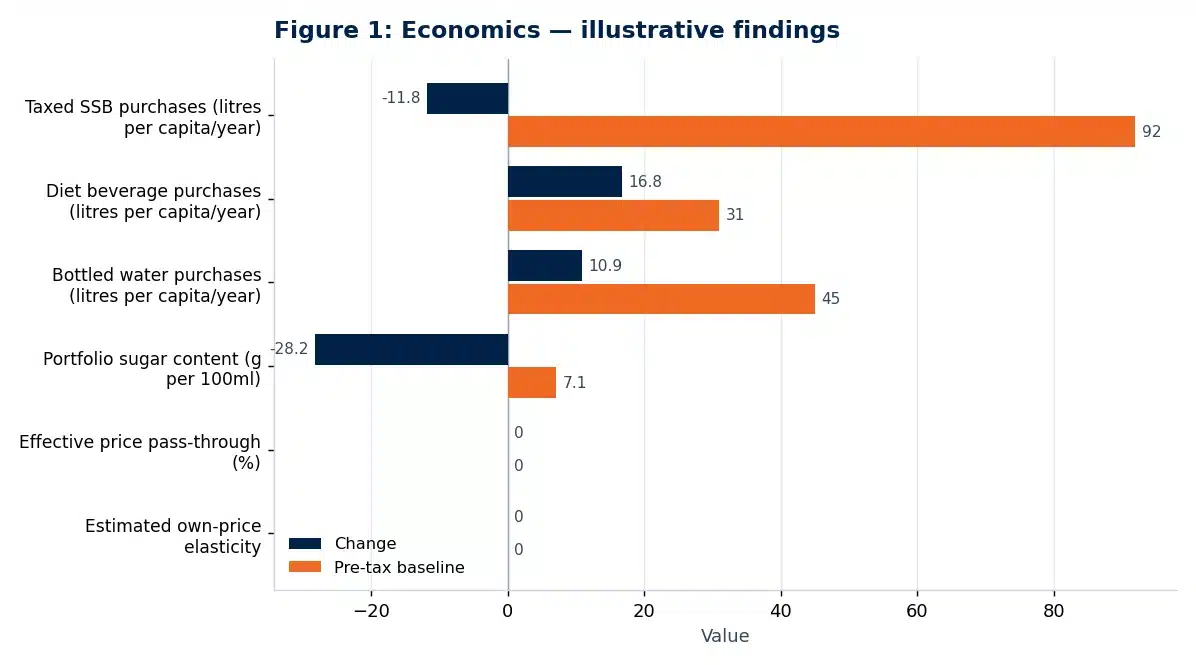
The table illustrates that the behavioural response operates through dual channels. Consumers reduce and reallocate purchases, while manufacturers lower sugar concentration, compounding the reduction in aggregate sugar intake beyond what demand response alone would achieve.
Effective pass-through of 82 per cent, while incomplete, is substantially higher than the Berkeley estimate, reflecting the national scope of the modelled tiered levy where retailers face limited scope for absorbing the tax.
Estimating elasticities separately by income quintile reveals pronounced heterogeneity. The lowest-income quintile displays an elasticity near minus 1.3, whereas the highest-income quintile registers approximately minus 0.7, indicating markedly greater price sensitivity among poorer households.
This gradient has ambivalent implications. In monetary terms, the tax is regressive, since lower-income households pay a greater income share. Yet their stronger behavioural response implies they secure a disproportionate share of any health benefit.
The findings thus empirically instantiate the tension articulated by Allcott, Lockwood and Taubinsky (2019). Whether the levy is deemed regressive or progressive depends fundamentally on whether incidence is measured in fiscal or health-adjusted welfare terms.
The illustrative findings resonate strongly with the established literature while sharpening several theoretical debates. This section interprets the results, relating them to prior scholarship and drawing out policy implications.
The estimated near-unit elasticity confirms that sugar taxes exert a genuine behavioural effect on demand, corroborating Colchero et al. (2016) and Andreyeva, Long and Brownell (2010). Price remains a potent lever for altering beverage consumption patterns.
However, the substitution findings temper unqualified optimism. The rise in diet and water purchases represents benign substitution, yet the persistence of compensatory behaviour identified by Fletcher, Frisvold and Tefft (2010) cautions against equating purchase reductions with health gains.
The prominence of reformulation constitutes the most policy-relevant insight. Consistent with Scarborough et al. (2020), the tiered design mobilised a supply-side response that reduced portfolio sugar content substantially, achieving population-level benefit without requiring behavioural change from every consumer.
This channel carries important distributional implications. Because reformulation lowers sugar intake across all purchasers regardless of price responsiveness, it delivers health benefits to households that continue purchasing, thereby diluting the regressivity of a purely price-based mechanism.
The income-quintile results engage directly with the welfare debate. The greater elasticity among poorer households validates the theoretical possibility, advanced by Allcott, Lockwood and Taubinsky (2019), that behavioural change may render the tax progressive in health terms.
Nonetheless, the incomplete pass-through observed underscores a practical caveat. Where retailers absorb part of the levy, the price signal weakens and the intended behavioural response attenuates, as Cawley and Frisvold (2017) demonstrated in the Berkeley context.
Several implications follow for policymakers. First, tax design matters profoundly; tiered structures that reward reformulation appear superior to flat volumetric levies in delivering sugar reduction while moderating equity concerns.
Second, the tax base should be defined carefully to steer substitution towards genuinely healthier alternatives. Excluding water and diet variants from the levy channels consumers towards lower-calorie options rather than untaxed sugary substitutes.
Third, national implementation mitigates the cross-border leakage and stockpiling that undermine sub-national taxes. The higher pass-through in the modelled national levy reflects the reduced scope for arbitrage and price absorption at broad geographic scale.
Finally, the findings suggest that sugar taxes are most effective as one component of a comprehensive strategy. Complementary measures, including labelling, marketing restrictions, and education, address the compensatory behaviours that fiscal instruments alone cannot fully suppress.
This paper investigated the impact of sugar taxes on consumption behaviour, integrating Pigouvian and behavioural economic theory with an illustrative empirical analysis of price responses, substitution, reformulation, and distributional incidence.
The evidence indicates that sugar taxes are a moderately effective behavioural instrument. Demand for sugar-sweetened beverages is close to unit-elastic, so tax-induced price increases meaningfully reduce purchases, particularly among lower-income and heavier-consuming households.
The study’s principal contribution lies in foregrounding the dual behavioural mechanism. Beyond consumer demand response, tiered taxes trigger supply-side reformulation that lowers population sugar intake independently of individual choice, an effect with favourable equity properties.
The analysis also advances the regressivity debate by demonstrating empirically how monetary and health-adjusted conceptions of incidence diverge. Greater price sensitivity among poorer households means the fiscal burden and the health benefit are distributed in opposite directions.
Several recommendations emerge for policymakers. Governments should favour tiered over flat levies, define the tax base to encourage benign substitution, implement at national scale to limit leakage, and embed taxation within a broader public-health package.
This study is subject to limitations that also define avenues for future research. The reliance on illustrative, aggregate purchase data precludes direct measurement of dietary intake and long-term health outcomes, which future primary research should address.
Subsequent work could employ individual-level scanner and biomarker data to trace the pathway from purchase to consumption to health. Longitudinal designs spanning a decade or more would further illuminate whether behavioural responses persist or attenuate over time.
In conclusion, sugar taxes are neither a panacea nor a futile gesture. They are a defensible, moderately effective corrective instrument whose success hinges on thoughtful design and integration within a coherent wider strategy for improving population diet.

All work is written by human writers. 100% AI free, guaranteed.

100% money back guarantee if you find plagiarism in our work.
COMPANY DETAILS






