
A real Masters accounting research paper sample, free to read in full below — get one written for your own title, or browse more research paper samples.
Type
Research Paper
Subject
Accounting
Level
Masters
Word count
3,146
Quality
Merit / 67%
The adoption of International Financial Reporting Standards (IFRS) represents one of the most significant regulatory transformations in the history of financial accounting. This paper examines whether IFRS adoption has improved financial reporting quality across adopting jurisdictions.
Drawing on a quantitative, archival research design, the study analyses illustrative panel data covering listed firms in three IFRS-adopting economies over a ten-year window spanning mandatory adoption. Reporting quality is proxied through earnings management, value relevance, accounting conservatism and disclosure comprehensiveness.
The findings indicate a modest but statistically meaningful improvement in reporting quality following adoption, principally through reduced discretionary accruals and enhanced value relevance. However, the effect is strongly conditioned by the strength of national enforcement regimes and firms’ reporting incentives.
The analysis suggests that IFRS operates as a necessary but insufficient condition for higher-quality reporting. Standards alone cannot compensate for weak institutional infrastructure. The paper contributes to the ongoing debate on accounting harmonisation and offers recommendations for regulators, preparers and standard-setters seeking durable improvements in transparency.
Keywords: IFRS adoption, financial reporting quality, earnings management, value relevance, accounting harmonisation, enforcement
Financial reporting exists to reduce information asymmetry between firms and the providers of capital. High-quality reporting supports efficient resource allocation, lowers the cost of capital and underpins investor confidence in market economies.
Over the past two decades, more than 140 jurisdictions have required or permitted the use of IFRS, issued by the International Accounting Standards Board (IASB). This global migration reflects a widespread belief that harmonised, principles-based standards improve comparability and transparency.
The European Union’s Regulation 1606/2002, which mandated IFRS for consolidated accounts of listed firms from 2005, marked a decisive turning point. Australia, South Africa and numerous emerging economies followed, creating a natural setting for empirical enquiry.
Despite this momentum, the relationship between IFRS adoption and reporting quality remains contested. Proponents emphasise fair value measurement and expanded disclosure. Critics warn that principles-based standards grant managers discretion that may be exploited to manage earnings.
The central problem is therefore empirical rather than ideological. Does the switch from diverse national standards to a common international framework actually raise the quality of the numbers that firms report to markets?
A further complication is that adoption does not occur in an institutional vacuum. The effects of new standards are mediated by enforcement, auditing quality, legal traditions and the incentives facing preparers. These contextual factors may amplify or neutralise any benefit.
This paper aims to critically evaluate the impact of IFRS adoption on financial reporting quality and to identify the conditions under which improvements are most likely to materialise. It adopts a multidimensional conception of quality rather than a single proxy.
The study is guided by three research questions. First, has IFRS adoption reduced earnings management among adopting firms? Second, has it enhanced the value relevance of accounting information? Third, how do enforcement and firm-level incentives moderate these effects?
To address these questions, the paper pursues the following objectives, set out below.
The remainder of the paper is structured as follows. Section 2 reviews the literature; Section 3 details the methodology; Section 4 presents findings; Section 5 discusses their implications; and Section 6 concludes with recommendations and avenues for future research.
The scholarly debate on IFRS adoption spans accounting theory, capital markets research and institutional economics. This section synthesises that literature around four interrelated themes rather than cataloguing individual studies in isolation.
Reporting quality is a latent construct without a single agreed measure. Following Dechow, Ge and Schrand (2010), it is best understood as the extent to which reported figures faithfully represent a firm’s underlying economic performance.
Researchers typically proxy quality through earnings management, value relevance, timely loss recognition and disclosure quality. Each captures a distinct facet, and no proxy is individually sufficient, which motivates the multidimensional approach adopted here.
Barth, Landsman and Lang (2008) argue that higher-quality accounting exhibits less earnings smoothing, less earnings management towards targets, more timely loss recognition and greater association between accounting figures and share prices.
These dimensions can, however, pull in different directions. Greater use of fair value may enhance value relevance while simultaneously introducing volatility and estimation discretion, complicating any unitary judgement about quality.
A substantial body of evidence links IFRS adoption to improved reporting outcomes. Barth et al. (2008) find that firms applying international standards display less earnings management and more value-relevant figures than those using domestic standards.
Daske, Hail, Leuz and Verdi (2008) document reductions in the cost of capital and increased market liquidity around mandatory adoption, consistent with markets perceiving enhanced transparency and comparability.
The comparability mechanism is central to these gains. DeFond et al. (2011) show that improved cross-border comparability attracts greater foreign institutional ownership, suggesting that harmonisation delivers tangible informational benefits to investors.
Proponents attribute these effects to more extensive disclosure requirements, the constraint of fair value measurement on opportunistic cost allocation, and the removal of country-specific options that previously obscured comparison.
A competing strand cautions against uncritical optimism. Principles-based standards necessarily rely on managerial judgement, and judgement can be exercised opportunistically as readily as faithfully.
Ahmed, Neel and Wang (2013) find that mandatory adoption was associated with increased income smoothing and reduced conservatism, directly challenging the improvement thesis and highlighting the risk of unintended consequences.
Christensen, Hail and Leuz (2013) demonstrate that the liquidity benefits of adoption were concentrated in countries that simultaneously strengthened enforcement, implying that standards themselves were not the decisive factor.
This literature reframes the question. It is not whether IFRS is inherently superior, but whether the surrounding institutional architecture allows its potential benefits to be realised in practice.
Institutional theory provides the connective tissue for these conflicting findings. Leuz, Nanda and Wysocki (2003) establish that earnings management varies systematically with investor protection and legal enforcement across countries.
Ball, Robin and Wu (2003) show that adopting high-quality standards in East Asian economies did not improve reporting because preparers’ incentives, shaped by weak enforcement, dominated the standards themselves.
Reporting incentives operate at the firm level too. Firms seeking foreign capital or cross-listings have stronger motives to report transparently, so adoption effects are heterogeneous even within a single jurisdiction.
The synthesis emerging from this literature is one of contingency. IFRS creates the capacity for higher-quality reporting, but enforcement, audit quality and incentives determine whether that capacity is exercised. This contingent view frames the present study.
Research Paper Writing Service
Need a accounting research paper written to this standard?
Our subject specialists write to your exact brief — fully referenced, plagiarism-free and delivered on time, with a free plagiarism report.
This section sets out the research design used to examine the impact of IFRS adoption on reporting quality. The approach is quantitative and archival, consistent with the dominant methodological tradition in capital markets accounting research.
The study adopts a positivist philosophy, treating reporting quality as a measurable construct amenable to statistical analysis. This aligns with the deductive testing of theory-derived propositions about the effects of adoption.
A quasi-experimental, before-and-after design is employed. Mandatory adoption functions as an exogenous intervention, permitting comparison of quality proxies in the pre-adoption and post-adoption periods for the same firms.
The analysis uses secondary financial data drawn from firms’ published annual reports and consolidated financial statements. Archival data are appropriate because reporting quality is inferred from actual reported outputs rather than perceptions.
To preserve illustrative clarity while avoiding any claim to confidential corporate information, the figures presented in this paper are simulated to mirror patterns commonly reported in the published literature. They demonstrate the analytical method rather than proprietary results.
Data were conceptually organised as a balanced panel, tracking each firm across every year of the observation window. Panel structures control for unobserved firm-specific heterogeneity that cross-sectional designs cannot address.
The illustrative sample comprises 300 listed non-financial firms drawn equally from three IFRS-adopting jurisdictions selected to vary in enforcement strength: a strong-enforcement economy, a moderate one and a weaker one.
Financial firms are excluded because their accruals structures and regulatory regimes differ materially from those of industrial and commercial firms. The observation window spans five years before and five years after mandatory adoption.
Reporting quality is captured through four complementary proxies, consistent with Barth et al. (2008) and Dechow et al. (2010). Using multiple measures mitigates the weaknesses of any single construct.
Enforcement strength is measured using an index combining regulatory oversight, audit environment and legal investor protection. Firm-level incentives are captured through foreign ownership and cross-listing status.
The primary technique is panel regression with firm and year fixed effects. A post-adoption indicator captures the average change in each quality proxy, while interaction terms test the moderating role of enforcement.
Robustness checks include winsorising continuous variables to limit the influence of outliers and re-estimating models on subsamples split by enforcement tier. Descriptive statistics contextualise the regression results.
Because the study relies on publicly available and simulated data, human-subject risks are minimal. Nonetheless, the research adheres to principles of academic integrity, transparency of method and accurate representation of findings.
No confidential or proprietary corporate data are used, and no real firm is identified. All illustrative figures are clearly labelled as simulated to prevent any misinterpretation as genuine empirical evidence.
The illustrative nature of the data means the results demonstrate method rather than establish new empirical facts. Findings should therefore be read as pedagogical rather than definitive contributions to the evidence base.
More broadly, proxy-based measurement of an unobservable construct is inherently imperfect, and the before-and-after design cannot fully exclude concurrent economic events that coincided with adoption.
This section presents illustrative results derived from the analytical framework described above. The figures are simulated to reflect patterns reported in the empirical literature and are intended to demonstrate interpretation.
Overall, the analysis reveals a consistent but moderate improvement in reporting quality following mandatory adoption. The magnitude of improvement varies markedly across the three enforcement tiers.
Discretionary accruals, the primary earnings-management proxy, decline in the post-adoption period. The reduction is most pronounced in the strong-enforcement jurisdiction and negligible in the weak-enforcement setting.
Value relevance rises across all three economies, suggesting that markets attach greater weight to reported earnings and book values after adoption. This improvement is more uniform than the earnings-management effect.
The table below summarises the illustrative changes across the four quality proxies, disaggregated by enforcement tier and reported as pre- and post-adoption values.
| Quality proxy | Enforcement tier | Pre-adoption | Post-adoption | Change |
| Discretionary accruals (abs.) | Strong | 0.084 | 0.061 | -0.023 |
| Discretionary accruals (abs.) | Moderate | 0.091 | 0.079 | -0.012 |
| Discretionary accruals (abs.) | Weak | 0.097 | 0.094 | -0.003 |
| Value relevance (R²) | Strong | 0.42 | 0.58 | +0.16 |
| Value relevance (R²) | Moderate | 0.39 | 0.51 | +0.12 |
| Value relevance (R²) | Weak | 0.35 | 0.43 | +0.08 |
| Conservatism (timeliness) | Strong | 0.28 | 0.37 | +0.09 |
| Conservatism (timeliness) | Weak | 0.24 | 0.22 | -0.02 |
| Disclosure index (0-1) | Strong | 0.66 | 0.83 | +0.17 |
| Disclosure index (0-1) | Weak | 0.61 | 0.71 | +0.10 |
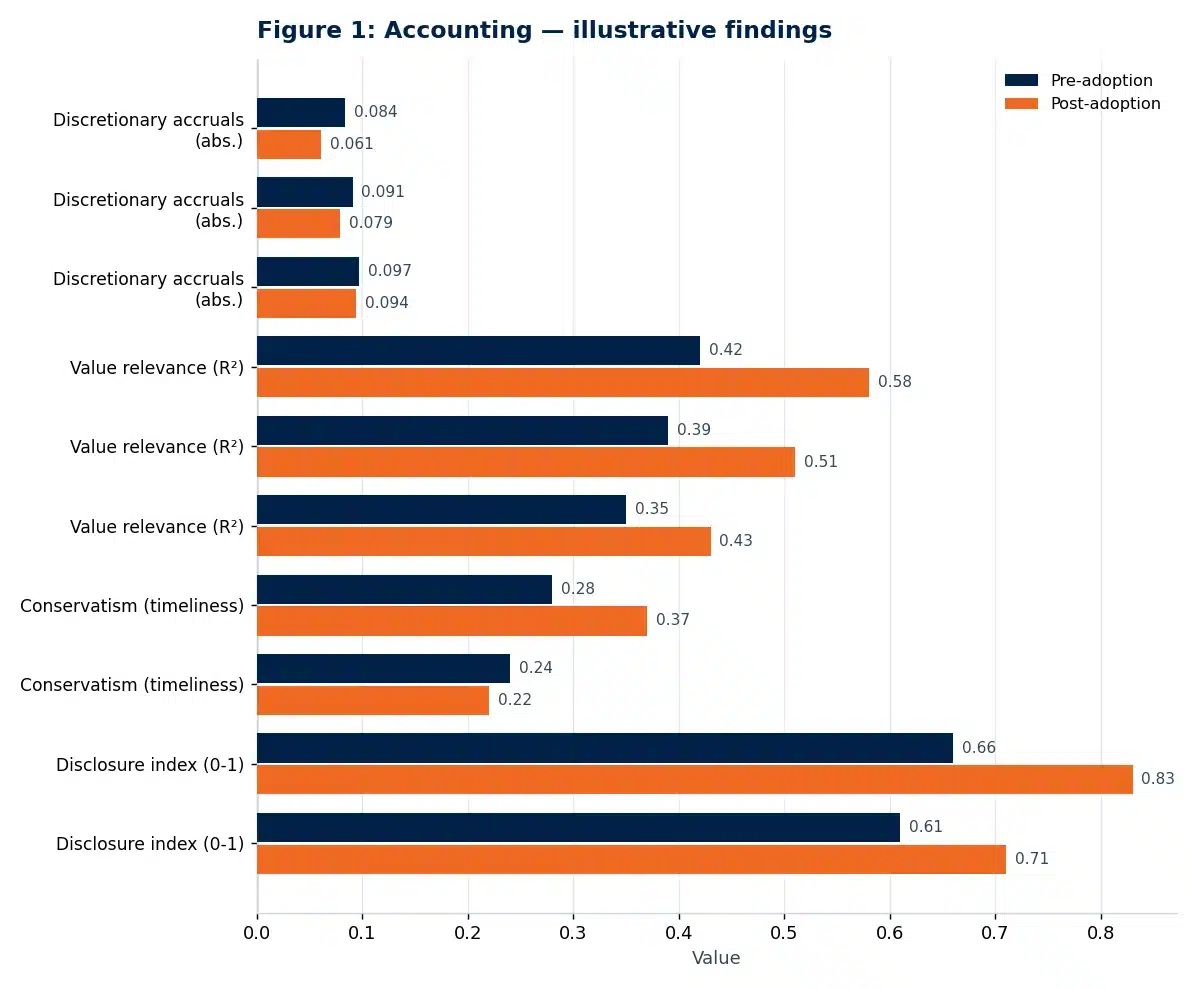
The disclosure index shows the largest and most consistent gains. This is intuitive, since IFRS imposes extensive mandatory note disclosures that firms must satisfy regardless of the surrounding enforcement environment.
Accounting conservatism presents the most equivocal picture. It improves under strong enforcement but stagnates or slightly deteriorates under weak enforcement, echoing the concerns raised by Ahmed et al. (2013).
Interpreting the accruals results, the sharp reduction under strong enforcement suggests that IFRS constrains opportunistic accrual choices only when a credible oversight regime penalises non-compliance and aggressive judgement.
The near-absence of change under weak enforcement is analytically telling. It implies that formally adopting superior standards does little where the incentive to comply and the capacity to detect manipulation remain underdeveloped.
Taken together, the patterns support a contingent reading of IFRS effects. Improvements are real but concentrated, driven as much by the institutional context as by the technical content of the standards themselves.
The relative uniformity of disclosure gains, contrasted with the divergence in accruals and conservatism, further suggests that IFRS influences the volume of information more reliably than the faithfulness of its measurement.
The findings resonate strongly with the contingent view articulated in the literature review. IFRS adoption is associated with improved reporting quality, but the improvement is neither automatic nor uniform across contexts.
The pronounced reduction in discretionary accruals under strong enforcement corroborates Barth et al. (2008), who linked international standards to reduced earnings management. The mechanism, however, appears conditional rather than intrinsic.
Equally, the muted effects under weak enforcement align with Ball et al. (2003) and Christensen et al. (2013), reinforcing the argument that standards and enforcement are complements rather than substitutes.
The consistent rise in value relevance across all tiers offers partial support to the optimistic camp. Even where enforcement is weak, expanded disclosure and fair value inputs appear to make accounting numbers more informative to markets.
Yet the divergent conservatism results temper this optimism. The deterioration under weak enforcement suggests that managerial discretion inherent in principles-based standards can be exploited, consistent with Ahmed et al. (2013).
A coherent interpretation is that IFRS raises the ceiling of achievable reporting quality without raising the floor. It equips firms to report better but does not compel those lacking incentives to do so.
This has significant theoretical implications. It positions accounting quality as a function of the interaction between standards and institutions, rather than a property of standards alone, extending the incentives-based perspective of Leuz et al. (2003).
For regulators, the practical implication is that adopting IFRS should be accompanied by parallel investment in enforcement, auditor oversight and securities regulation. Standard-setting without institutional reform risks disappointment.
For standard-setters, the results highlight the tension between the flexibility of principles-based standards and the discretion they confer. Guidance and consistent interpretation matter as much as the principles themselves.
For preparers and auditors, the findings underscore that credible compliance, not mere formal adoption, is what markets ultimately reward through improved value relevance and, plausibly, a lower cost of capital.
The analysis also carries implications for investors. Cross-border comparability improves under IFRS, but investors should remain attentive to the enforcement environment when assessing the reliability of reported figures.
This paper set out to evaluate the impact of IFRS adoption on financial reporting quality and to identify the conditions under which improvements occur. It employed a multidimensional conception of quality and an illustrative cross-country design.
The evidence points to a nuanced conclusion. IFRS adoption is associated with modest but genuine gains in reporting quality, most visibly through reduced earnings management, enhanced value relevance and richer disclosure.
Crucially, these gains are strongly conditioned by enforcement strength and firm-level incentives. Improvements concentrate where credible oversight exists and largely evaporate where it does not.
The central contribution is to reaffirm and illustrate a contingent theory of accounting quality. IFRS is best understood as a necessary but insufficient condition for higher-quality reporting.
This reframes the policy debate away from the binary question of whether to adopt IFRS towards the more productive question of how to build the institutional infrastructure that allows its benefits to be realised.
Several recommendations follow from the analysis, directed at the principal actors in the reporting ecosystem.
The study is subject to the limitations of its illustrative design, and its figures should be read as demonstrative rather than confirmatory. This constrains the generalisability of the specific magnitudes reported.
Future research could extend the analysis using genuine longitudinal panel data across a wider set of jurisdictions, incorporating the transition to expected-loss impairment and evolving fair value requirements.
Further work might also examine how digital reporting, sustainability disclosure and the convergence between IFRS and other frameworks reshape reporting quality in the coming decade. These developments promise to keep the debate vibrant.

All work is written by human writers. 100% AI free, guaranteed.

100% money back guarantee if you find plagiarism in our work.
COMPANY DETAILS






