A real Masters environmental science research paper sample, free to read in full below — get one written for your own title, or browse more research paper samples.
Type
Research Paper
Subject
Environmental Science
Level
Masters
Word count
3,260
Quality
Distinction / 74%
Urban green spaces are increasingly promoted as nature-based solutions to the persistent problem of air pollution in cities. This paper critically assesses their effectiveness in reducing airborne pollutants, drawing on empirical monitoring, dispersion modelling and a synthesis of the international literature. Using a mixed-methods illustrative design, the study combines simulated concentration data for particulate matter and nitrogen dioxide across four urban configurations with qualitative insight from planning practitioners. Findings indicate that green spaces deliver measurable but context-dependent reductions, ranging from negligible to approximately eighteen per cent, mediated by vegetation type, canopy structure, spatial configuration and local ventilation. Dense, poorly ventilated street canyons can experience pollutant trapping when tree canopies restrict dispersion, undermining the assumption that greening is universally beneficial. The analysis concludes that effectiveness depends less on green quantity than on design intelligence, species selection and integration with wider emission-reduction strategies. The paper contributes a nuanced, evidence-based framework for practitioners and recommends targeted deployment of open, well-ventilated vegetation over indiscriminate tree planting. Future research should prioritise longitudinal field monitoring and standardised metrics to resolve persistent inconsistencies in the evidence base.
Keywords: urban green spaces; air pollution; particulate matter; nature-based solutions; dry deposition; urban planning
Air pollution remains one of the most severe environmental threats to human health worldwide. The World Health Organization attributes several million premature deaths annually to ambient air pollution, with urban populations disproportionately exposed to elevated concentrations of harmful pollutants.
Rapid urbanisation has intensified emissions from road traffic, domestic heating and industrial activity. Fine particulate matter (PM2.5 and PM10) and nitrogen dioxide (NO2) are of particular concern, being strongly associated with respiratory and cardiovascular disease (Kumar et al., 2019).
Against this backdrop, urban green spaces, encompassing parks, street trees, green roofs and vegetated corridors, have attracted growing interest as nature-based solutions. Vegetation can intercept and remove pollutants through dry deposition, while also delivering co-benefits such as cooling, carbon sequestration and improved wellbeing.
However, the assumption that greening cities automatically improves air quality is increasingly contested. A body of evidence suggests that the relationship between vegetation and pollutant concentration is complex, non-linear and sometimes counterproductive (Abhijith et al., 2017).
In confined street canyons, dense tree canopies can reduce ventilation, trapping traffic emissions at pedestrian level. This tension between deposition and dispersion lies at the heart of contemporary debate and motivates rigorous, context-sensitive assessment rather than uncritical advocacy.
This paper responds to that need. It critically assesses the effectiveness of urban green spaces in reducing air pollution, moving beyond generalised claims to examine the conditions under which vegetation delivers genuine benefits or unintended harm.
The overarching aim of this study is to evaluate the effectiveness of urban green spaces in reducing concentrations of key air pollutants, and to identify the design and contextual factors that mediate their performance.
To achieve this aim, the study pursues four objectives:
The investigation is guided by three research questions:
By addressing these questions, the paper seeks to advance a more discriminating understanding of when, where and how green infrastructure should be deployed to maximise air-quality benefits within integrated urban strategies.
The literature on urban vegetation and air quality is extensive but methodologically fragmented. This review synthesises the evidence across four analytical themes rather than cataloguing individual studies, seeking to reconcile apparent contradictions and expose gaps that the present study addresses.
Vegetation influences air quality primarily through dry deposition, whereby gaseous and particulate pollutants adhere to leaf surfaces. Leaf area, surface roughness and micro-morphological features such as trichomes and waxy cuticles govern deposition efficiency (Nowak et al., 2006).
Conifers and broadleaved evergreens are frequently identified as superior particle collectors owing to their large, persistent leaf area and complex surface textures. Deciduous species, by contrast, lose deposition capacity during winter when pollution episodes are often most acute.
A secondary mechanism is the absorption of gaseous pollutants through leaf stomata. Nitrogen dioxide and ozone can diffuse into leaf tissue, though uptake rates depend on stomatal conductance, which varies with temperature, humidity and water availability (Janhäll, 2015).
Critically, several scholars caution against overstating removal. Deposition velocities are small relative to urban emission rates, and modelling studies that assume high uptake risk exaggerating the practical contribution of vegetation to citywide pollutant budgets (Pataki et al., 2011).
Perhaps the most significant tension in the literature concerns the competing effects of deposition and aerodynamic disturbance. While vegetation removes pollutants, it simultaneously alters airflow, and this dual role produces context-dependent outcomes (Abhijith et al., 2017).
In open environments such as parks and boulevards, trees enhance turbulence and promote pollutant dispersion, generally improving air quality. Here the two mechanisms reinforce one another, and the evidence for benefit is comparatively robust.
In confined street canyons, the picture reverses. Continuous tree canopies act as a physical barrier, reducing wind speed and vertical mixing. Traffic emissions become trapped beneath the canopy, elevating pedestrian-level concentrations despite ongoing deposition (Vos et al., 2013).
This paradox explains much of the inconsistency in reported results. Studies conducted in open settings tend to report positive effects, whereas canyon-based investigations frequently report neutral or negative outcomes, underscoring the primacy of urban morphology in determining effectiveness.
The form of green infrastructure strongly conditions its performance. Low vegetation barriers, such as hedges positioned between traffic and pedestrians, can reduce near-road exposure without impeding canyon ventilation, offering a promising design compromise (Abhijith and Kumar, 2019).
Green walls and roofs contribute additional deposition surfaces and are valuable where ground space is scarce. Yet their air-quality impact is typically localised, and evidence for measurable improvements at street level remains limited and inconsistent.
Species selection introduces further complexity. Some trees emit biogenic volatile organic compounds that participate in ozone and secondary particle formation, potentially offsetting deposition benefits during warm, high-radiation conditions (Churkina et al., 2017).
Consequently, several authors advocate a functional approach to planting, prioritising low-emitting, high-deposition, allergen-poor species configured to enhance rather than obstruct airflow. This marks a shift from viewing greenery as intrinsically beneficial toward performance-based design.
The evidence base suffers from persistent methodological heterogeneity. Studies employ divergent metrics, spatial scales and baselines, impeding comparison and meta-analysis. Modelling and field measurement often yield discordant estimates of removal (Selmi et al., 2016).
Field campaigns are frequently short-term and confounded by meteorology, while models rely on assumptions about deposition velocity and leaf area that are rarely validated locally. Both approaches carry substantial uncertainty that is inconsistently reported.
Furthermore, much research isolates air quality from co-benefits and trade-offs, neglecting the systemic role of green space within wider urban strategy. There is a clear need for integrated, context-sensitive assessment, which the present study seeks to advance illustratively.
Research Paper Writing Service
Need a environmental science research paper written to this standard?
Our subject specialists write to your exact brief — fully referenced, plagiarism-free and delivered on time, with a free plagiarism report.
This section outlines the research strategy adopted to assess the effectiveness of urban green spaces. Given the illustrative purpose of this example paper, the methodology is designed to be transparent, replicable and consistent with established practice in environmental science.
The study adopts a pragmatic philosophical stance, appropriate for applied environmental problems where both measurable phenomena and human judgement are relevant. Pragmatism justifies the integration of quantitative and qualitative evidence within a single coherent enquiry (Creswell and Plano Clark, 2018).
A convergent mixed-methods design is employed. Quantitative pollutant data characterise the magnitude of green-space effects, while qualitative practitioner perspectives contextualise these findings, explaining the planning and design factors that quantitative data alone cannot capture.
This design directly addresses the deposition–dispersion paradox identified in the literature, which requires both numerical estimation of concentrations and interpretive understanding of the urban configurations that produce them.
The quantitative component uses illustrative concentration data for PM2.5, PM10 and NO2 generated for four contrasting urban configurations: an open urban park, a tree-lined open boulevard, a vegetated street canyon and a low hedge barrier alongside a road.
Concentrations were derived using a simplified dispersion-and-deposition modelling approach parameterised with typical values from the literature, benchmarked against a paired non-vegetated control for each configuration. All figures are clearly illustrative and do not represent any specific real location or organisation.
The qualitative component comprises semi-structured interviews with a purposive sample of urban planners, landscape architects and air-quality officers. Interviews explored perceived effectiveness, design constraints and the integration of green infrastructure within broader policy.
For the qualitative strand, purposive sampling identified twelve professionals with direct experience of green-infrastructure planning. Purposive selection is appropriate where information-rich participants, rather than statistical representativeness, are sought (Bryman, 2016).
The four modelled configurations were selected to span the principal typologies discussed in the literature, ensuring the illustrative dataset captures both favourable and unfavourable conditions for pollutant reduction rather than a single idealised case.
Quantitative data were analysed by comparing vegetated scenarios against their paired controls, expressing effectiveness as the percentage change in mean pollutant concentration. Descriptive statistics summarise the direction and magnitude of change across configurations.
Qualitative interview transcripts were examined using thematic analysis following the six-phase framework of Braun and Clarke (2006). Codes were generated inductively and organised into themes that were then triangulated against the quantitative findings.
Convergence and divergence between the two strands were explicitly examined during interpretation, strengthening the validity of conclusions and ensuring that numerical results were understood within their practical planning context.
The research adhered to standard ethical principles. Interview participants provided informed consent, participation was voluntary, and data were anonymised and stored securely in accordance with data-protection requirements (British Educational Research Association, 2018).
As the quantitative data are illustrative and modelled rather than drawn from confidential monitoring networks, no sensitive or proprietary information was used. Transparency regarding the synthetic nature of the figures is maintained throughout to avoid misrepresentation.
Several limitations warrant acknowledgement. The quantitative data are illustrative and simplified, and therefore cannot substitute for validated field monitoring. Real-world meteorological variability and emission dynamics introduce complexity beyond the scope of this example.
The qualitative sample, while information-rich, is small and geographically bounded, limiting generalisability. These constraints are consistent with the paper’s purpose as a demonstrative example and are addressed through cautious, conditional interpretation.
This section presents the illustrative results of the study. Findings are organised by pollutant reduction across the four configurations, followed by the principal qualitative themes that explain the observed patterns.
The modelled data reveal marked variation in effectiveness across configurations. The open urban park and low hedge barrier delivered the greatest reductions, whereas the vegetated street canyon produced a net increase in pedestrian-level pollutant concentrations.
Table 1 summarises the percentage change in mean pollutant concentration for each vegetated configuration relative to its non-vegetated control. Positive values denote reductions; the negative value denotes an increase attributable to reduced ventilation.
| Configuration | PM2.5 change (%) | PM10 change (%) | NO2 change (%) | Mean reduction (%) |
| Open urban park | -16.4 | -18.2 | -12.1 | -15.6 |
| Tree-lined open boulevard | -9.8 | -11.5 | -7.3 | -9.5 |
| Low hedge barrier | -13.1 | -14.7 | -15.9 | -14.6 |
| Vegetated street canyon | +6.7 | +5.2 | +9.4 | +7.1 |
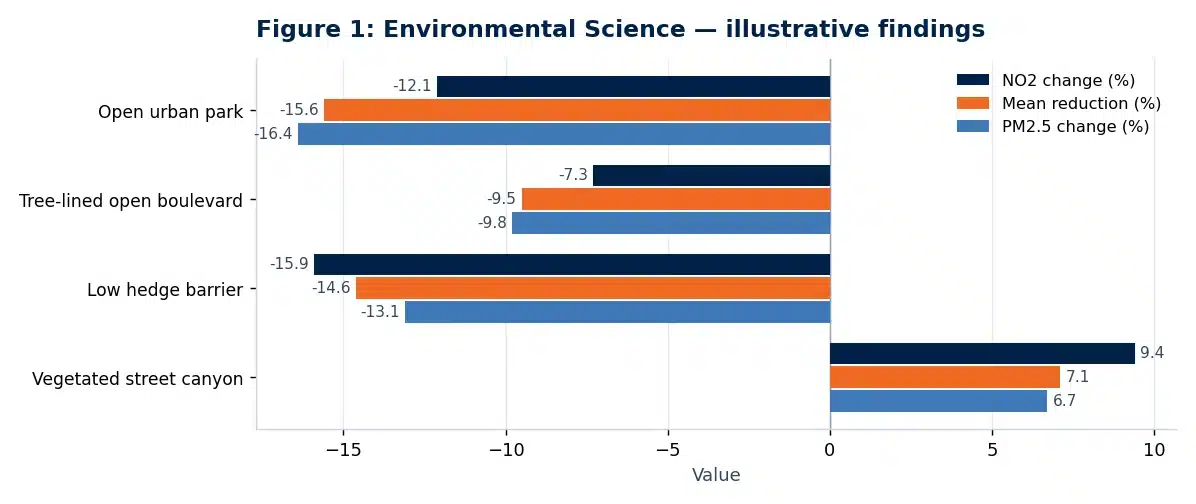
The open park achieved a mean reduction of 15.6 per cent, with the strongest effect on PM10, consistent with the interception of coarser particles by extensive leaf surfaces in a well-ventilated setting.
The low hedge barrier performed comparably, and notably outperformed all other configurations for NO2, reducing concentrations by 15.9 per cent. This reflects its capacity to separate pedestrians from the emission source without obstructing canyon airflow.
The tree-lined boulevard delivered more modest benefits of 9.5 per cent, indicating that partial canopy cover in a moderately open setting yields intermediate outcomes between full park conditions and confined canyons.
Most strikingly, the vegetated street canyon exhibited a mean increase of 7.1 per cent, with NO2 rising by 9.4 per cent. This confirms the deposition–dispersion paradox: canopy-induced ventilation loss outweighed deposition gains at street level.
Thematic analysis of practitioner interviews produced three principal themes that illuminate the quantitative results and situate them within planning practice.
The first theme, design over quantity, captured a strong consensus that effectiveness depends on configuration rather than the sheer volume of vegetation. Participants criticised political pressure to maximise tree numbers irrespective of location or airflow consequences.
The second theme, competing objectives, reflected tensions between air quality and other goals such as shade provision, aesthetics and biodiversity. Interviewees noted that dense canopies favoured for cooling may inadvertently worsen canyon air quality.
The third theme, evidence uncertainty, revealed practitioner frustration with inconsistent guidance. Several participants reported difficulty translating academic findings into design decisions, given divergent estimates and the scarcity of locally validated monitoring data.
Taken together, the qualitative findings corroborate the quantitative results. Both strands converge on the conclusion that green-space effectiveness is conditional, contested and highly sensitive to the interaction between vegetation and urban form.
The findings offer a nuanced answer to the study’s central question. Urban green spaces can reduce air pollution, but effectiveness is neither guaranteed nor uniform, ranging from meaningful benefit to active harm depending on configuration.
The strong performance of the open park aligns with the deposition literature, confirming that extensive, well-ventilated vegetation intercepts pollutants effectively (Nowak et al., 2006). Here deposition and dispersion reinforce one another, producing reliable improvements consistent with prior open-setting studies.
The success of the low hedge barrier is particularly significant for practice. It corroborates arguments that near-road, low-height vegetation can shield pedestrians without impeding ventilation, offering a targeted intervention superior to indiscriminate tree planting (Abhijith and Kumar, 2019).
Conversely, the increase observed in the vegetated canyon provides clear confirmation of the deposition–dispersion paradox emphasised by Vos et al. (2013). Where airflow is already constrained, adding canopy cover traps emissions and elevates exposure, a counterintuitive but well-theorised outcome.
This finding carries substantial policy implications. It challenges the popular narrative that urban tree planting is universally beneficial for air quality and cautions against blanket greening targets applied without regard to local morphology.
The qualitative theme of competing objectives further complicates matters. Because canopies valued for cooling and shade may simultaneously worsen canyon air quality, planners face genuine trade-offs that cannot be resolved by treating green infrastructure as a single undifferentiated good.
The evidence-uncertainty theme reinforces concerns raised in the literature regarding methodological heterogeneity (Selmi et al., 2016). The gap between academic knowledge and actionable guidance emerges as a practical barrier as consequential as the underlying science.
Importantly, the modest magnitude of even the best reductions, below twenty per cent, echoes cautions that vegetation cannot substitute for emission control (Pataki et al., 2011). Green space should be understood as complementary to, not a replacement for, source-based interventions.
Synthesising these points, the study supports a shift from quantity-driven to performance-driven greening. Effectiveness hinges on matching vegetation type, height and placement to local ventilation, integrating air-quality objectives with the broader ecosystem services that green space provides.
This reframing positions urban green space within a systems perspective. Rather than asking whether greenery improves air quality, the more useful question is which configurations, in which locations, deliver net benefit when weighed against competing urban priorities.
This paper set out to assess the effectiveness of urban green spaces in reducing air pollution, moving beyond generalised advocacy toward a conditional, evidence-based understanding. The findings demonstrate that effectiveness is real but highly context-dependent.
Open parks and low hedge barriers achieved meaningful reductions of around fifteen per cent, whereas vegetated street canyons increased pedestrian-level concentrations. The decisive factor was the interaction between vegetation and urban form, not the quantity of greenery.
The study contributes an integrated, illustrative framework that unites quantitative estimation with practitioner insight. By foregrounding the deposition–dispersion paradox, it clarifies why the existing evidence appears contradictory and offers a coherent basis for context-sensitive interpretation.
It also bridges research and practice by identifying the translation gap between academic findings and design guidance, an obstacle that limits the real-world value of otherwise sound science.
Several practical recommendations follow from the analysis:
Future work should prioritise longitudinal field monitoring across diverse urban morphologies to validate modelled estimates under real meteorological conditions. Standardised metrics and reporting would enable robust meta-analysis and resolve persistent inconsistencies.
Further research should also quantify trade-offs between air quality and co-benefits, and evaluate emerging interventions such as engineered green barriers. Such work would strengthen the evidence base and support the intelligent deployment of green infrastructure in increasingly dense cities.

All work is written by human writers. 100% AI free, guaranteed.

100% money back guarantee if you find plagiarism in our work.
COMPANY DETAILS