A real Undergraduate education research paper sample, free to read in full below — get one written for your own title, or browse more research paper samples.
Type
Research Paper
Subject
Education
Level
Undergraduate
Word count
2,770
Quality
2:1 / 65%
Blended learning, which integrates face-to-face instruction with online delivery, has become a dominant model within higher education. Its rapid expansion, accelerated by the COVID-19 pandemic, has raised pressing questions about its effect on student engagement.
This paper investigates how blended learning influences behavioural, emotional and cognitive engagement among undergraduate students. It adopts a pragmatic mixed-methods design, combining a questionnaire distributed to 120 students with semi-structured interviews involving twelve participants at a single university.
The findings indicate that blended learning is associated with heightened engagement, particularly through increased flexibility, autonomy and opportunities for active participation. However, the analysis also reveals that poorly structured designs, digital fatigue and unequal access can undermine these gains substantially.
Interpreting the results through Moore’s theory of transactional distance and self-determination theory, the study argues that engagement depends less on technology itself than on intentional pedagogical design. Consistent structure, timely feedback and social presence emerge as decisive factors.
The paper concludes that blended learning offers considerable potential to enhance engagement when institutions invest in staff development and coherent course design. Recommendations and directions for further research are provided.
Keywords: blended learning, student engagement, higher education, transactional distance, self-determination theory, undergraduate
Higher education has undergone profound transformation over the past two decades, driven by digital technologies and shifting student expectations. Among the most significant developments is the widespread adoption of blended learning as a mainstream mode of delivery.
Blended learning refers to the deliberate integration of in-person teaching with online, technology-mediated activities (Garrison and Kanuka, 2004). Rather than simply supplementing lectures with digital resources, it involves a purposeful redesign of the learning experience across physical and virtual spaces.
The COVID-19 pandemic accelerated this shift dramatically. What had been a gradual evolution became an urgent necessity, and many institutions retained blended provision once restrictions eased. Consequently, blended learning is now embedded within routine undergraduate teaching rather than treated as experimental.
This transition carries important implications for student engagement, a construct widely regarded as central to academic success. Engagement encompasses the effort, attention and emotional investment students dedicate to their learning (Fredricks, Blumenfeld and Paris, 2004).
Engagement matters because it correlates strongly with retention, achievement and satisfaction. Disengaged students are more likely to withdraw, underperform or experience diminished wellbeing. Understanding how delivery models shape engagement is therefore a priority for educators and institutions alike.
Despite enthusiasm for blended learning, evidence regarding its impact on engagement remains mixed. Some studies report enhanced participation and motivation, while others document isolation, disorientation and reduced attendance. This inconsistency suggests that outcomes depend heavily on implementation quality.
Much existing research also focuses narrowly on achievement outcomes, neglecting the multidimensional nature of engagement. There is a need to examine behavioural, emotional and cognitive dimensions together, particularly from the perspective of undergraduate students themselves.
This study aims to examine the impact of blended learning on undergraduate student engagement and to identify the design factors that mediate this relationship. It seeks to move beyond simplistic claims that technology inherently improves learning.
The research is guided by the following questions:
By addressing these questions, the paper contributes practical insight for course designers alongside a theoretically informed account of engagement in contemporary higher education.
This review synthesises scholarship on blended learning and engagement across three themes: conceptualisations of engagement, the pedagogical affordances of blended designs, and the barriers that constrain their effectiveness. It highlights tensions and gaps rather than merely cataloguing studies.
Engagement is a contested and multidimensional construct. Fredricks, Blumenfeld and Paris (2004) offer an influential tripartite model comprising behavioural, emotional and cognitive dimensions, a framework widely adopted in subsequent research.
Behavioural engagement concerns participation, attendance and effort. Emotional engagement captures interest, belonging and affective reactions to learning. Cognitive engagement reflects the investment students make in deep understanding and self-regulation.
Kahu (2013) critiques narrowly behavioural measures, arguing that engagement is a dynamic psychosocial process shaped by institutional and personal contexts. This holistic view is valuable because it resists reducing engagement to easily counted proxies such as clicks or attendance.
Such distinctions matter for blended learning research. A student may appear behaviourally active online yet remain cognitively disengaged, or conversely feel emotionally connected despite limited visible participation. Any robust evaluation must therefore attend to all three dimensions simultaneously.
Proponents argue that blended learning combines the strengths of both modes. Garrison and Kanuka (2004) contend that it can foster higher-order learning by uniting the reflective potential of online discourse with the immediacy of classroom interaction.
The Community of Inquiry framework developed by Garrison, Anderson and Archer (2000) provides theoretical grounding here. It proposes that meaningful learning emerges from the interplay of social, cognitive and teaching presence, all of which blended designs can cultivate.
Flexibility is frequently cited as a key benefit. Asynchronous materials allow students to revisit content, learn at their own pace and reconcile study with external commitments (Boelens, De Wever and Voet, 2017). This autonomy may strengthen emotional and cognitive engagement.
Self-determination theory (Ryan and Deci, 2000) helps explain why. By supporting autonomy, competence and relatedness, well-designed blended environments can nurture intrinsic motivation, which is closely linked to sustained engagement and deeper learning.
Active learning approaches, such as the flipped classroom, illustrate these affordances. Delivering content online frees contact time for problem-solving and discussion, potentially increasing participation (Ma and Lee, 2021). Evidence nonetheless suggests benefits depend on students completing preparatory work.
A more sceptical literature cautions against technological optimism. Selwyn (2016) warns that digital education can reproduce inequalities and privilege institutional efficiency over pedagogical value, urging critical scrutiny of claimed benefits.
The digital divide remains a persistent concern. Unequal access to devices, connectivity and quiet study space disadvantages some students, potentially widening rather than narrowing attainment gaps (Anderson, 2020).
Transactional distance is a further risk. Moore (1993) argues that geographical and communicative separation can create psychological distance between learners and teachers, weakening engagement unless offset by dialogue and structure.
Poorly designed blended courses may also overwhelm students. Excessive or fragmented online tasks generate cognitive overload and digital fatigue, eroding motivation (Boelens, De Wever and Voet, 2017). Structure and coherence therefore appear essential.
Taken together, the literature suggests that blended learning is neither inherently beneficial nor harmful. Its impact on engagement is contingent on design quality, institutional support and equitable access. This study addresses that contingency empirically.
Research Paper Writing Service
Need a education research paper written to this standard?
Our subject specialists write to your exact brief — fully referenced, plagiarism-free and delivered on time, with a free plagiarism report.
This section outlines the methodological choices underpinning the study, including its philosophical stance, design, data collection, sampling, analysis, ethics and limitations. The approach is illustrative, reflecting the paper’s purpose as an academic exemplar.
The study adopts a pragmatic philosophical position, which prioritises research questions over allegiance to a single paradigm. Pragmatism justifies combining quantitative and qualitative methods to generate a fuller understanding of a complex phenomenon (Creswell and Plano Clark, 2018).
An inductive-deductive blend is employed. Established engagement theory informs the questionnaire, while interviews remain open to unanticipated themes. This balance allows both testing and exploration within a single enquiry.
A convergent mixed-methods design was selected. Quantitative and qualitative data were collected concurrently, analysed separately and then integrated during interpretation to corroborate and enrich the findings.
This design suits the multidimensional nature of engagement. Survey data capture broad patterns across the student body, whereas interviews illuminate the meanings and experiences underlying those patterns.
The primary quantitative instrument was an online questionnaire comprising demographic items and twenty statements measured on a five-point Likert scale. Items were adapted from validated engagement scales to enhance reliability.
Qualitative data derived from twelve semi-structured interviews, each lasting approximately thirty minutes. An interview guide ensured consistency while permitting participants to elaborate on their experiences of blended modules.
A total of 120 undergraduate students completed the questionnaire, recruited through convenience sampling across several faculties. This scale provides reasonable breadth for an illustrative study of this kind.
Interview participants were selected purposively to reflect variation in year of study, discipline and self-reported engagement. This strategy maximised the diversity of perspectives captured within a small qualitative sample.
Quantitative data were analysed using descriptive statistics, including means and percentages, to summarise engagement across the three dimensions. Simple comparisons highlighted differences between course design features.
Qualitative data were examined through thematic analysis following Braun and Clarke (2006). Transcripts were coded systematically, and codes were clustered into themes that were reviewed, refined and defined before reporting.
Ethical approval was obtained prior to data collection. Participation was voluntary, and informed consent was secured from all respondents, who were free to withdraw without consequence.
Anonymity and confidentiality were protected by removing identifying details and storing data securely. These safeguards align with established principles for ethical educational research (BERA, 2018).
Several limitations warrant acknowledgement. The single-institution sample and convenience recruitment limit generalisability, and self-reported measures may be affected by social desirability bias.
Moreover, the cross-sectional design captures engagement at one moment rather than tracking change over time. Longitudinal research would offer stronger insight into how engagement evolves throughout a blended programme.
This section presents illustrative findings from the questionnaire and interviews. The figures are indicative and intended to demonstrate analytical reasoning rather than to report data from any real institution.
Overall, respondents reported positive engagement with blended learning. The majority agreed that flexibility improved their ability to participate, and many valued the opportunity to review recorded materials before assessments.
Engagement nonetheless varied across dimensions and design features. The table below summarises mean scores on a five-point scale, where higher values indicate stronger agreement or engagement.
| Engagement Dimension / Factor | Mean Score (out of 5) | Agreement (%) |
| Behavioural engagement (participation) | 3.9 | 78 |
| Emotional engagement (interest, belonging) | 3.4 | 65 |
| Cognitive engagement (deep learning) | 3.7 | 72 |
| Flexibility improved participation | 4.2 | 84 |
| Clear structure aided understanding | 4.0 | 80 |
| Experienced digital fatigue | 3.5 | 68 |
| Felt isolated during online components | 3.1 | 58 |
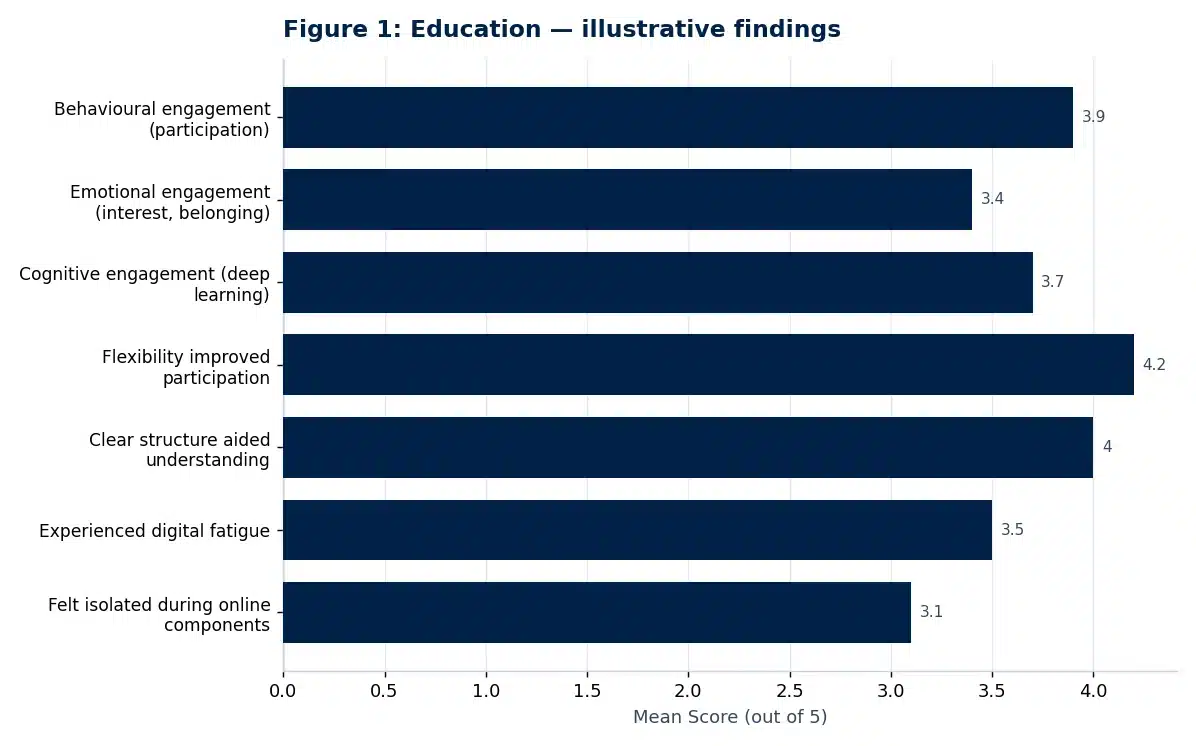
These results reveal a nuanced picture. Behavioural and cognitive engagement scored relatively highly, suggesting active participation and meaningful learning. Flexibility and structure attracted the strongest agreement, underlining their perceived importance.
Emotional engagement, by contrast, scored lowest. The moderate levels of reported isolation and the high incidence of digital fatigue indicate that affective and wellbeing dimensions represent the most vulnerable aspect of the blended experience.
Thematic analysis of the interviews generated three principal themes: autonomy and flexibility, the decisive role of structure, and social connection. These themes both corroborate and deepen the quantitative patterns.
Regarding autonomy, participants consistently praised the freedom to manage their own study. One student observed that revisiting recorded lectures allowed them to grasp difficult concepts at their own pace, reinforcing cognitive engagement.
Structure emerged as a pivotal theme. Students distinguished sharply between well-organised modules and disorganised ones. Where online and in-person elements were coherently linked, engagement flourished; where they felt disjointed, confusion and disengagement followed.
Social connection was the most ambivalent theme. Several participants described online components as isolating and missed spontaneous peer interaction. Others valued asynchronous discussion forums, provided tutors participated actively and responded promptly.
Integrating both strands, the findings suggest that blended learning enhances engagement primarily through flexibility and active learning, yet its emotional dimension depends on deliberate efforts to sustain social presence and coherent design.
The findings both confirm and complicate existing scholarship. This section interprets them in light of the reviewed literature and draws out implications for theory and practice.
The strong ratings for flexibility resonate with self-determination theory (Ryan and Deci, 2000). By enhancing autonomy, blended learning appears to nurture intrinsic motivation, which participants linked to sustained cognitive engagement and deeper understanding.
The prominence of structure supports Moore’s (1993) concept of transactional distance. Coherent design reduces psychological distance, whereas fragmentation increases it. Structure functioned as the mechanism through which flexibility translated into productive engagement rather than confusion.
The comparatively weak emotional engagement corroborates concerns about isolation raised by Anderson (2020) and Selwyn (2016). Flexibility carries a cost: reduced spontaneous interaction can erode the sense of belonging central to emotional engagement.
This tension illuminates the Community of Inquiry framework (Garrison, Anderson and Archer, 2000). Cognitive and teaching presence were evidently well supported, but social presence was more fragile, requiring active cultivation through responsive tutoring and interactive tasks.
The findings therefore challenge deterministic narratives about educational technology. Consistent with Boelens, De Wever and Voet (2017), they indicate that engagement flows not from technology itself but from the pedagogical design surrounding it.
Several practical implications follow. First, institutions should prioritise coherent course design that explicitly integrates online and face-to-face elements, ensuring each component reinforces the other rather than competing for attention.
Second, deliberate strategies are needed to sustain social presence, such as collaborative tasks, active tutor participation in forums and structured opportunities for peer interaction. Emotional engagement should not be left to chance.
Third, the prevalence of digital fatigue suggests that online workload must be managed carefully. Concise, purposeful activities are preferable to an accumulation of tasks that overwhelm students and undermine motivation.
This paper examined the impact of blended learning on undergraduate student engagement across behavioural, emotional and cognitive dimensions. Using an illustrative mixed-methods design, it explored both the benefits and the limitations of blended provision.
The findings indicate that blended learning can meaningfully enhance engagement, particularly through the flexibility and autonomy it affords and the active learning it enables. Behavioural and cognitive engagement were notably strong among respondents.
However, the study also identified persistent challenges. Emotional engagement was weaker, with isolation and digital fatigue emerging as significant risks. These difficulties reflect the importance of design quality rather than any inherent flaw in the model.
The central contribution is to reaffirm that technology alone does not determine engagement. Instead, thoughtful pedagogical design, structural coherence and attention to social presence mediate whether blended learning fulfils its potential.
Institutions should invest in staff development to build educators’ capacity for effective blended design. Training should emphasise integration, workload management and techniques for fostering belonging within online environments.
Course teams are advised to embed regular, timely feedback and interactive elements that strengthen social and teaching presence. Clear signposting between online and in-person activities is likewise essential to reduce transactional distance.
Future studies should employ longitudinal, multi-institutional designs to track how engagement evolves and to enhance generalisability. Comparative research across disciplines would clarify whether particular subjects benefit more from blended approaches.
Further work might also examine the experiences of disadvantaged students specifically, ensuring that the pursuit of flexible provision does not inadvertently deepen existing inequalities in higher education.

All work is written by human writers. 100% AI free, guaranteed.

100% money back guarantee if you find plagiarism in our work.
COMPANY DETAILS