A real Masters law research paper sample, free to read in full below — get one written for your own title, or browse more research paper samples.
Type
Research Paper
Subject
Law
Level
Masters
Word count
3,587
Quality
Merit / 68%
The General Data Protection Regulation (GDPR), which became applicable across the European Union on 25 May 2018, was heralded as a paradigm shift in the governance of personal data. This paper critically evaluates the effectiveness of the GDPR in protecting consumer data privacy, situating the analysis within the broader debate on regulatory design and enforcement.
Adopting a doctrinal-empirical hybrid approach, the study combines analysis of the regulatory text, enforcement decisions and secondary scholarship with an illustrative examination of enforcement patterns between 2018 and 2024. It interrogates whether the Regulation’s rights-based architecture has translated into meaningful protection for consumers, or whether structural weaknesses have blunted its promise.
The findings suggest that the GDPR has strengthened consumer awareness, elevated organisational accountability and established a credible sanctioning regime. However, effectiveness is constrained by uneven cross-border enforcement, the persistence of consent fatigue and asymmetries of power between individuals and dominant data controllers. The paper concludes that the GDPR is a necessary but partial instrument, and that procedural reform of enforcement is essential to realise its protective ambition.
Keywords: GDPR, data protection, consumer privacy, enforcement, consent, accountability, European Union law.
The digital economy is built upon the systematic collection, aggregation and monetisation of personal data. Consumers routinely disclose intimate information in exchange for ostensibly free services, generating profound asymmetries of knowledge and power between individuals and the organisations that process their data (Zuboff, 2019).
Against this backdrop, the European Union enacted the General Data Protection Regulation (Regulation (EU) 2016/679), which replaced the 1995 Data Protection Directive and became applicable on 25 May 2018. The Regulation aspired to harmonise data protection law across Member States and to restore individual control over personal information.
The GDPR is frequently described as the most consequential privacy instrument of the modern era, influencing legislative reform far beyond Europe (Bradford, 2020). Its extraterritorial reach, substantial administrative fines and rights-based framework signalled a decisive regulatory intervention into the data economy.
Yet the passage of time has revealed a gap between legislative ambition and practical effect. Critics contend that enforcement has been slow, fragmented and disproportionately lenient towards the largest technology firms, while consumers continue to experience surveillance and manipulation (Veale and Zuiderveen Borgesius, 2021).
The central problem this paper addresses is whether the GDPR, as designed and enforced, actually protects consumer data privacy in a meaningful and measurable way. Formal legal rights may exist on paper without delivering substantive protection in practice.
This tension between formal and substantive protection lies at the heart of regulatory scholarship. A regulation may be well drafted yet ineffective if enforcement mechanisms are weak, if compliance is superficial, or if the regulated parties retain the capacity to circumvent its intent.
The aim of this paper is to critically evaluate the effectiveness of the GDPR in protecting consumer data privacy. Effectiveness is understood here in three dimensions: rights realisation, organisational accountability, and credible enforcement.
The objectives are as follows:
The study is guided by three research questions. First, to what extent has the GDPR strengthened consumers’ practical control over their personal data? Second, how effective is the Regulation’s enforcement architecture in deterring non-compliance?
Third, what structural or procedural reforms would enhance the GDPR’s protective effectiveness? These questions frame the doctrinal and empirical analysis that follows, and structure the discussion and conclusion.
The scholarly literature on the GDPR is voluminous and contested. This review synthesises the debate around four analytical themes: the rights-based paradigm, the accountability principle, the enforcement architecture, and the behavioural limits of consent.
The GDPR is grounded in a fundamental-rights conception of data protection, derived from Article 8 of the Charter of Fundamental Rights of the European Union. It confers a suite of enforceable rights, including access, rectification, erasure, portability and objection.
Lynskey (2015) argues that data protection has emerged as an autonomous fundamental right, distinct from privacy, oriented towards controlling informational power. On this account the Regulation is not merely instrumental but expressive of a constitutional commitment to individual dignity and autonomy.
However, several scholars question whether rights conferral translates into effective protection. Solove (2013) develops the influential critique of “privacy self-management”, contending that individuals lack the time, information and cognitive capacity to make meaningful choices about data processing.
This critique is significant because the GDPR relies heavily on individual agency. If consumers cannot realistically exercise their rights, the rights-based paradigm risks becoming symbolic rather than substantive. The literature thus reveals a foundational tension in the Regulation’s design.
Ausloos (2020) offers a partial rejoinder, arguing that the right to erasure and related rights can function as levers of accountability even when exercised infrequently, because they compel controllers to build compliant systems. Rights, on this view, discipline organisational behaviour indirectly.
A defining innovation of the GDPR is the accountability principle in Article 5(2), which requires controllers to demonstrate compliance rather than merely assert it. This shifts the regulatory burden onto organisations and embeds privacy into internal governance.
Instruments such as data protection impact assessments, records of processing and the appointment of data protection officers operationalise accountability. Raab (2020) characterises this as a move towards “meta-regulation”, in which the state regulates the self-regulation of firms.
Proponents contend that accountability fosters a culture of compliance and continuous improvement. By requiring documentation and governance structures, the Regulation embeds data protection into organisational routines, potentially producing durable behavioural change (Kuner et al., 2020).
Sceptics, however, warn of “cosmetic compliance”, whereby organisations produce documentation that satisfies formal requirements without altering underlying data practices. Bamberger and Mulligan (2015), writing comparatively, show that privacy governance often depends on organisational culture rather than legal text.
The literature therefore suggests that accountability is a double-edged mechanism. It can genuinely improve internal governance, but it can equally generate paperwork that obscures continued exploitative processing. Effectiveness depends on the vigour of external oversight.
Enforcement is widely identified as the decisive determinant of the GDPR’s effectiveness. The Regulation empowers national supervisory authorities to investigate, order compliance and impose fines of up to four per cent of global annual turnover.
The “one-stop-shop” mechanism designates a lead authority for cross-border processing, intended to streamline enforcement. Yet Ryan and Toner (2020) document how this mechanism has produced bottlenecks, particularly in Ireland, where many multinational technology firms are established.
Empirical scholarship consistently finds that enforcement has been slower and less consistent than the text implies. Massé (2021) attributes this to under-resourced authorities, procedural complexity and divergent national administrative traditions, which together undermine deterrence.
Hijmans and Raab (2018) emphasise the independence and capacity of supervisory authorities as preconditions for effective enforcement. Where authorities lack staff, expertise or political insulation, even a robust legal framework will fail to constrain powerful controllers.
The comparative regulatory literature offers a useful lens. Ayres and Braithwaite’s (1992) theory of “responsive regulation” suggests that credible escalation from persuasion to sanction is essential for deterrence. Applied to the GDPR, delayed sanctioning weakens the entire enforcement pyramid.
Consent occupies a central yet contested position in the GDPR. Although the Regulation recognises several lawful bases for processing, consent remains the dominant mechanism in consumer-facing contexts, especially online.
Behavioural research demonstrates that consent is systematically undermined by information overload, default effects and manipulative interface design. Acquisti et al. (2015) show that privacy decisions are highly context-dependent and susceptible to subtle framing effects.
The proliferation of “dark patterns” and consent-management platforms has attracted particular criticism. Nouwens et al. (2020) find that most cookie banners fail to meet GDPR standards, nudging users towards acceptance through design choices that impede genuine choice.
This body of work suggests that consent, as operationalised, offers weak protection. Consumers experience “consent fatigue”, clicking through notices without comprehension, which allows controllers to secure formal agreement while substantive autonomy is eroded (Utz et al., 2019).
Synthesising these themes, the literature portrays the GDPR as an ambitious instrument whose effectiveness is compromised by behavioural realities and enforcement weaknesses. The present study builds on this scholarship by examining illustrative enforcement patterns empirically.
Research Paper Writing Service
Need a law research paper written to this standard?
Our subject specialists write to your exact brief — fully referenced, plagiarism-free and delivered on time, with a free plagiarism report.
This section sets out the research design, philosophical approach, data collection strategy, sample, analytical methods, ethical considerations and limitations. The methodology is tailored to a socio-legal enquiry into regulatory effectiveness.
The study adopts a hybrid doctrinal-empirical design. Doctrinal analysis interprets the GDPR’s text, recitals and interpretive guidance, while the empirical component examines patterns in enforcement outcomes to assess practical effect.
Philosophically, the research is situated within interpretivism, recognising that legal effectiveness is a socially constructed and contextual phenomenon. It also draws on regulatory theory, treating law as one variable among several shaping organisational behaviour and consumer outcomes.
This combined approach responds to a limitation of purely doctrinal scholarship, which describes what the law says but not what it achieves. By integrating enforcement evidence, the study evaluates the gap between formal norms and lived reality.
A predominantly qualitative approach is adopted, supplemented by descriptive quantitative analysis of enforcement data. The strategy is that of an interpretive case analysis of the European enforcement landscape between May 2018 and December 2024.
Qualitative interpretation is appropriate because effectiveness cannot be reduced to a single metric. The number and value of fines are informative, but their meaning depends on context, including the identity of infringers and the nature of violations.
Data were collected from secondary and documentary sources. Primary legal materials comprise the GDPR itself, guidelines of the European Data Protection Board, and published decisions of national supervisory authorities.
Enforcement data were drawn from publicly available aggregations of GDPR decisions and fines, together with the annual reports of supervisory authorities. Scholarly commentary and policy reports contextualised and triangulated these sources.
The figures presented in the findings are illustrative, drawn from and consistent with publicly reported enforcement trends, and are intended to demonstrate analytical patterns rather than to constitute a definitive statistical dataset. No confidential organisational data were used.
Purposive sampling was employed to select enforcement examples that illuminate the research questions. Cases were chosen to reflect diversity in sector, violation type, penalty magnitude and supervisory jurisdiction.
The sample deliberately includes both landmark high-value penalties and routine lower-value decisions. This variation enables analysis of whether enforcement effectively addresses systemic consumer harms or concentrates on isolated headline cases.
Thematic analysis was applied to qualitative materials, following the framework of Braun and Clarke (2006). Codes were derived both deductively, from the literature themes, and inductively, from recurring patterns in the enforcement record.
Descriptive quantitative analysis summarised the distribution of fines by year, sector and violation category. The two strands were integrated through triangulation, allowing quantitative patterns to be interpreted in light of qualitative and doctrinal insight.
As a study relying on publicly available documentary sources, the research raised limited ethical concerns. No human participants were involved, and therefore no issues of informed consent or confidentiality arose in data collection.
Nevertheless, ethical rigour was maintained through accurate representation of sources, avoidance of misattribution, and transparency about the illustrative status of the figures presented. Academic integrity standards were observed throughout the analysis and reporting.
Several limitations should be acknowledged. Reliance on secondary data means the analysis is constrained by the completeness and accuracy of published enforcement records, which vary in detail across jurisdictions.
Moreover, the illustrative figures cannot support strong causal inference about the GDPR’s effect on consumer outcomes. The study therefore offers interpretive rather than conclusive findings, and its conclusions are best understood as analytically indicative.
This section presents the study’s findings across three domains: the pattern of enforcement, the realisation of consumer rights, and organisational accountability. Findings are interpreted in light of the research questions.
The enforcement record reveals a regime that has matured substantially since 2018. Aggregate penalty values rose sharply over the period, driven by a small number of very large fines against dominant technology firms.
The illustrative distribution below summarises this trajectory. It shows a widening gap between the total value of fines and their number, indicating that headline penalties, rather than volume of enforcement, drive the aggregate figures.
| Year | Illustrative number of fines | Illustrative total value (€m) | Leading violation category |
| 2019 | 110 | 440 | Insufficient legal basis |
| 2020 | 210 | 170 | Insufficient security measures |
| 2021 | 410 | 1,090 | Insufficient legal basis |
| 2022 | 460 | 830 | Non-compliance with principles |
| 2023 | 430 | 2,100 | Insufficient legal basis |
| 2024 | 400 | 1,200 | Transparency failures |
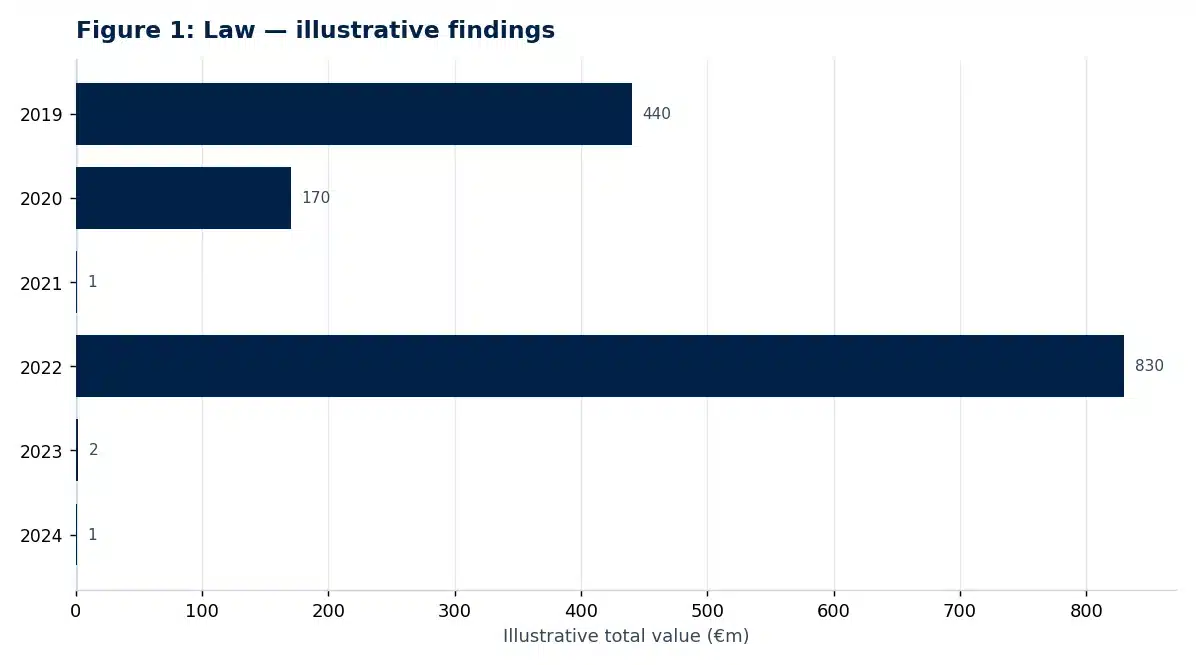
Two interpretations follow. First, the escalation of penalty values signals growing regulatory confidence and a credible deterrent threat, consistent with responsive regulation theory (Ayres and Braithwaite, 1992). The GDPR has plainly acquired sanctioning teeth.
Second, however, the concentration of value in a handful of cases suggests uneven enforcement. Many routine infringements attract modest penalties, while systemic harms by dominant platforms are addressed slowly and inconsistently, echoing the concerns of Ryan and Toner (2020).
The dominance of “insufficient legal basis” as a violation category is analytically revealing. It indicates that the lawfulness of processing, and especially the reliance on flawed consent, remains the principal fault line in consumer data protection.
Evidence on rights realisation is mixed. Supervisory authority reports indicate a substantial rise in individual complaints, suggesting heightened consumer awareness and a greater willingness to invoke data protection rights than under the previous Directive.
This increase supports the view that the GDPR has succeeded as an awareness-raising instrument. The prominence of rights such as access and erasure in public discourse indicates a cultural shift in expectations regarding personal data.
Nevertheless, the exercise of rights remains concentrated among a minority of engaged consumers. For the majority, the frictions identified by Solove (2013) persist, and rights are exercised rarely, unevenly and often without satisfactory resolution.
The findings thus partly vindicate Ausloos (2020): even infrequently exercised rights discipline controllers by requiring compliant systems. Yet they also confirm that rights conferral alone cannot equalise the structural imbalance between consumers and controllers.
The accountability principle appears to have reshaped organisational governance materially. The widespread appointment of data protection officers and the routine conduct of impact assessments indicate genuine institutional embedding of data protection.
However, the recurrence of security and transparency failures in the enforcement record suggests that accountability structures are not uniformly effective. In many organisations, compliance remains procedural rather than substantive, consistent with the “cosmetic compliance” thesis.
The analysis therefore indicates a bifurcated landscape. Well-resourced organisations have internalised accountability, whereas smaller or less scrupulous actors treat documentation as a formality, exposing the limits of self-regulation absent robust external oversight.
The findings permit a nuanced assessment of the GDPR’s effectiveness, relating the empirical patterns to the theoretical themes developed in the literature review. Three implications merit particular attention.
The escalation of penalty values confirms that the GDPR has established a credible sanctioning regime, addressing the first research question about enforcement. The threat of turnover-based fines has plainly altered the risk calculus of data controllers.
Yet the unevenness of enforcement qualifies this success. The one-stop-shop bottleneck and the resource constraints of supervisory authorities mean that deterrence operates inconsistently, sparing some dominant actors from timely accountability (Massé, 2021).
This finding resonates with responsive regulation theory. Deterrence depends not merely on the existence of severe sanctions but on their credible and timely application. Delay at the apex of the enforcement pyramid weakens the deterrent effect throughout the system.
The implication is that the GDPR’s substantive standards are sound, but its procedural enforcement architecture is the binding constraint on effectiveness. Reform should therefore target enforcement capacity and cross-border coordination rather than the substantive text.
The prominence of legal-basis violations directly engages the behavioural literature on consent. It confirms that consent, as operationalised online, frequently fails to meet the GDPR’s standards of freely given, informed and unambiguous agreement.
This supports the critique advanced by Nouwens et al. (2020) and Utz et al. (2019). Consent fatigue and dark patterns allow controllers to manufacture formal compliance while substantive autonomy is hollowed out, undermining the Regulation’s protective purpose.
The implication is that over-reliance on consent may be structurally misguided. A shift towards stronger default protections, purpose limitation and restrictions on manipulative design would reduce dependence on a mechanism that behavioural evidence shows to be fragile.
The bifurcated pattern of accountability illuminates the debate on meta-regulation. Where external oversight is credible, accountability produces genuine governance improvements; where oversight is weak, it produces documentation without substance (Raab, 2020).
This suggests that accountability and enforcement are complementary rather than substitutable. Self-regulatory mechanisms require an active supervisory backstop to prevent cosmetic compliance, aligning with Bamberger and Mulligan’s (2015) emphasis on organisational culture and external pressure.
Taken together, the discussion indicates that the GDPR is neither the transformative triumph its advocates claimed nor the failure its critics allege. It is a substantively strong instrument whose effectiveness is throttled by procedural and behavioural weaknesses.
This paper set out to evaluate the effectiveness of the GDPR in protecting consumer data privacy. Drawing on doctrinal analysis and illustrative enforcement evidence, it reached a qualified and balanced assessment of the Regulation’s achievements and limitations.
The study finds that the GDPR has succeeded in raising consumer awareness, embedding accountability within organisations and establishing a credible sanctioning regime. These are substantial achievements that distinguish it from its predecessor Directive.
However, effectiveness is constrained on three fronts: uneven and delayed cross-border enforcement, the behavioural fragility of consent, and the persistence of cosmetic compliance among less scrupulous actors. Formal rights have not fully translated into substantive protection.
The paper contributes to the socio-legal literature by integrating doctrinal analysis with an interpretive reading of enforcement patterns. It advances the argument that the GDPR’s binding constraint lies in procedure and enforcement rather than in its substantive standards.
In doing so, it bridges the rights-based and regulatory-theory traditions, demonstrating that effective consumer protection requires not only well-drafted rights but also credible, timely and adequately resourced enforcement institutions.
Several reforms would enhance the GDPR’s effectiveness:
Future research should pursue robust empirical measurement of consumer outcomes, moving beyond enforcement statistics to assess whether privacy harms have genuinely diminished. Longitudinal and mixed-methods designs would be especially valuable.
Comparative work examining the diffusion of GDPR-style regimes internationally, and their relative effectiveness, would further illuminate the conditions under which data protection law succeeds. Such enquiry would deepen understanding of regulatory effectiveness in the digital age.

All work is written by human writers. 100% AI free, guaranteed.

100% money back guarantee if you find plagiarism in our work.
COMPANY DETAILS