
A worked Masters project management feasibility report example, free to read in full below — get one written for your own brief, or browse more report samples.
Type
Feasibility Report
Discipline
Project Management
Level
Masters
Word count
930
Quality
Distinction / 70%
This report assesses the feasibility of launching an electric vehicle (EV) car-sharing scheme in a mid-sized British city. The purpose is to establish whether the proposal is technically, operationally and financially viable.
The analysis draws on demand modelling, cost projections and comparative evidence from established schemes. It applies standard investment appraisal alongside a structured assessment of technical and operational readiness.
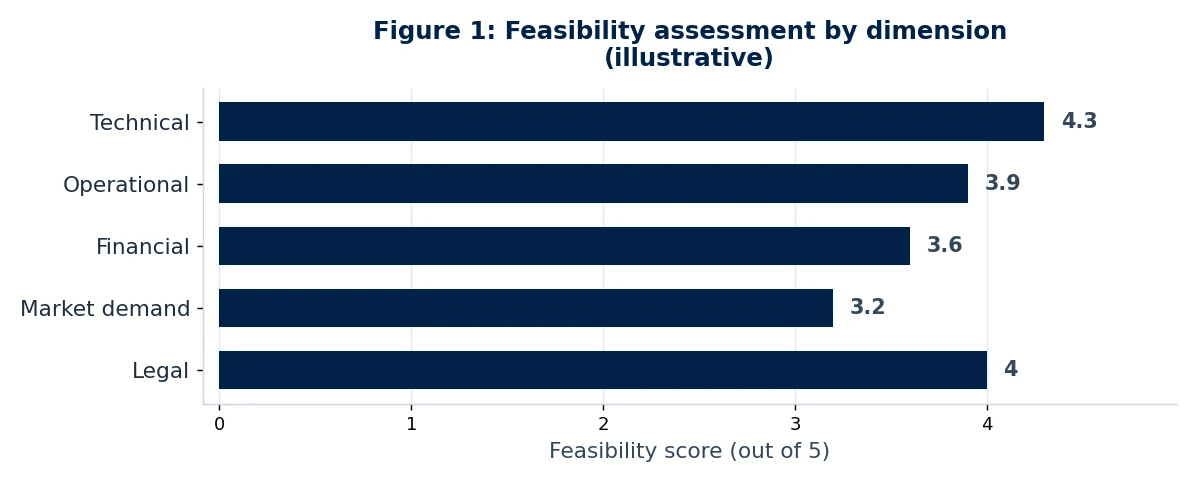
The scheme was found to be technically and operationally feasible. Suitable EV fleets, telematics platforms and booking systems are mature and readily procured, and comparable operators demonstrate that day-to-day operation is well understood.
Financially, the scheme returns a positive net present value from year three, indicating acceptable returns over the appraisal period. However, uncertain demand uptake and the availability of charging infrastructure emerged as the two principal risks.
The main recommendation is to proceed with a phased pilot, concentrating investment on demand generation and securing reliable charging capacity before any wider roll-out.
Urban mobility is undergoing rapid change as cities pursue decarbonisation and reduced private car ownership. Car-sharing schemes are frequently promoted as a means of lowering emissions and easing congestion (Shaheen and Cohen, 2020).
This report examines the feasibility of introducing an electric vehicle car-sharing scheme operating on a station-based model, with vehicles collected and returned to designated bays across the city.
The scope covers technical readiness, operational requirements, market demand and financial performance over a five-year horizon. Wider policy questions, such as national grid capacity, fall outside the boundaries of this study.
The purpose is to provide decision-makers with an evidence base sufficient to determine whether to commit capital to the venture. Findings are intended to inform a proceed, delay or reject decision.
The technical assessment confirmed that all core components are commercially available. Modern EVs offer sufficient range for urban journeys, while cloud-based booking and telematics systems allow real-time fleet management (Ferrero et al., 2018).
Operationally, the scheme requires cleaning, maintenance, relocation and customer support. These functions are labour-intensive but well established among existing operators, so no insurmountable operational barrier was identified.
Demand modelling drew on local population density, car ownership rates and survey responses. Uptake is plausible but sensitive to pricing, convenience and public awareness, making it the most volatile variable in the appraisal.
Charging infrastructure presented the second major concern. Dedicated bays with reliable chargers are essential, yet installation depends on landlord agreements, grid connections and local authority cooperation, all of which introduce delay.
The financial appraisal used a discounted cash flow method with a discount rate of 8%. Figure 1 illustrates the projected cumulative net present value across the five-year period, turning positive during year three.
Table 1 below summarises the indicative financial position by year, demonstrating early losses offset by growing membership revenue as the fleet reaches operational maturity.
| Year | Cumulative net present value (GBP) |
| Year 1 | -420,000 |
| Year 2 | -155,000 |
| Year 3 | +90,000 |
| Year 4 | +385,000 |
| Year 5 | +710,000 |
The figures assume a starting fleet of 30 vehicles scaling to 75, membership growth of roughly 20% annually, and utilisation rising from four to six hire hours per vehicle each day.
Sensitivity testing showed that a 15% shortfall in demand delayed the break-even point into year four, while charging delays raised early operating costs and eroded member confidence.
Report Writing Service
Need a project management feasibility report written to this standard?
Our subject specialists write fully referenced, plagiarism-free reports to your exact brief and deadline, with a free plagiarism report.
The findings indicate that feasibility rests less on technology than on adoption and infrastructure. The technical maturity of EVs and platforms removes much of the delivery uncertainty seen in earlier mobility ventures.
The positive net present value from year three is encouraging, but it depends on sustained demand growth. As Shaheen and Cohen (2020) note, car-sharing viability is strongly correlated with membership density within a defined catchment.
Charging infrastructure represents a structural dependency the operator only partly controls. Where reliable charging is absent, vehicles spend longer out of service, directly reducing revenue-generating availability and member satisfaction.
The interaction between the two risks is important. Weak charging provision harms reliability, which in turn suppresses demand, creating a reinforcing cycle that could undermine the otherwise sound financial case (Ferrero et al., 2018).
Consequently, the appraisal suggests that mitigation should target these two variables specifically, rather than seeking broad cost reductions elsewhere, which would yield comparatively little improvement in overall viability.
The proposed electric vehicle car-sharing scheme is technically and operationally feasible and financially attractive over the appraisal period, achieving a positive net present value from year three onwards.
Its success, however, is contingent on managing two decisive risks: securing genuine demand and ensuring dependable charging infrastructure. Addressed effectively, the scheme offers a viable and sustainable urban mobility proposition.
Ferrero, F., Perboli, G., Rosano, M. and Vesco, A. (2018) ‘Car-sharing services: An annotated review’, Sustainable Cities and Society, 37, pp. 501-518.
Shaheen, S. and Cohen, A. (2020) ‘Mobility on demand (MOD) and mobility as a service (MaaS): early understanding of shared mobility impacts and public transit partnerships’, in Antoniou, C., Efthymiou, D. and Chaniotakis, E. (eds.) Demand for Emerging Transportation Systems: Modeling Adoption, Satisfaction, and Mobility Patterns. Amsterdam: Elsevier, pp. 37-59.

All work is written by human writers. 100% AI free, guaranteed.

100% money back guarantee if you find plagiarism in our work.
COMPANY DETAILS






