
A real Undergraduate business literature review sample, free to read in full below — get one written for your own title.
Type
Literature Review
Subject
Business
Level
Undergraduate
Word count
4,433
Quality
2:1 standard
Due to the rapid growth of new technologies, the Business Intelligence (BI) market is growing as well that forces the corporations to adopt their offerings to the needs of the customer. Adoption of Business Intelligence system has become one of the most important technological and organizational innovations in modern organization that promote knowledge diffusion, and cornerstone of business decision making processes. Since the way of BI integrated and implemented is quite different among organizations, it is important to approach BI literature by adaption of BI application and its implementation, BI architects, and enabling factors in BI projects. Furthermore, we are also going to discuss how technological capabilities such as user access, data quality and the integration of BI with other systems in the firm, as well as organizational capabilities such as flexibility and risk management support, are essential for BI success, regardless of the decision environment. Last but not least, this paper will also discuss how the idea of BI has been built on the school of thought. We expect that results could create the value and input for enterprises that plan to implement a BI application in their organization.
Keywords: Business Intelligence, BI Capabilities, BI Architectures, Enabling Factors
Present day association settings are very convoluted and continually evolving. Organizations, in both public and private sector, are under extraordinary pressure for offering an explanation to the top management about change condition and innovation. To do so, it requires an organization to possess strategic, operational and tactical decisions; however, they are complicated and are taken rapidly. The basic leadership requires a lot of data, information, and knowledge. One ought to process this data as required basic leadership and fast, on time and ongoing preparing is expected to end up modernized (Turban et al, 2010). Furthermore, nowadays business life cycle has turned out to be shorter. Henceforth, to gain the competitive advantage organization must have quick and proper decision making. Decision maker indeed needs good data, to make the right decision at the right time and place (Farjami, 2015).
The concept of BI existed during the 1950s and it grew out from a technology called decision support. Decision support is still used by many companies to come up with decisions that would help them to gain competitive advantage amongst their competitors.
BI has grown strong during the recent years mainly due to increased data collection and better technology with greater storage capacity. Due to the improvement of technology, the company can use BI to store a large amount of data with cheaper rate. Companies have access to a lot of data in the form of smartphone, internet records, social media activities and so on. BI can sift through these data to find patterns and trends (Raisinghani, 2004).
In any organization regardless its size, the business activities include the administration of extensive amounts of data from both inner and outside business conditions; all these data identified with interior operations, advertise, clients, providers, economic assets, and so forth., historically cumulated, on action times of the organization, shape the reason for some complex and greatly helpful economic and money related problems in the organization's administration decision making process (Mihaelia and Rozalia, 2012).
In this paper, we are going to use secondary data from the previous literature review of the Business Intelligence with dozens of article and secondary sources of data collection. The paper is concluded with the literature review of Business Intelligence. Business Intelligence mainly focuses how to collect, organize and interpret the data to relevant department to make an effective decision under the uncertainty to obtain the organizational goal. In the discussion session, we will try to draw a link between Business Intelligence aspect and Thematic School of Thought under the theme of uncertainty, information and game theory which mainly related to decision making. Furthermore, we will rationalize how Business Intelligence is related or has been built on the School of Thought.
There is another issue with a great number of definitions; they tend to change after some time, in light of the fact that the way of what they consider changes. This is the situation with BI for instance. Initially, software business engaged with BI, BI used to be comprehended as private insight, rather than state or open knowledge. Even after many years, BI is still used by engineers and programmers (Solberg Søilen, 2015).
BI is characterized as frameworks that gather, change, and present organized information from various sources lessening the required time to acquire significant business data and enable their efficiency use in management decision making process (Den Hamer, 2004), permitting dynamic enterprise information look, recovery, examination, and clarification of the necessities of administrative choices (Nofal and Yusof, 2013). As indicated by Tyson (1986), BI concentrates on gathering, process and present information concerning customers, contenders, the business sectors, technology, and products. Pirttimäki (2007) depicts BI as a procedure that incorporates a series of activities, being driven by the particular data needs of decision makers and the objective of achieving competitive advantage.
BI is a framework that transforms information into data and afterward into learning, consequently enhancing company's basic decision-making process (Singh and Samalia, 2014). BI is characterized as a framework which gathers, changes and shows organized information from various sources. BI is a system and an answer that helps decision makers to comprehend the economic circumstance of the firm (Nofal et al., 2013).
BI is termed to as a set of numerical and methodological models for examination utilized for extracting data and valuable information from raw information for utilizing confused basic leadership prepare (Vercellis, 2013). Similarly, Wixom and Watson (2010, p.14) mention that ―Business intelligence (BI) is a broad category of technologies, applications, and processes for gathering, storing, accessing, and analyzing data to help its users make better decisions.‖ We can upgrade the bits of knowledge gave by BI applications—particularly by utilizing information mining procedures, through simulation and modeling of real world under a "systems thinking" approach, enhancing forecasts, and adding to a superior comprehension of the business progression of any organization (Raisinghani, 2004).
BI helps administrators by breaking down information from various resources in better basic leadership at both tactical and strategic level, for customary utilization, conventional data frameworks farewell, yet for hierarchical and functional planning; new tools are required for business analysis (Rasoul and Mohammad, 2016).
In BI context, we always see the word data, information, and knowledge which could lead us getting confused on its use and implication. Carlo (2009) distinguishes their definition.
Data: It refers to a structured codification of single primary entities and as well as of transactions involving two or more primary entities Carlo (2009). BI is popular among companies mainly because of analysis of data that is of any form and formulate a strategy accordingly. Generally data is classified into three types—structured data, semi-structured data, and unstructured data.
Structured data are information that is fixed form, the data may be a collection of forms of websites, and detailed address that can be easily read by the computers since the data is already standardized.
Unstructured data are information that cannot be easily read by computers, which may be text, documents, video tapes, websites, and pictures (Jermol et al. 2003), or any other type of information that cannot be clearly sorted or organized into rows and columns. Information is used many times to Company data are found across different locations and places in the form of Customer Relation Management (CRM) programs, marketing automation systems and social media platforms. Information: It refers to the result of extraction and processing activities carried out on data, and it appears meaningful for those who receive it in a specific domain.
Knowledge: It is formed from information which is used to make decisions and develop the corresponding actions. Hence, we could say that knowledge consists of information that puts to work into a specific domain, and it is enhanced by the experience and competence of decision makers in tackling and solving complex problems.
Carlo (2009) uses the following pyramid to describe how business intelligence system is constructed.
Data sources: The sources mostly consist of data belonging to operationalize systems, but may also include unstructured data, such as emails, and data received from external providers.
Data warehouse/Data mart: Data warehouses are used to consolidate different kinds of data into a central location using a process known as extract, transform and load (ETL) and standardize these results across systems that are allowed to be queried. Data marts are generally small warehouses that focus on information on a single department, instead of collecting data across a company. They limit the complexity of databases and are cheaper to implement than full warehouses.
Data exploration: Data exploration is a passive BI analysis consisting of query and reporting systems, as well as statistical method.
Data mining: Data mining is active BI methodologies with the purpose of information and knowledge extraction from data.
Optimization: Optimization model allows us to determine the best solution out of a set of alternative actions, which is usually fairly extensive and sometimes even infinite.
Decisions: When business intelligence methodologies are available and successfully adopted, the choice of a decision pertains to the decision makers, who may also take advantage of informal and unstructured information available to adapt and modify the recommendations and the conclusions achieved through the use of mathematical models.
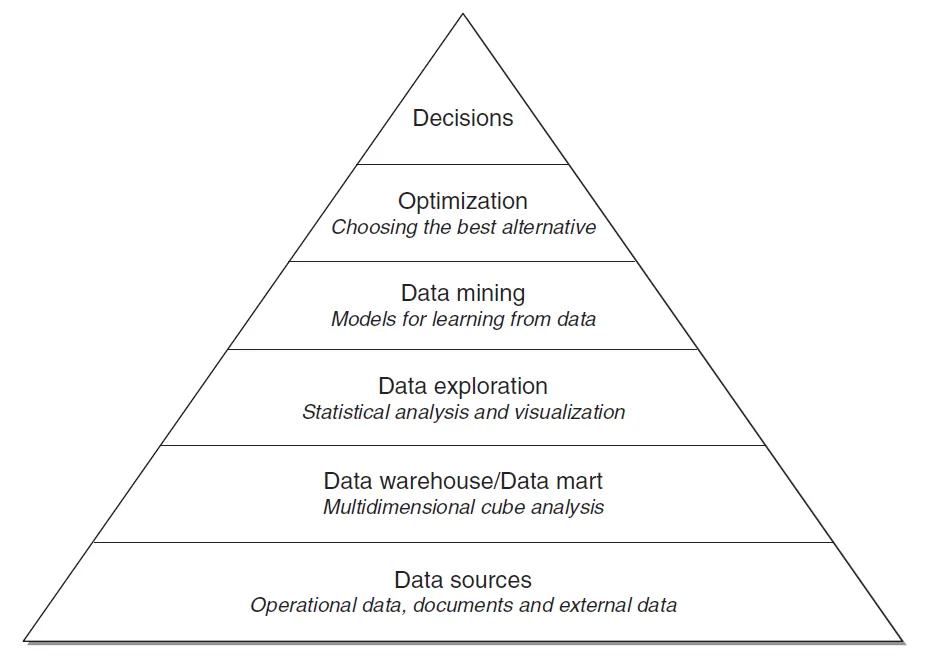
Figure: The main components of a Business Intelligence System (Carlo, 2009:10)
Custom Literature Review Writing Service
Need a business literature review written to this standard?
Our subject specialists write to your exact brief — fully referenced, plagiarism-free and delivered on time, with a free plagiarism report.
One underlying theme that is evident through the research is that BI used in an organization should be suited for decision making, which in turn contributes to BI success (Clark, Jones & Armstrong, 2007). However, many scholars gained that this success is yet to be realized by many organizations (Hostmann, Herschel, & Rayner, 2007). BI capacities are basic capacities that help organizations enhance both its adjustment to change and its execution (Watson & Wixom, 2007).
Many researchers state that failure in adopting BI in an organization because of an absence of fit between organization’s BI and its characteristics and objectives. An organization that has made progress with their BI usage have attempted to guarantee that their BI is steady with their corporate business targets and much research on BI achievement concentrates on the alignment amongst BI and business targets (McMurchy, 2008). However, little is known about the part BI abilities play in accomplishing this objective. In-spite, the fact that there is a collection of research tending to BI abilities, it has remained to a great extent quiet on the part of BI capacities in accomplishing the important match amongst BI and the decision environment in which it is implemented. Nonetheless, numerous BI examples of overcoming adversity demonstrate the significance of utilizing BI with the essential abilities and for the correct purposes to make BI progress (Schlegel & Sood, 2007).
According to Oyku et al. (2012), BI can be examined from both organizational and technological views. Technological BI capabilities are referring to the data quality (data standard), technical platforms that could be integrated with other systems in the organization and user access. Organizational BI is the assets supporting the BI application that runs in the organization such as flexibility and shared risks and responsibilities (Ross, Beath and Goodhue, 1996).
BI has largely relied on numerical and/or structured data, which can be measured on a numerical scale and analyzed with statistical methods and computing equipment (Isik et al. 2013, p.14). Ponniah (2001) stated that data quality is the most important element leading to BI success. Similarly, Kimball et al. (2008) also stated that the data quality is the most important factor, and they added that the massive data from many different sources of a large enterprise can be integrated into a coherent body to provide a clear view of its business, therefore, meaningful information can be delivered at the right time, in the right location, and in the right form to assist individuals, departments, divisions or even larger units to facilitate improved decision making. Data quality refers to the data which is consistent and comprehensive. Poor data reliability is because of poor data handling processes, poor data maintenance procedures, and errors in the migration process from one system to another. If the information that we collect is not accurately or consistently analyzed, organizations cannot satisfy their customers’ expectations nor keep up with new information-centric regulations. According to Oyku et al. (2012), in order to improve the business agility, the organization should develop the technological ability that could deliver accurate, consistent and timely information to its users. Moreover, clean and relevant data are one of the most essential factors of BI success. As companies incorporate data from a wider variety of sources, they will continue to face new and ever-increasing issues surrounding the quality of the data on which they rely.
Since BI system is a new system for organization, the integration between BI system and other systems in the organization is another crucial activity behind the BI success. The integrating activity is involving with the connection between various systems and their application or data together, either physically or functionally, thus each individual system can create and provide value to the organization (White, 2005). Furthermore, the organization using data from multiple sources and feeding the data into multiple information systems, the performance of integration will be affected directly by the quality of the communication between these systems (Oyku, 2012).
BI tools according to Oyku et al. (2012) have different capabilities and serve different purposes so that one size does not fit with all BI. Whether the organization prefers to use a single BI suite or best-of-breed applications, it is essential to match tool capabilities with user types. While some organizations limit user access through practicing authorization/authentication and access control, others prefer to allow full access to all types of users through a web-centric approach. It is critical that organizations achieve the necessary balance to allow the way BI users access information to fit the types of decisions they make using BI.
In order to achieve the competitive advantages provided by BI, organizations must consider carefully on selecting the underlying technology to support BI and also be flexible with the strictness of the business process rules and regulations since flexibility is one of the key factors to run BI successfully in the organization (Oyku et al. 2012).
Risk management is one of the major supports in BI, as it helps in decision making, where the conditions tend to be uncertain, for example, when all the factors are known (Harding, 2003). Risk management is crucial for organizations that operate in high-risk environments, as well as, it is important for organizational success (Davenport, 2006). Despite, hazard and instability exist in each business decisions, and organizations may utilize BI to limit vulnerability and settle on better choices. The impact of BI in decision-making capabilities affects its success.
According to Alaskar and Efthimios (2015), not all of BI solutions succeed in all organizations, and, there are signs, before a project begins, that could indicate whether the project will succeed, struggle, or fail and it is essential that organizations are aware of the key indicators of success in adopting BI, so as to overcome the challenges or risks that are associated with the BI project during its implementation.
Some factors such as technologies, analytics and human resources that Carlo (2009) mentions are more critical than others to the success of a BI project.
The crucial enabling factors that have facilitated the development of BI systems in the complex organization and enterprise are hardware and software technologies. This pattern has empowered the utilization of advanced processes which are required to utilize inductive learning strategies and enhancement models, keeping the processing times inside a sensible range. Additionally, it allows the appropriation of best in class graphical perception strategies, featuring real-time animations. A further important factor gets from the exponential increment in the limit of mass storage's, again at low costs, enabling any organization to store terabytes of information for business insight analysis. What's more, system network, as Extranets or Intranets, has played an essential part in the diffusion inside organizations of data and learning separated from BI. Finally, the simple integration of hardware and software obtained by various providers, or grew inside by an organization, is another factor influencing the diffusion of data analysis of tools.
Mathematical model and analytical methodologies play an important role in information advancement and knowledge taking out from the accessible data inside most organizations. The mere visualization of the data according to timely and flexible logical views, plays a relevant role in facilitating the decision-making process, but still, represents a passive form of support. Hence, it is essential to apply more advanced models of inductive learning and optimization in order to achieve active forms of support for the decision-making process.
The human resources of an organization are built up by the competencies of those who operate within its boundaries, whether as individuals or collectively. When employees possess the ability of knowledge that could acquire information and then translate it into the practical way, they will have a major influence on the quality of decision-making process. The organization must emphasize the personal skills of its knowledge workers to work out creative solutions and to devise effective action plan if it implements an advanced BI systems. Every company could access to available analytical tools equally, but if a company wants to have the competitive advantage over its competitors, it should employ human resources endowed with a greater mental agility and willing to accept changes in decision-making style.
Jack (1971) states that information is considered to be a classic example of a ―collective good‖, the type of commodity for which private incentives is supposed to lead to under-provision rather than over-provision on the market. According to Richard et al. (1983), information plays two crucial roles which the first role refers to the physical state of the world that can indicate the quality of the goods one considers acquiring. Another role of information is about one’s potential competitors including their number, their preferences, and the information which they could, in turn, possess indicate the degree of competition that one must expect to encounter.
The understanding that competitive markets facilitate the efficient production and allocation of resources in a decentralized manner, that is without a complete exchange of information among economic agents (Radner). In another way, it could be emphasized the premise that economic agents come to markets with diverse information that is not publicly available, or at least only at substantial cost. The mention of information implies the prior existence of uncertainty about something, whether that uncertainty is probabilistic or not. Likewise, Paul (1981) mentions that when each trader is able to access his/her own private source of information, or when traders can acquire information at a cost, the traders’ strategic options may be drastically different than in the case where all information is public. It may be possible, for example, for a trader to infer information from the terms of the trade he is offered or, more generally, from any observations he makes concerning the behavior of other traders. The prices vary directly with underlying qualities. Higher prices indicate better quality.
Another perspective from the school of thought under the theme of Game Theory, decision theory is the primary framework that Radner (2011) extended to formalize the theory of teams. Decision theory refers to making choices under uncertainty. The core of the problem is for many players with a common payoff to make a choice under uncertainty with only partial knowledge, so the extension seems natural. Furthermore, according to Radner, a decentralized organization is defined as one with more than one decision maker, in which different decision makers are responsible for different decision variables and make those decisions on the basis of different information, and in which the outcome to the organization depends jointly on the several decisions and on some stochastic environmental variables. Similarly, the concept of BI is to make an effective decision making in the organization, only data or information from one or two departments is not adequate to optimize the overcome of the decision, but the joint data or information from all related departments is very crucial to gather enough information to make the right decision.
Base on the concept extracting from the School of Thought and the literature reviews, we observe that BI has been built on the ideas from the Thematic School under the theme of game theory and information and uncertainty. Basically, the idea of BI is about extracting information or private information within the organization by using mathematical and methodological models for analysis and using that information for making the decision which is under uncertainty. By doing so, the organization must invest an amount of budget in the process of collecting data, transforming data and presenting the meaningful data or information to related departments to make the right decision (Rajnoha et al., 2016). Hence, this would confirm to the idea of school of thought that there are different decision variables referring to diverse information to make the right decision as well as to get the diverse information, organization must pay for substantial cost.
Even though the concept of BI just emerged several decades ago, it now is becoming a major concern for enterprises regardless of its size to take it into consideration whether they should invest in this system or not in order to satisfy the customer needs and wants. Nowadays, BI establishes a real business value of data asset and provides remarkable improvement in recognizing and taking advantage of business opportunities. Many multinational corporations have adopted BI system, but some of them failed in adapting this system. Operational and organizational factors such as strategy, human capital, leadership, culture, quality management and strategic orientation of a firm significantly affect BI system’s implementation and integration. Understanding capabilities of both technological and management aspect is a key success in adopting BI system in the firm.
Adamala, S. & Cidrin, L. (2011). Key Success Factors in Business Intelligence. Journal of Intelligence Studies in Business, Vol. 1(1).
Alaskar, T., & Efthimios, P. (2015). Business Intelligence Capabilities and Implementation Strategies. International Journal of Global Business, Vol. 8 (1), pp. 34-45.
Ashrafi, R., and Murtaza, M. (2008). Use and Impact of ICT on SMEs in Oman. The Electronic Journal Information Systems. Vol. 11(3), pp. 125-138.
Carlo, V. (2009). Business Intelligence: Data Mining and Optimization for Decision Making. Politecnico di Milano, Italy; John Wiley & sons Ltd.
Clark, T. D.; Jones, M. C., & Armstrong, C. P. (2007). The dynamic structure of management support systems: theory development, research focus, and direction. MIS Quarterly, Vol. 31 (3), pp. 579–615.
Davenport, T. H. (2006). Competing on analytics. Harvard Business Review.
Den Hamer, P. (2005). The organization of Business Intelligence. The Hague: SDU Publishers.
Farjami, Y., & Molanapour, R. (2015). Business intelligence (from Idea to Practice), Ati-Negar Press, 1st Edition.
Harding, W. (2003). Business Intelligence crucial to making the right decision. Financial Executive, Vol. 19 (2), pp. 49–50.
Hostmann, B.; Herschel, G., & Rayner, N. (2007). The Evolution of Business Intelligence: The Four Worlds.
Isik, Ö.; Jones, M.C. & Sidorova, A. (2013). Business intelligence success: The roles of BI capabilities and decision environments. Information & Management, Vol. 50(1), pp. 13-23.
Jack, H. (1971). The Private and Social Value of Information and the Reward to Inventive Activity. The American Economic Review, Vol. 61, pp. 561-574.
Jermol, M., Lavrac, N., & Urbancic, T. (2003). Managing business intelligence in a virtual enterprise: A case study and knowledge management lessons learned. Journal of Intelligent & Fuzzy Systems, Vol. 14(3), pp. 121-136.
Kimball, R.; Ross, M.; Thornthwaite, W.; Mundy, J., & Becker, B. (2008). The Data Warehouse Lifecycle Toolkit. 2nd edition. Indianapolis: John Wiley & Sons
McMurchy, N. (2008). Take These Steps to Develop Successful BI Business Cases.
Mihaelia, F. T., & Rozalia, V. R. (2012). Business Intelligence Solutions for SMEs. Economics and Finance. Vol. 3, pp. 865-870.
Nofal, M., & Yusof, Z. (2013). Integration of Business Intelligence and Enterprise Resource Planning within Organizations. Technology, Vol. 11, pp. 658-665.
Oyku, I.; Mary C. J.; and Anna, S. (2012). Business intelligence success: The roles of BI capabilities and decision environments. Information & Management, Vol. 50, pp. 13– 23.
Paul, R. M. (1981). Rational Expectations, Information Acquisition, and Competitive Bidding. Econometrica, Vol. 49 (4). pp. 921-943.
Pirttimäki, V. H. (2007). Conceptual analysis of business intelligence. South African Journal of Information Management, Vol. 9(2), pp. 1-17.
Ponniah, P. 2001. Data Warehousing Fundamentals: A Comprehensive Guide for IT Professionals. New York: Jon Wiley and Sons, Inc.
Radner, R. (2011). Team Decision Problems.
Radner, R. (n.a). The role of private information in markets and other organizations
Raisinghani, M. (2004). Business Intelligence in the Digital Economy: Opportunities, Limitations and Risks. IDEA Group Publishing.
Rajnoha, R.; Stefko, R.; Merkova, M. and Dobrovic, J. (2016). Business Intelligence as a key information and knowledge tool for strategic business performance management. Information Management.
Rasoul, D. G., and Mohammad, H. (2016). A model of measuring the direct and impact of business intelligence on organizational agility with partial Mediatory role of Empowerment: Tehran construction Engineering Organization (TCEO) and EKTA organization industries.co. Social and Behavioral Sciences, Vol. 230, pp. 413-421.
Richard, E. W.; Paul, R. M., & Robert, J. W. (1983). Competitive Bidding and Proprietary Information. Journal of mathematical Economics, Vol. 11, pp. 161-169.
Ross, J.W.; Beath, C.M. & Goodhue, D. L. (1996). Develop long-term competitiveness through IT assets. Sloan Management Review, Vol. 38 (1), pp. 31–44.
Schlegel, K., & Sood, K. (2007). Business Intelligence Platform Capability Matrix.
Solberg Søilen, K. (2015). A place for Intelligence studies as a Scientific Discipline, Halmstad, Sweden. Journal of Intelligence Studies in Business, Vol. 5(3), pp. 35-46.
Turban, E.; Sharda, R., & Delen, D. (2010). Decision Support and Business Intelligence Systems, 9th ed., Prentice Hall Press, Upper Saddle River NJ.
Tyson, K.W.M. (1986). Business intelligence: Putting it all together. Lombard: Leading Edge Publications.
Vercellis, C. (2013). Business Intelligence: Data mining and optimization for Decision Making. Amirkabir University Press, 2nd Edition.
Watson, H. J., & Wixom, H. (2007). Enterprise agility and mature BI capabilities. Business Intelligence Journal. Vol. 12 (3), pp. 13–28.
White, C. (2005). The next generation of Business Intelligence: Operational BI. Information Management Magazine
Wixom, B. and Watson, H. 2010. The BI-Based Organization. International Journal of Business Intelligence Research, Vol. 1(1), pp. 12-24.

All work is written by human writers. 100% AI free, guaranteed.

100% money back guarantee if you find plagiarism in our work.
COMPANY DETAILS






