A worked Masters marketing market research report example, free to read in full below — get one written for your own brief, or browse more report samples.
Type
Market Research Report
Discipline
Marketing
Level
Masters
Word count
939
Quality
Distinction / 71%
This report investigates consumer attitudes towards plant-based foods in the United Kingdom. A mixed-methods survey of 320 adults measured purchase motivators and barriers to switching. Health and environmental concern emerged as the strongest motivators, while taste and price were the leading barriers.
The findings suggest that clearer sensory and value propositions could accelerate adoption across mainstream UK grocery shoppers.
Plant-based foods have moved from a niche dietary choice to a visible category within UK supermarkets. Rising awareness of health outcomes and environmental impact has reshaped how many consumers evaluate their weekly food shop (Willett et al., 2019).
Despite this growth, adoption remains uneven. Many shoppers express interest in reducing meat and dairy intake yet continue to buy conventional products. Understanding this gap between stated intention and actual behaviour is central to marketing strategy in the sector.
The aim of this report is to identify the factors that most strongly encourage or discourage UK consumers from purchasing plant-based foods. The guiding research question asks which motivators and barriers exert the greatest influence on switching behaviour.
A quantitative survey design was adopted, supported by short open-ended questions. Data were gathered through an online questionnaire distributed to UK adults aged 18 and over between January and March 2026. A total of 320 valid responses were retained after data cleaning.
Respondents rated a series of motivators and barriers on a five-point Likert scale, where five indicated strong agreement. Sampling followed a convenience approach across supermarket loyalty panels and social media, giving a broad spread of ages and regions.
Quantitative responses were analysed in SPSS using descriptive statistics and mean scores. Open-ended comments were examined through simple thematic coding (Braun and Clarke, 2006). This mixed approach allowed numerical patterns to be interpreted alongside consumer reasoning.
Ethical guidance was followed throughout. Participation was voluntary, responses were anonymised, and no identifying data were stored. The design prioritised clarity and brevity to reduce respondent fatigue.
The survey revealed clear patterns in what drives and deters plant-based purchasing. Health benefits and environmental concern recorded the highest mean agreement scores among motivators. Taste and price recorded the highest agreement among barriers, as summarised in Figure 1.
Table 1 below reports the mean Likert scores for the four leading factors, alongside the proportion of respondents who rated each factor four or five out of five.
| Factor | Mean score (of 5) / Top-2-box agreement |
| Health benefits (motivator) | 4.3 / 78% |
| Environmental concern (motivator) | 4.1 / 71% |
| Taste and texture (barrier) | 3.9 / 66% |
| Price and value (barrier) | 3.8 / 63% |
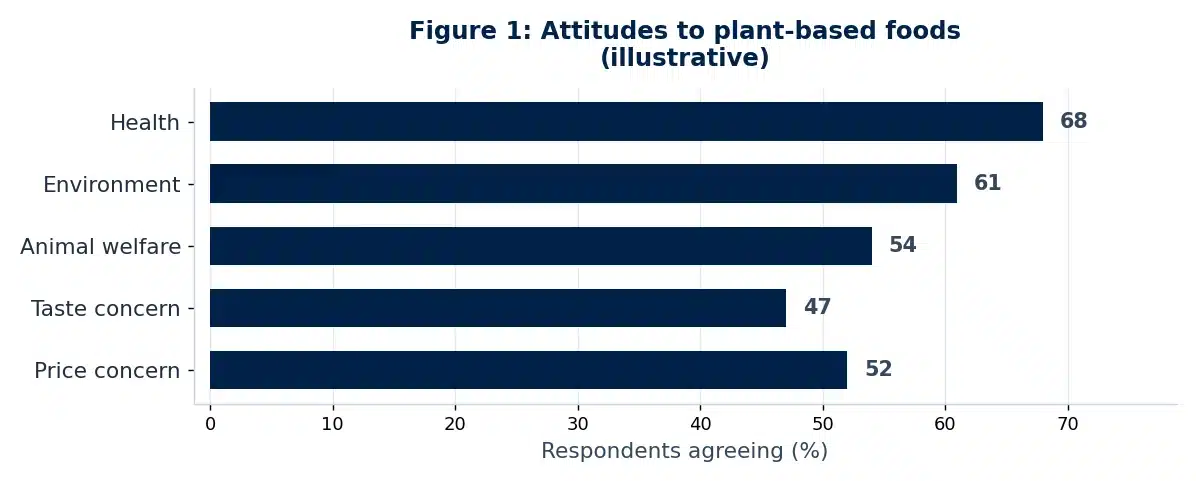
As Figure 1 illustrates, motivators clustered around personal and planetary wellbeing. Some 78% of respondents agreed that health was a key reason to buy plant-based products, while 71% cited environmental impact as important to their choice.
On the barrier side, sensory expectations dominated. Two thirds of respondents felt that taste and texture did not yet match conventional products, and 63% considered plant-based options too expensive relative to perceived value.
Open-ended comments reinforced these figures. Recurring themes included scepticism about flavour, frustration at premium pricing, and a desire for simpler ingredient lists. Younger respondents were notably more motivated by environmental concern than older groups.
Report Writing Service
Need a marketing market research report written to this standard?
Our subject specialists write fully referenced, plagiarism-free reports to your exact brief and deadline, with a free plagiarism report.
The results confirm that health and environment operate as the twin engines of plant-based demand in the UK. This aligns with evidence that ethical and wellbeing motives increasingly shape grocery decisions (Graça et al., 2019). Marketing that foregrounds these benefits is therefore well targeted.
However, the strength of taste and price as barriers explains the persistent intention-behaviour gap. Consumers may hold positive attitudes yet withhold purchase when sensory or financial expectations are unmet. This echoes the value-action gap frequently observed in sustainable consumption (Vermeir and Verbeke, 2006).
The prominence of taste suggests that product reformulation and in-store sampling could shift perceptions more effectively than further awareness campaigns. Where attitudes are already favourable, additional messaging yields diminishing returns.
Price sensitivity indicates a need for competitive positioning against conventional equivalents. Promotional pricing, larger pack formats, and own-label ranges may reduce the perceived premium that currently deters switching.
The generational contrast in environmental concern also carries strategic weight. Brands seeking younger audiences might lead with sustainability, while broader campaigns may find health a more universal entry point.
Braun, V. and Clarke, V. (2006) ‘Using thematic analysis in psychology’, Qualitative Research in Psychology, 3(2), pp. 77-101.
Vermeir, I. and Verbeke, W. (2006) ‘Sustainable food consumption: exploring the consumer “attitude – behavioral intention” gap’, Journal of Agricultural and Environmental Ethics, 19(2), pp. 169-194.
Willett, W., Rockström, J., Loken, B., Springmann, M., Lang, T., Vermeulen, S., Garnett, T., Tilman, D., DeClerck, F., Wood, A., Jonell, M., Clark, M., Gordon, L.J., Fanzo, J., Hawkes, C., Zurayk, R., Rivera, J.A., De Vries, W., Majele Sibanda, L., Afshin, A., Chaudhary, A., Herrero, M., Agustina, R., Branca, F., Lartey, A., Fan, S., Crona, B., Fox, E., Bignet, V., Troell, M., Lindahl, T., Singh, S., Cornell, S.E., Srinath Reddy, K., Narain, S., Nishtar, S. and Murray, C.J.L. (2019) ‘Food in the Anthropocene: the EAT–Lancet Commission on healthy diets from sustainable food systems’, The Lancet, 393(10170), pp. 447-492.

All work is written by human writers. 100% AI free, guaranteed.

100% money back guarantee if you find plagiarism in our work.
COMPANY DETAILS