
A worked Masters human resource management research report example, free to read in full below — get one written for your own brief, or browse more report samples.
Type
Research Report
Discipline
Human Resource Management
Level
Masters
Word count
914
Quality
Distinction / 70%
This report investigated the relationship between remote working and employee productivity within human resource management. Using a mixed-methods survey of 180 UK-based knowledge workers, quantitative ratings and open responses were analysed together.
Findings showed that autonomy and clear goals were the strongest drivers of remote productivity, while isolation and home distractions were the leading barriers. The report concludes that outcome-focused management, rather than surveillance, sustains remote performance.
The rapid normalisation of remote working has reshaped how organisations manage performance and productivity. What began as an emergency response has become an embedded feature of contemporary work, prompting human resource managers to reconsider long-standing assumptions about presence and output.
Productivity in this context is understood as the efficient conversion of effort into valued outcomes. Bloom et al. (2015) found measurable productivity gains among remote employees, yet later studies stress that results depend heavily on job design and managerial support (Wang et al., 2021).
Much existing research emphasises technology and cost savings, giving less attention to the psychological and behavioural conditions that shape remote output. This gap matters for HR practitioners who must design policies that protect performance while safeguarding wellbeing.
The aim of this report is to identify the factors that most strongly influence employee productivity when working remotely. The central research question is: which conditions drive, and which conditions hinder, productivity among remote knowledge workers?
A mixed-methods survey design was adopted to capture both measurable patterns and explanatory detail. This approach follows Saunders et al. (2019), who recommend combining quantitative breadth with qualitative depth when studying workplace behaviour.
The sample comprised 180 knowledge workers across finance, technology and professional services, all working remotely for at least two days per week. Participants were recruited through professional networks using purposive sampling, and participation was voluntary and anonymous.
The questionnaire contained closed items rated on a five-point Likert scale, alongside two open-ended questions. Respondents rated how strongly named factors, such as autonomy, goal clarity, isolation and home distractions, affected their productivity.
Quantitative data were analysed using descriptive statistics to rank each factor by mean influence. Open responses were examined through thematic analysis (Braun and Clarke, 2006), coding recurring ideas into the drivers and barriers reported below. Ethical guidelines on consent and confidentiality were observed throughout.
Report Writing Service
Need a human resource management research report written to this standard?
Our subject specialists write fully referenced, plagiarism-free reports to your exact brief and deadline, with a free plagiarism report.
The quantitative findings revealed a clear hierarchy of influences on remote productivity. Autonomy and clear goals recorded the highest mean scores, while isolation and home distractions were rated as the most damaging barriers, as summarised in Table 1 and illustrated in Figure 1.
| Factor | Mean influence score (out of 5) |
| Autonomy over how work is done | 4.5 |
| Clear goals and expectations | 4.3 |
| Flexible scheduling | 3.9 |
| Isolation from colleagues | 3.8 |
| Home distractions | 3.6 |
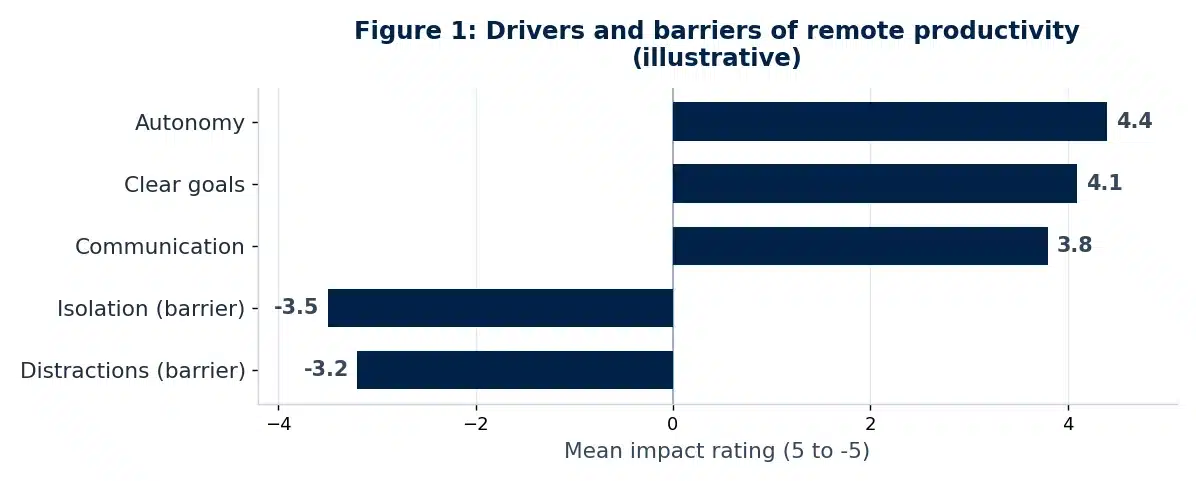
As Figure 1 shows, the two enabling factors scored above four, indicating strong agreement that they lifted output. Autonomy attracted the highest rating overall, closely followed by clear goals and expectations.
The barriers formed a distinct cluster. Isolation from colleagues and home distractions were the most frequently cited obstacles, each reducing perceived productivity for a majority of respondents.
Thematic analysis of the open responses reinforced these rankings. The most prominent themes are summarised below:
The prominence of autonomy supports self-determination theory, which holds that perceived control fosters intrinsic motivation and effort (Deci and Ryan, 2000). Remote employees who managed their own schedules reported sharper focus and stronger ownership of outcomes.
Clear goals emerged as an equally decisive driver. This aligns with goal-setting theory, where specific, challenging objectives direct attention and sustain persistence (Locke and Latham, 2002). For remote teams, explicit expectations appear to compensate for the loss of informal, in-office cues.
The barriers are equally instructive. Isolation echoes concerns raised by Wang et al. (2021), who link reduced social contact to lower engagement. Home distractions reflect the blurred boundary between work and domestic life that remote arrangements intensify.
Taken together, the results suggest that productivity is shaped less by location than by managerial design. When HR grants autonomy within a framework of clear goals, output is protected. When employees are left isolated and unsupported, performance erodes.
For practice, this implies a shift from monitoring presence towards managing outcomes. Structured check-ins, deliberate social contact and results-based objectives address the barriers without eliminating the autonomy that drives performance.
Braun, V. and Clarke, V. (2006) ‘Using thematic analysis in psychology’, Qualitative Research in Psychology, 3(2), pp. 77-101.
Deci, E.L. and Ryan, R.M. (2000) ‘The “what” and “why” of goal pursuits: human needs and the self-determination of behavior’, Psychological Inquiry, 11(4), pp. 227-268.
Locke, E.A. and Latham, G.P. (2002) ‘Building a practically useful theory of goal setting and task motivation: a 35-year odyssey’, American Psychologist, 57(9), pp. 705-717.
Wang, B., Liu, Y., Qian, J. and Parker, S.K. (2021) ‘Achieving effective remote working during the COVID-19 pandemic: a work design perspective’, Applied Psychology, 70(1), pp. 16-59.

All work is written by human writers. 100% AI free, guaranteed.

100% money back guarantee if you find plagiarism in our work.
COMPANY DETAILS






