A worked Undergraduate marketing case study example on Coca-Cola, free to read in full below — get one written for your own brief, or browse more case study samples.
Type
Case Study
Discipline
Marketing
Level
Undergraduate
Word count
924
Quality
2:1 / 66%
The Coca-Cola Company is one of the most recognised consumer brands in the world, operating a beverage portfolio distributed across more than two hundred markets. Founded in the late nineteenth century, it has grown into a global marketing benchmark.
This case study examines how the organisation balances a globally consistent brand identity with locally responsive marketing. The purpose is to illustrate strategic analysis for teaching, using publicly known information rather than confidential data.
The scope centres on the tension between standardisation and adaptation, often termed the “glocal” approach (Levitt, 1983). A Strengths, Weaknesses, Opportunities and Threats (SWOT) framework serves as the primary analytical lens throughout.
Coca-Cola competes in the carbonated soft drinks and wider non-alcoholic beverage sector, a mature market in developed economies but a growing one across emerging regions. Its principal rival remains PepsiCo, alongside numerous regional bottlers and private labels.
The organisation’s strategy rests on a franchised bottling model, whereby a concentrate is produced centrally and distribution is handled through local partners. This structure enables enormous reach while devolving operational adaptation to regional level.
Marketing has historically combined a uniform global brand image with localised campaigns, flavours and pricing. Festive campaigns, sponsorship of sporting events and localised product variants all reflect this dual logic of consistency and responsiveness.
The central strategic issue this case examines is how Coca-Cola sustains growth amid shifting consumer attitudes. Rising health consciousness, sugar taxation and demand for functional beverages challenge a portfolio historically anchored in sugary carbonated drinks.
Understanding this issue requires assessing both internal capabilities and external pressures. The SWOT framework, widely used in strategic management (Johnson et al., 2020), offers a structured means of organising these competing considerations before drawing conclusions.
Applying the SWOT framework rigorously means distinguishing internal factors, namely strengths and weaknesses, from external factors, namely opportunities and threats. The value of the tool lies in linking these dimensions to strategic action (Johnson et al., 2020).
Coca-Cola’s strengths derive substantially from intangible resources. Its brand equity, global recognition and distribution network constitute assets that are valuable, rare and difficult to imitate, consistent with the resource-based view of competitive advantage (Barney, 1991).
Its weaknesses, by contrast, stem from a portfolio concentration in sugary drinks and a perceived association with unhealthy consumption. These internal vulnerabilities become acute when external conditions shift against carbonated soft drinks.
Opportunities and threats reflect the external environment. Diversification into low-sugar, water and functional categories represents growth potential, while regulation, health campaigns and competition threaten established revenue streams. The table below summarises these factors.
| Internal Factors | External Factors |
| Strengths: world-leading brand recognition; unmatched global distribution and bottling network; strong marketing capability; deep financial and organisational resources. | Opportunities: expansion of low-sugar and zero-sugar variants; growth in bottled water and functional drinks; deeper penetration of emerging markets; digital marketing personalisation. |
| Weaknesses: heavy reliance on sugary carbonated drinks; perceived health negatives; limited presence in some fast-growing wellness categories; dependence on bottling partners. | Threats: sugar taxes and tightening regulation; changing consumer health attitudes; intense competition from PepsiCo and local brands; environmental scrutiny of packaging. |
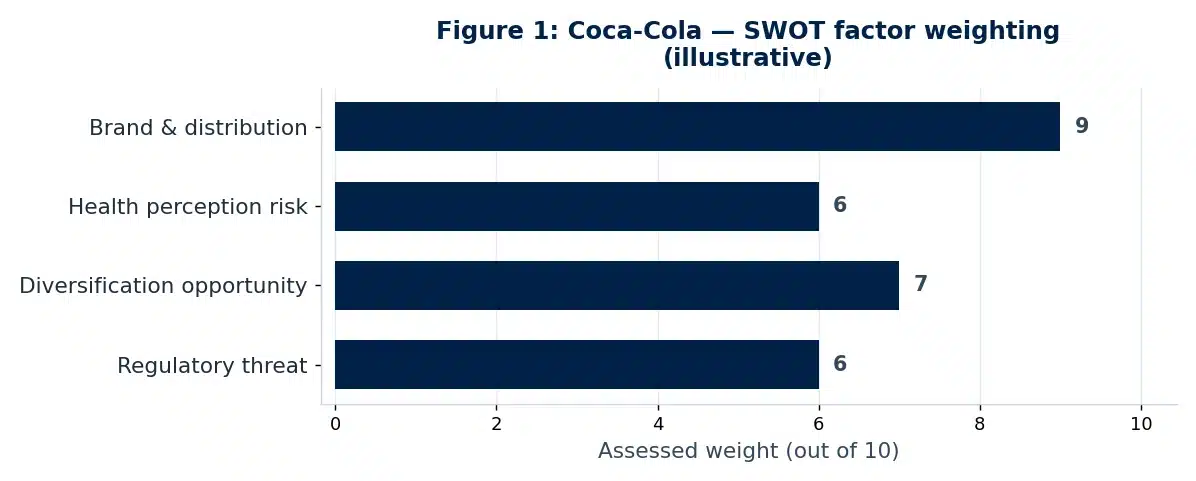
Read together, the analysis reveals a classic strategic dilemma. Coca-Cola’s greatest strengths lie in scale and brand, yet these are anchored to a product category facing structural external pressure from health and regulatory trends.
Case Study Writing Service
Need a marketing case study written to this standard?
Our subject specialists write fully referenced, plagiarism-free case studies to your exact brief and deadline, with a free plagiarism report.
The first finding is that brand recognition and distribution reach remain Coca-Cola’s dominant strengths. Few competitors can match its global visibility or the density of its bottling and retail network, giving it durable market power.
These strengths align with the resource-based view, which holds that sustained advantage flows from resources that are valuable, rare and hard to imitate (Barney, 1991). Coca-Cola’s brand and distribution clearly satisfy these conditions.
The second finding concerns vulnerability. Health perceptions and sugar regulation function simultaneously as a weakness and a threat, linking an internal portfolio concentration to an external environment that is turning against sugary drinks.
This convergence is strategically significant. When an internal weakness and an external threat reinforce one another, the resulting pressure is greater than either factor alone, demanding a deliberate strategic response rather than incremental adjustment.
The third finding identifies the principal opportunity. Portfolio diversification into low-sugar variants, bottled water and functional beverages offers the clearest route to offset declining demand in traditional carbonated categories.
Crucially, diversification allows Coca-Cola to redeploy its existing strengths. The same brand equity and distribution network that support cola can carry new low-sugar and water products, turning a defensive necessity into a growth strategy (Johnson et al., 2020).
This case study shows how Coca-Cola’s global strength rests on brand recognition and distribution, yet is tested by health perceptions and regulation. The SWOT analysis exposes a reinforcing link between internal weakness and external threat.
The most promising response is portfolio diversification that redeploys existing strengths into low-sugar and water categories. By combining global consistency with local adaptation, Coca-Cola can defend its position while pursuing sustainable, health-oriented growth.
Barney, J. (1991) ‘Firm resources and sustained competitive advantage’, Journal of Management, 17(1), pp. 99-120.
Johnson, G., Whittington, R., Scholes, K., Angwin, D. and Regnér, P. (2020) Exploring Strategy: Text and Cases. 12th edn. Harlow: Pearson.
Levitt, T. (1983) ‘The globalization of markets’, Harvard Business Review, 61(3), pp. 92-102.

All work is written by human writers. 100% AI free, guaranteed.

100% money back guarantee if you find plagiarism in our work.
COMPANY DETAILS