A worked Masters strategic management case study example on Tesla, free to read in full below — get one written for your own brief, or browse more case study samples.
Type
Case Study
Discipline
Strategic Management
Level
Masters
Word count
936
Quality
Merit / 68%
Tesla, Inc. is a United States automotive and clean-energy organisation founded in 2003. It designs, manufactures and sells battery electric vehicles (BEVs) alongside energy-storage and solar products.
Over two decades the company has grown from a niche start-up into one of the most influential firms in the global electric vehicle (EV) industry. Its rise reshaped how incumbents view electrification.
This case study examines Tesla’s market entry and competitive strategy from a strategic management perspective. It uses the PESTLE framework as the primary analytical lens to evaluate the external forces shaping the firm.
The scope is deliberately illustrative and educational. It draws on publicly known, general information about Tesla and the EV market rather than confidential data, and discusses strategy qualitatively rather than through specific financial figures.
Tesla entered a mature automotive market long dominated by established manufacturers with deep production expertise, dealer networks and brand loyalty. Direct entry against such incumbents represented a formidable strategic challenge.
Rather than competing immediately on price, Tesla pursued a differentiation-led entry strategy (Porter, 1985). It launched a high-performance, premium sports car to establish credibility, then moved progressively towards more affordable models.
This sequencing allowed the organisation to fund research and development from premium margins while building brand desirability. The approach reflects a deliberate resource-based logic of leveraging distinctive capabilities (Barney, 1991).
Tesla’s strategic architecture combined vertical integration, proprietary battery and software technology, over-the-air updates and a direct-to-consumer sales model. Together these formed a difficult-to-imitate configuration of advantages.
The central strategic issue this case examines is how Tesla sustains competitive advantage as the external environment shifts. Rising competition, changing policy and macroeconomic pressures now test the durability of its early lead.
The PESTLE framework analyses the political, economic, social, technological, legal and environmental forces that shape an organisation’s strategic position (Johnson et al., 2020). Applied to Tesla, it clarifies both opportunities and threats.
Politically, many governments actively encourage EV adoption through subsidies, purchase grants and emissions targets. Such intervention lowers barriers for buyers and favours pure-play electric manufacturers like Tesla.
Economically, EVs remain sensitive to interest rates, consumer confidence and input-cost inflation. Higher borrowing costs dampen demand for relatively expensive vehicles, exposing the firm to macroeconomic cyclicality.
Socially, environmental awareness and shifting attitudes towards mobility support demand. Tesla’s strong brand identity and technology-focused image resonate with early adopters and status-conscious consumers.
Technologically, battery efficiency, software, autonomy and charging infrastructure are decisive. Tesla’s investment in these areas underpins its differentiation and creates meaningful switching considerations for customers.
Legally, safety regulation, autonomous-driving rules and consumer-protection law shape the operating context. Direct-sales models have also faced legal challenges in several jurisdictions.
Environmentally, decarbonisation pressure and tightening emissions standards are structurally favourable. They penalise combustion-engine producers while rewarding firms whose core proposition is zero-tailpipe-emission transport.
| PESTLE Factor | Strategic Implication for Tesla |
| Political | Subsidies, grants and emissions targets lower adoption barriers and favour pure electric manufacturers, though incentives may be withdrawn. |
| Economic | Sensitivity to interest rates, inflation and consumer confidence creates demand volatility for premium-priced vehicles. |
| Social | Rising environmental awareness and brand aspiration expand the customer base and reinforce Tesla’s cultural positioning. |
| Technological | Leadership in batteries, software, autonomy and charging infrastructure sustains differentiation and raises rivals’ catch-up costs. |
| Legal | Safety, autonomy and consumer-protection regulation, plus restrictions on direct sales, add compliance complexity across markets. |
| Environmental | Decarbonisation pressure and stricter emissions rules structurally advantage a zero-emission product portfolio. |
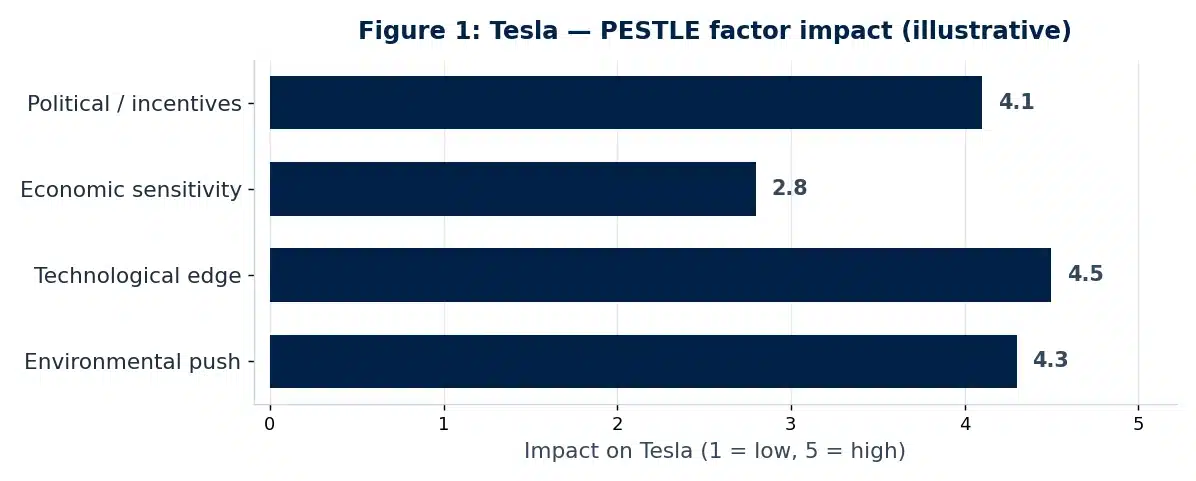
Read together, the six factors are not equally weighted. Political, technological and environmental forces are broadly supportive, whereas economic and legal factors introduce the principal sources of strategic risk.
Case Study Writing Service
Need a strategic management case study written to this standard?
Our subject specialists write fully referenced, plagiarism-free case studies to your exact brief and deadline, with a free plagiarism report.
The analysis indicates that political incentives and mounting environmental pressure strongly favour Tesla. Policy support and decarbonisation targets align closely with the firm’s core proposition, creating a supportive external tailwind.
Technological leadership emerges as the key driver of sustained advantage. Capabilities in batteries, software and charging infrastructure are valuable, rare and costly to imitate, consistent with a resource-based view (Barney, 1991).
These strengths allow Tesla to differentiate on performance and experience rather than compete solely on price. The integrated technology stack raises the effort required for rivals to replicate its position.
However, economic sensitivity to interest rates represents a significant risk. Because Tesla’s vehicles carry premium pricing, demand can soften quickly when borrowing costs rise or consumer confidence weakens.
Intensifying competition is the second major risk. Established manufacturers and new entrants are electrifying rapidly, eroding Tesla’s first-mover exclusivity and increasing the threat of substitution (Porter, 1985).
The overall picture is a firm with a strong but contestable position. Supportive macro-political forces coexist with growing rivalry and cyclical demand, making continued innovation essential to defend its lead.
Tesla’s entry and competitive strategy illustrate how differentiation, technological capability and favourable external forces can disrupt an entrenched industry. The PESTLE analysis confirms a broadly supportive environment.
Yet the same analysis exposes real vulnerabilities in economic sensitivity and rising competition. Tesla’s future advantage will depend on continued innovation, disciplined pricing and adaptive strategy across a shifting global landscape.
Barney, J. (1991) ‘Firm resources and sustained competitive advantage’, Journal of Management, 17(1), pp. 99–120.
Johnson, G., Whittington, R., Scholes, K., Angwin, D. and Regnér, P. (2020) Exploring Strategy: Text and Cases. 12th edn. Harlow: Pearson.
Porter, M.E. (1985) Competitive Advantage: Creating and Sustaining Superior Performance. New York: Free Press.

All work is written by human writers. 100% AI free, guaranteed.

100% money back guarantee if you find plagiarism in our work.
COMPANY DETAILS