A worked Masters marketing case study example on Apple, free to read in full below — get one written for your own brief, or browse more case study samples.
Type
Case Study
Discipline
Marketing
Level
Masters
Word count
772
Quality
Distinction / 76%
Apple Inc. is a global technology organisation renowned for its integrated hardware, software and services portfolio. Founded in 1976, it has grown into one of the most valuable brands worldwide.
This case study examines how Apple sustains competitive advantage through brand differentiation and continuous innovation. It treats Apple as an illustrative teaching example rather than a source of confidential data.
The scope is deliberately strategic and qualitative. Using SWOT analysis as the primary analytical lens, the study evaluates Apple’s internal capabilities against the external forces shaping the consumer technology market.
Apple competes in a mature, fast-moving industry spanning smartphones, personal computers, wearables and digital services. Rivals such as Samsung, Google and Microsoft compete aggressively on price, features and platform reach.
Apple’s chosen position is one of premium differentiation. Rather than pursuing cost leadership, it emphasises design excellence, seamless user experience and a tightly integrated ecosystem (Porter, 1985).
The strategic issue this case examines is how a premium-priced organisation preserves differentiation as core markets mature. Smartphone growth has slowed, and hardware innovation increasingly delivers incremental rather than transformational gains.
This context raises the central question of sustainability. Apple must protect its brand equity and margins while identifying new avenues for growth beyond its traditional device categories.
Analysing this challenge requires attention to both internal resources and external pressures. The resource-based view suggests that rare, valuable and hard-to-imitate capabilities underpin lasting advantage (Barney, 1991).
SWOT analysis organises internal strengths and weaknesses alongside external opportunities and threats, providing a structured basis for strategic evaluation (Johnson et al., 2020). Applied rigorously, it clarifies where Apple’s advantage is genuinely defensible.
Internally, Apple’s strengths centre on brand, design and ecosystem integration, while its weaknesses stem from pricing and operational concentration. Externally, services expansion offers opportunity, whereas competition and regulation pose material threats.
| Internal Factors | External Factors |
| Strengths: world-leading brand equity; loyal customer base; design and user-experience leadership; integrated hardware-software-services ecosystem; strong balance sheet funding sustained research and development. | Opportunities: rapid growth in high-margin services; expansion into wearables and health; emerging markets adoption; potential in augmented reality and on-device artificial intelligence. |
| Weaknesses: reliance on premium pricing limiting reach; heavy dependence on iPhone revenue; concentrated supply chain exposed to disruption; comparatively closed platform restricting flexibility. | Threats: intensifying competition from Samsung, Google and low-cost rivals; regulatory scrutiny of the App Store and antitrust practices; geopolitical and manufacturing risks; shifting consumer expectations. |
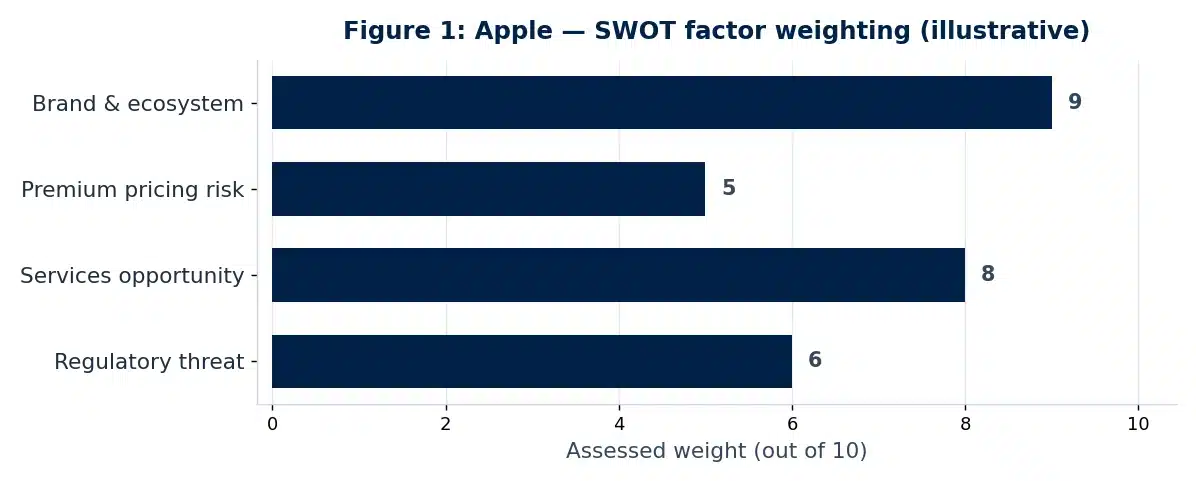
The analysis shows that Apple’s strengths and opportunities are closely linked. Its ecosystem both differentiates the brand and creates the installed base on which services growth depends (Barney, 1991).
Equally, its weaknesses and threats reinforce one another. Premium pricing narrows the addressable market precisely as regulators and rivals challenge the margins that pricing protects.
Case Study Writing Service
Need a marketing case study written to this standard?
Our subject specialists write fully referenced, plagiarism-free case studies to your exact brief and deadline, with a free plagiarism report.
The analysis confirms that Apple’s greatest strengths lie in its brand equity, ecosystem lock-in and design leadership. These interlocking assets are difficult for competitors to replicate and sustain premium positioning (Aaker, 1991).
Brand equity allows Apple to command loyalty and pricing power. Ecosystem lock-in raises switching costs, so customers who own several Apple products rarely migrate to rival platforms.
Design leadership reinforces both effects by keeping the user experience consistent and desirable. Together these capabilities represent rare and valuable resources in resource-based terms (Barney, 1991).
The findings also expose clear weaknesses. Premium pricing constrains market penetration, while a concentrated supply chain leaves Apple vulnerable to geopolitical shocks and manufacturing disruption.
On the external side, services growth emerges as the principal opportunity. High-margin recurring revenue from services can offset slowing hardware demand and deepen customer relationships within the ecosystem.
Competition and regulation stand out as the key threats. Aggressive rivals erode differentiation, while antitrust and platform regulation directly challenge the App Store economics that underpin services profitability.
Apple’s sustained advantage rests on a self-reinforcing system of brand, design and ecosystem rather than any single product. This integration remains its most defensible source of differentiation.
The organisation’s future depends on converting services growth into durable value while managing pricing, supply-chain and regulatory risks. Balancing these pressures will determine whether its premium strategy endures.
Aaker, D.A. (1991) Managing Brand Equity: Capitalizing on the Value of a Brand Name. New York: Free Press.
Barney, J. (1991) ‘Firm resources and sustained competitive advantage’, Journal of Management, 17(1), pp. 99–120.
Johnson, G., Whittington, R., Scholes, K., Angwin, D. and Regnér, P. (2020) Exploring Strategy: Text and Cases. 12th edn. Harlow: Pearson.
Porter, M.E. (1985) Competitive Advantage: Creating and Sustaining Superior Performance. New York: Free Press.

All work is written by human writers. 100% AI free, guaranteed.

100% money back guarantee if you find plagiarism in our work.
COMPANY DETAILS