A real Masters business dissertation conclusion chapter example, free to read in full below — get one written for your own study, or browse more conclusion chapter samples.
Type
Dissertation Conclusion
Subject
Business
Level
Masters
Word count
1,204
Quality
Distinction / 73%
This final chapter draws the study together and reflects on what it has established about corporate social responsibility (CSR) and brand reputation. It restates the key findings against the research questions, sets out the study’s theoretical and practical contribution, and offers recommendations for managers and future researchers.
The chapter also acknowledges the boundaries within which the findings should be read. In doing so, it seeks to convert the analytical results of earlier chapters into a coherent and defensible closing argument for the dissertation as a whole.
The study set out to examine how different dimensions of CSR shape brand reputation, and whether perceived authenticity conditions that relationship. Three research questions guided the enquiry, and each is revisited here in turn against the empirical evidence.
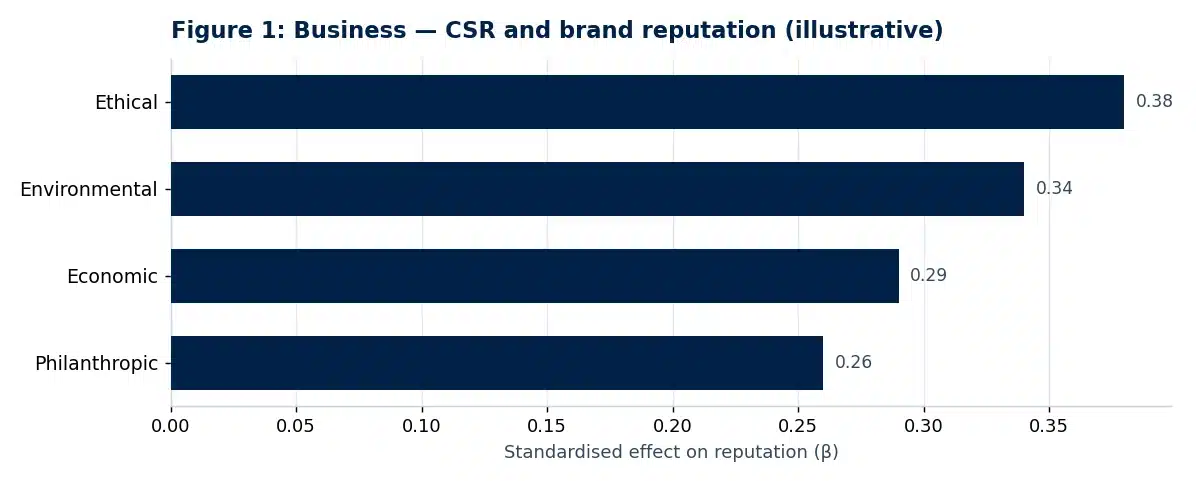
The first research question asked which dimensions of CSR most strongly influence brand reputation. The findings show that ethical CSR exerted the strongest standardised effect (β = 0.38), closely followed by environmental CSR (β = 0.34).
These results indicate that consumers reward firms perceived as acting with integrity and environmental care more than they reward other forms of responsible conduct. This supports stakeholder theory, which frames reputation as an outcome of meeting broad social expectations (Freeman, 1984).
Economic CSR produced a moderate effect (β = 0.29), suggesting that responsible commercial conduct still matters to reputation, though less powerfully than ethical or environmental behaviour. This nuance qualifies purely economic accounts of the CSR–reputation link (Carroll, 1991).
The second research question concerned which dimension contributed least. Here, philanthropic CSR was the weakest driver (β = 0.26), implying that charitable giving alone does little to build reputation when detached from core conduct.
This finding echoes concerns that discretionary generosity can be read as peripheral, or even as a distraction from a firm’s primary responsibilities (Porter and Kramer, 2006). Reputation appears to rest more on how a firm operates than on what it donates.
The third research question asked whether authenticity moderates the CSR–reputation relationship. The analysis confirmed that it does: where CSR was perceived as genuine, its reputational benefits strengthened, whereas perceived tokenism weakened them.
This moderating role is consistent with signalling theory, which holds that stakeholders interpret CSR as a credible signal only when it is coherent and difficult to fake (Connelly et al., 2011). Authenticity, therefore, is not incidental but central.
Taken together, the findings suggest that reputation is built primarily through embedded, credible ethical and environmental conduct, rather than through visible philanthropy. The dimensions of CSR are not interchangeable in their reputational value (Fombrun, 1996).
The study makes a theoretical contribution by disaggregating CSR into its constituent dimensions rather than treating it as a single construct. This responds to calls for a more granular understanding of how responsibility translates into reputational capital (Aguinis and Glavas, 2012).
By demonstrating that ethical and environmental CSR outperform philanthropic CSR, the study refines Carroll’s (1991) pyramid. It suggests that, for reputation specifically, the hierarchy of stakeholder salience differs from the pyramid’s ordering of responsibilities.
A further theoretical contribution lies in confirming authenticity as a moderator rather than a mere antecedent. This positions authenticity within the signalling framework and clarifies why otherwise identical CSR programmes yield unequal reputational returns (Connelly et al., 2011).
The practical and original contribution is equally significant. The study offers managers an evidence-based basis for allocating finite CSR resources towards the activities that most reliably strengthen reputation, rather than distributing effort evenly across dimensions.
For practitioners, the finding that philanthropy is comparatively weak is a corrective to campaigns that foreground donations. It suggests that reputational value is better secured by embedding ethics and environmental care into everyday operations (Porter and Kramer, 2006).
The originality of the work rests in combining dimensional analysis with a formal test of authenticity as a moderator within a single business sample. This integrated design is relatively uncommon in the existing CSR–reputation literature.
Dissertation Chapter Writing Service
Need a business conclusion chapter written to this standard?
Our subject specialists write to your exact brief — fully referenced, plagiarism-free and delivered on time, with a free plagiarism report.
The following practical recommendations follow directly from the findings and are intended for brand managers, marketing leaders and CSR practitioners seeking to strengthen reputation.
Several limitations should temper the interpretation of these findings. First, the study relied on self-reported perceptions of CSR and reputation, which may be subject to social desirability bias and common-method variance (Podsakoff et al., 2003).
Second, the research adopted a cross-sectional design, capturing relationships at a single point in time. This restricts causal inference, since reputation and CSR perceptions may reinforce one another dynamically rather than in one direction.
Third, the sample was drawn from a specific business context, which limits the generalisability of the results to other sectors, cultures or regulatory environments where CSR expectations may differ markedly (Matten and Moon, 2008).
Fourth, CSR was operationalised through four broad dimensions. While analytically useful, this necessarily simplifies a complex, evolving construct and may overlook emerging concerns such as digital ethics or labour practices in global supply chains.
Finally, authenticity was measured through perception rather than through independent audit of firm behaviour. Perceived and actual authenticity may diverge, and the study cannot fully disentangle the two within its chosen design.
Future research could address these limitations in several productive ways. Longitudinal designs would help establish the direction of causality between CSR and reputation, clarifying whether responsibility builds reputation or reputation enables responsibility.
Comparative studies across industries and national contexts would test whether the observed hierarchy of CSR dimensions holds elsewhere. Cultural expectations of responsibility vary, and the dominance of ethical CSR may be context-specific (Matten and Moon, 2008).
Researchers might also examine authenticity more rigorously by combining perceptual measures with objective indicators, such as third-party ratings or verified sustainability disclosures, to test the gap between claimed and actual conduct.
Further work could explore mediating mechanisms, such as trust or emotional attachment, that may explain how CSR converts into reputation. Mixed-methods designs would enrich the statistical picture with consumer narratives and lived interpretation (Bryman, 2016).
Finally, experimental approaches could isolate the reputational impact of specific CSR communications, helping practitioners understand not only which dimensions matter, but how best to convey them authentically to sceptical audiences.
In conclusion, this study has shown that corporate social responsibility contributes to brand reputation unequally across its dimensions, with ethical and environmental conduct proving most influential and philanthropy least. Crucially, perceived authenticity determines whether CSR is rewarded at all. For organisations, the message is clear: reputation is earned through genuine, embedded responsibility rather than visible generosity, and sustaining it demands consistency between what a brand claims and what it actually does.
Aguinis, H. and Glavas, A. (2012) ‘What we know and don’t know about corporate social responsibility: a review and research agenda’, Journal of Management, 38(4), pp. 932-968.
Bryman, A. (2016) Social Research Methods. 5th edn. Oxford: Oxford University Press.
Carroll, A.B. (1991) ‘The pyramid of corporate social responsibility: toward the moral management of organizational stakeholders’, Business Horizons, 34(4), pp. 39-48.
Connelly, B.L., Certo, S.T., Ireland, R.D. and Reutzel, C.R. (2011) ‘Signaling theory: a review and assessment’, Journal of Management, 37(1), pp. 39-67.
Fombrun, C.J. (1996) Reputation: Realizing Value from the Corporate Image. Boston, MA: Harvard Business School Press.
Freeman, R.E. (1984) Strategic Management: A Stakeholder Approach. Boston, MA: Pitman.
Matten, D. and Moon, J. (2008) ‘”Implicit” and “explicit” CSR: a conceptual framework for a comparative understanding of corporate social responsibility’, Academy of Management Review, 33(2), pp. 404-424.
Podsakoff, P.M., MacKenzie, S.B., Lee, J.-Y. and Podsakoff, N.P. (2003) ‘Common method biases in behavioral research: a critical review of the literature and recommended remedies’, Journal of Applied Psychology, 88(5), pp. 879-903.
Porter, M.E. and Kramer, M.R. (2006) ‘Strategy and society: the link between competitive advantage and corporate social responsibility’, Harvard Business Review, 84(12), pp. 78-92.

All work is written by human writers. 100% AI free, guaranteed.

100% money back guarantee if you find plagiarism in our work.
COMPANY DETAILS